Biography
Shenoute the Archimandrite
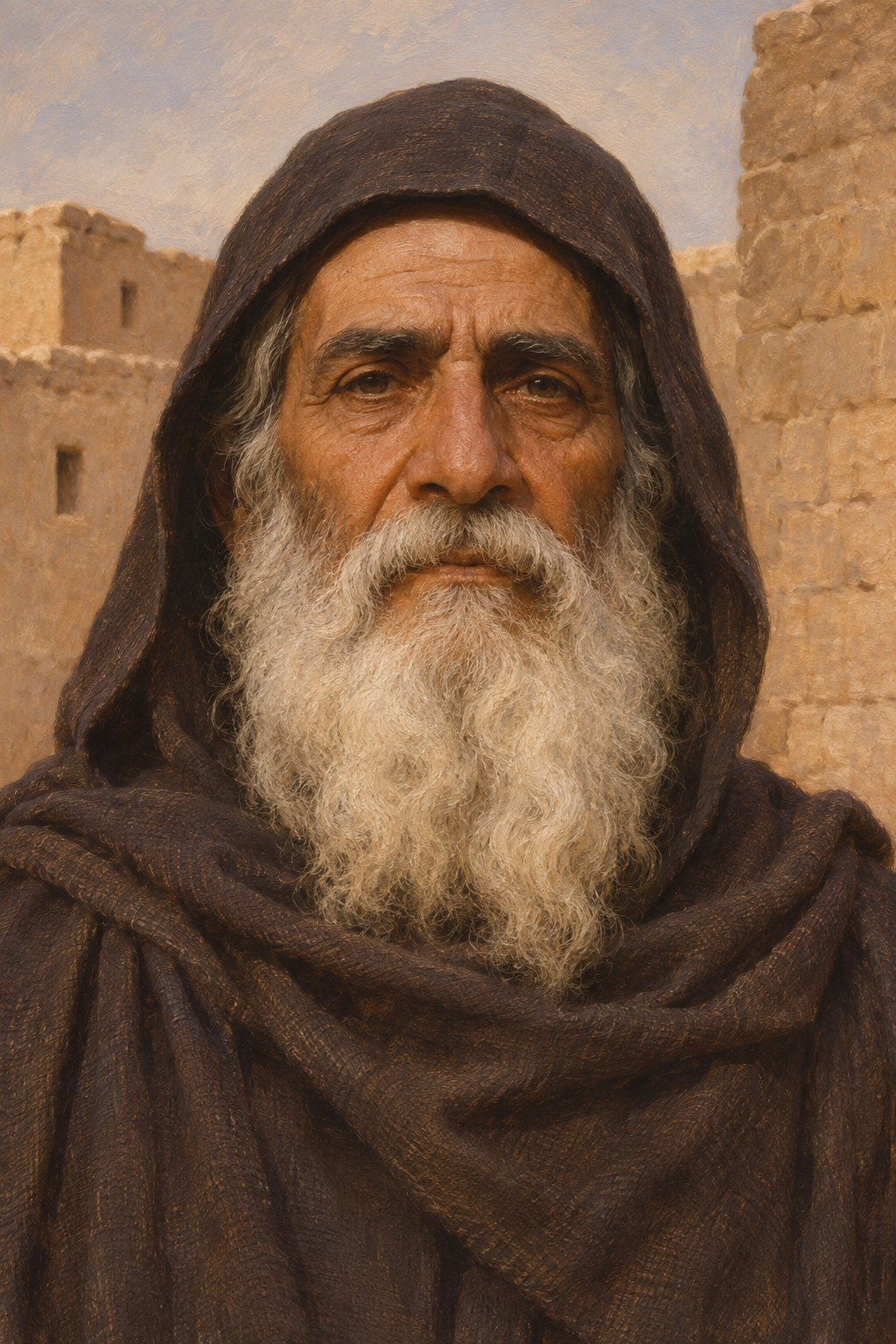
About Shenoute the Archimandrite
Shenoute led the White Monastery federation near Atripe in Upper Egypt, with his leadership conventionally dated from about 385 until his death around 465. The chronology is reconstructed from Coptic writings and later scholarship. His own works—letters, Canons, and Discourses—offer direct evidence for concerns he chose to address, but survive in fragments and do not form a continuous autobiography.
Canon 1 presents Shenoute’s rise through his conflict with Ebonh. Shenoute says he challenged wrongdoing among the brothers; modern analysis connects the crisis with sexual misconduct and the theft of food. Ebonh answered with accusations of slander and ambition. Shenoute withdrew to the desert, where he describes praying and calling the monks to repentance. The account is autobiographical and shaped by his own argument, but it records a rupture serious enough to lead him to separate himself from the community.
As abbot, Shenoute addressed monks and lay visitors through sermons, letters, and rules. The Canons preserve internal regulations and correspondence, while the Discourses include preaching to broader audiences. Their fragmented state means individual texts must be read in their own settings. Together they show that Shenoute treated communal discipline, religious teaching, and social responsibilities as connected parts of leadership.
Shenoute’s writings also engaged the monastery’s material life. Early letters criticize costly construction and direct attention to support for poor people. Later sermons on the Great House church present a building not simply as a monument but as a sacred space whose use depends on the conduct of the community. The contrast shows that his thinking about buildings changed or responded to different circumstances; the texts should not be flattened into one consistent architectural policy.
“Not Because a Fox Barks” addresses Gessius, a local landowner identified by modern scholarship with Flavius Aelius Gessius. Its title comes from the opening words, and the surviving discourse uses polemic in a dispute involving local authority. It is not a neutral report of the conflict. Read alongside Shenoute’s other writings, it shows how he used scriptural argument and forceful language to challenge powerful people.
Shenoute’s relationship with the non-Christian religious landscape was confrontational. Yale Egyptology notes that he attacked Egyptian religion in word and deed. Archaeological evidence shows that stones from earlier temples were reused in Christian buildings, but this material alone does not assign each act to him. His polemics belong to the record alongside the institutional history of the monastery; describing them candidly avoids replacing a complex historical figure with an idealized picture.
Shenoute’s surviving writings are the most direct evidence for his arguments and leadership; the later Bohairic Life preserves the community’s hagiographic memory. Read together with archaeological work at the monastery, they show both the breadth of his influence and the limits of reconstructing particular episodes.
The monastic federation grew beyond a single men’s house. Heike Behlmer’s update describes two male monasteries, a women’s monastery at Atripe, and hermit cells as parts of the network associated with Shenoute’s leadership. The community’s rules drew on Pachomian practice, and its size and cultural role expanded under him. Shenoute’s influence therefore involved oversight across connected communities and different forms of religious life, not simply the authority of an isolated abbot.
Behlmer summarizes different proposals for Shenoute’s birth and death, including 450, 465, and 466 for his death. Cambridge editors place his birth around 347 and death in 465. The dates are scholarly reconstructions; the convention of leadership from about 385 to 465 remains approximate.
More than 4,000 pages from over 100 incomplete codices survive from Shenoute’s works, according to Behlmer. His Canons address monastic rules and discipline; the Discourses preserve preaching and theological reflection. Together, these writings provide an unusually extensive record of communal life in fifth-century Upper Egypt.
In early letters Shenoute criticized spending on construction when poor people needed support. Decades later, his sermons on the Great House church describe the building as bound to the conduct of its community. Hedstrom notes that construction took about five months. The texts show him applying different arguments to different circumstances rather than setting out one timeless policy.
Later writings refer to a serious illness that led Shenoute to withdraw from his communities for a time. His works and modern studies also connect his leadership with care for poor people and refugees during regional crises. These records place pastoral responsibilities alongside his discipline of the federation and confrontational religious polemics.
The episode also shows how Shenoute understood authority: correction involved the abbot, the conduct of individual monks, and the well-being of the entire house. Hedstrom notes that the letters in Canon 1 use biblical language to explain why wrongdoing left unchecked threatened the community. Shenoute’s withdrawal is therefore not simply a tale of a solitary spiritual crisis; in his telling, it became a means of forcing the monks to confront their shared obligations and return to a disciplined life.
Wondering how to weigh the stories and sources? Learn how to read a saint biography.