Biography
Susanna
About Susanna
Susanna is the central woman in a Greek story associated with the Book of Daniel. Catholic Bibles place it at Daniel 13; the Orthodox Church in America notes that the Septuagint presents it as a preamble, while the Latin Vulgate places it at the book’s end. The USCCB explains that Susanna was never part of the Hebrew-Aramaic Book of Daniel or the Hebrew Bible, though Catholic tradition receives it among inspired writings. This textual history is documented. Susanna’s personal dates and independent historicity are not. Her account is therefore presented as scriptural tradition rather than a securely reconstructable Babylonian biography.
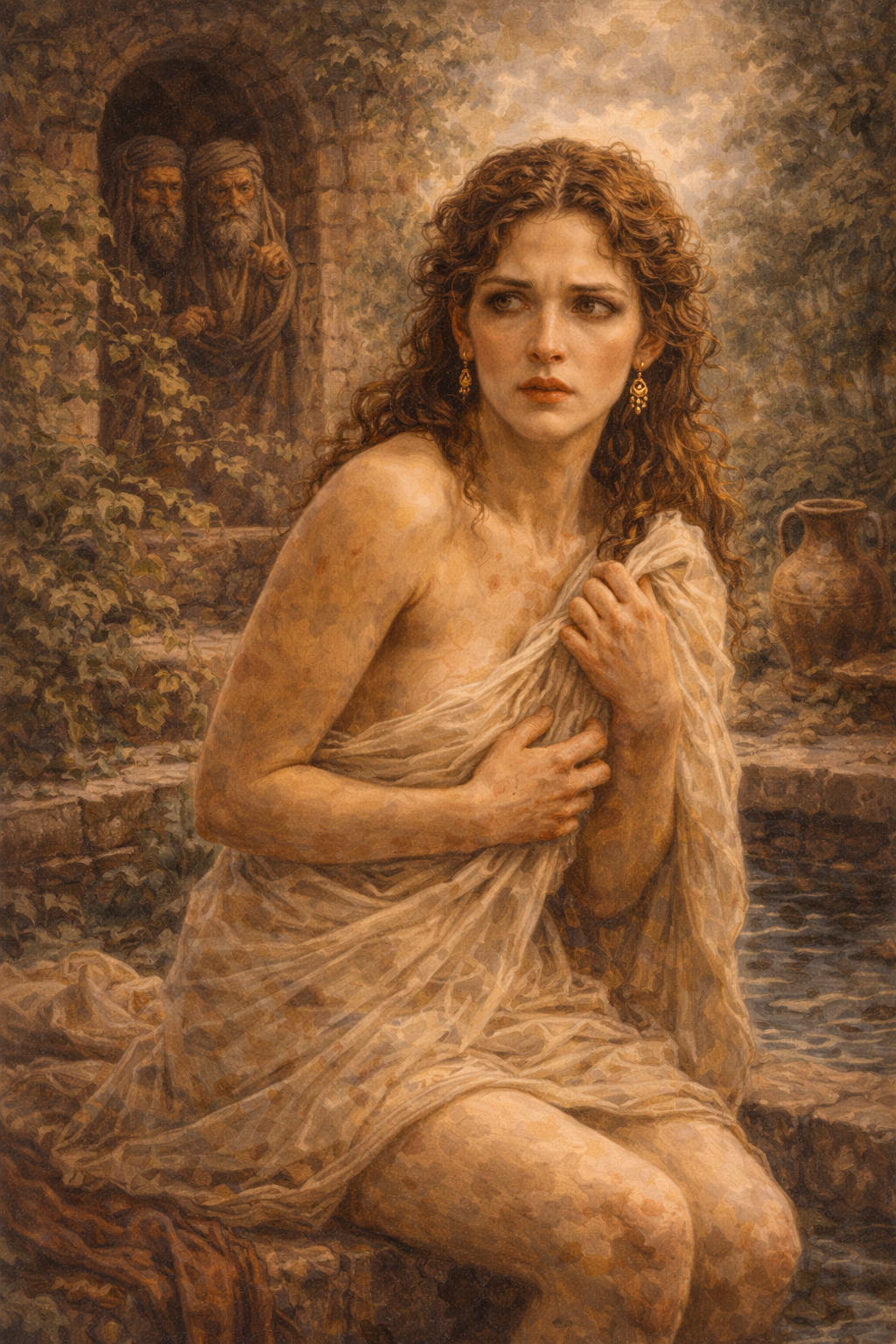
The story sets Susanna in Babylon. She is daughter of Hilkiah, wife of the wealthy Joakim, mother of children, and a woman taught the law of Moses by righteous parents. Members of the Jewish community regularly come to Joakim’s house because of his standing. Two elders serving as judges also frequent it. They watch Susanna take midday walks in the household garden, cultivate desire for her, and conceal that desire from each other until both return to spy on her. The narrative’s praise of Susanna’s beauty never transfers responsibility to her. The elders choose surveillance and conspire to exploit judicial authority.
One warm day Susanna enters the enclosed garden with two maids and asks them to bring oil and soap while she bathes. The elders have hidden inside. After the maids leave, they confront her with a coercive demand: submit sexually or they will swear that she dismissed the servants to meet a young man. Susanna names the trap. Yielding would violate her conscience; refusing exposes her to the elders’ power and a potentially fatal accusation. Nothing in the account makes this a consensual proposal. It is sexual harassment backed by institutional status, isolation, and threat of death.
Susanna refuses and screams. The elders shout too, open the gates, and construct their accusation when the household arrives. The next day they summon her before family and community. They order that she be unveiled, continuing to use public procedure for humiliation and gratification. They place hands on her head while giving false testimony. The assembly believes them because they are elders and judges and condemns Susanna to death. The scene depicts a system failing at several levels: respected officials lie, rank substitutes for evidence, and the community moves toward execution without testing the account.
Susanna weeps and prays aloud. She appeals to God as one who knows hidden things and says plainly that the witnesses have lied and that she is innocent of their accusation. Her words matter because they resist both coercion and the community’s verdict. The story does not portray courage as freedom from terror; Susanna speaks while being led toward death. Nor does rescue depend on her producing private proof unavailable in an enclosed garden. The failure belongs to the accusers and the court that trusted status over investigation, not to the woman targeted by them.
A young Daniel interrupts the execution and declares himself innocent of Susanna’s blood. He rebukes the assembly for condemning a daughter of Israel without inquiry or clear evidence and orders the hearing reopened. Separating the elders, he asks each beneath what tree the alleged encounter occurred. One answers a mastic tree; the other, an oak. Their contradiction exposes the fabricated testimony. The Greek version reinforces the exchange with wordplay between the tree names and Daniel’s announced punishments, a feature the USCCB note explains. The literary design makes careful cross-examination, not intuition about Susanna’s character, the decisive public test.
The assembly turns against the elders. Under the law governing false witnesses, they receive the death they intended for Susanna. The narrative celebrates the sparing of innocent blood, and Susanna’s parents, husband, relatives, and community praise God after her innocence is recognized. Yet the execution of the offenders belongs to an ancient capital legal world and should not be converted into a modern prescription for responding to abuse. Justice today requires protection, credible investigation, due process, and accountability without treating retaliatory violence as the lesson. The story itself exposes what happens when a court abandons those safeguards.
Susanna’s account has sometimes been retold mainly as the beginning of Daniel’s public reputation. Daniel 13 does close by saying he became greatly esteemed. But Susanna is not merely the occasion for a male hero’s cleverness. Before Daniel speaks, she has resisted two powerful men, rejected secrecy purchased by submission, cried out, maintained truthful testimony under collective condemnation, and prayed without surrendering her moral agency. Her maids, children, parents, and husband are present in the story, but none prevents the initial miscarriage of justice. Rescue requires a challenge to the court’s method as well as sympathy for its victim.
The Orthodox Church in America commemorates Righteous Susanna on December 17 and explicitly ties that observance to the 64-verse Septuagint story. This is evidence of present Christian reception, not independent proof of the narrative’s Babylonian setting or chronology. Exact birth and death dates, birthplace, burial place, and patronage are left unset. Susanna remains significant because her story names intertwined forms of abuse: predatory watching, sexual coercion, reputational threat, misuse of religious and judicial office, public shaming, and uncritical trust in powerful witnesses. Her witness is concrete—the refusal to cooperate with a lie even when institutions have made truth dangerous.
Wondering how to weigh the stories and sources? Learn how to read a saint biography.