Biography
Thomas Becket
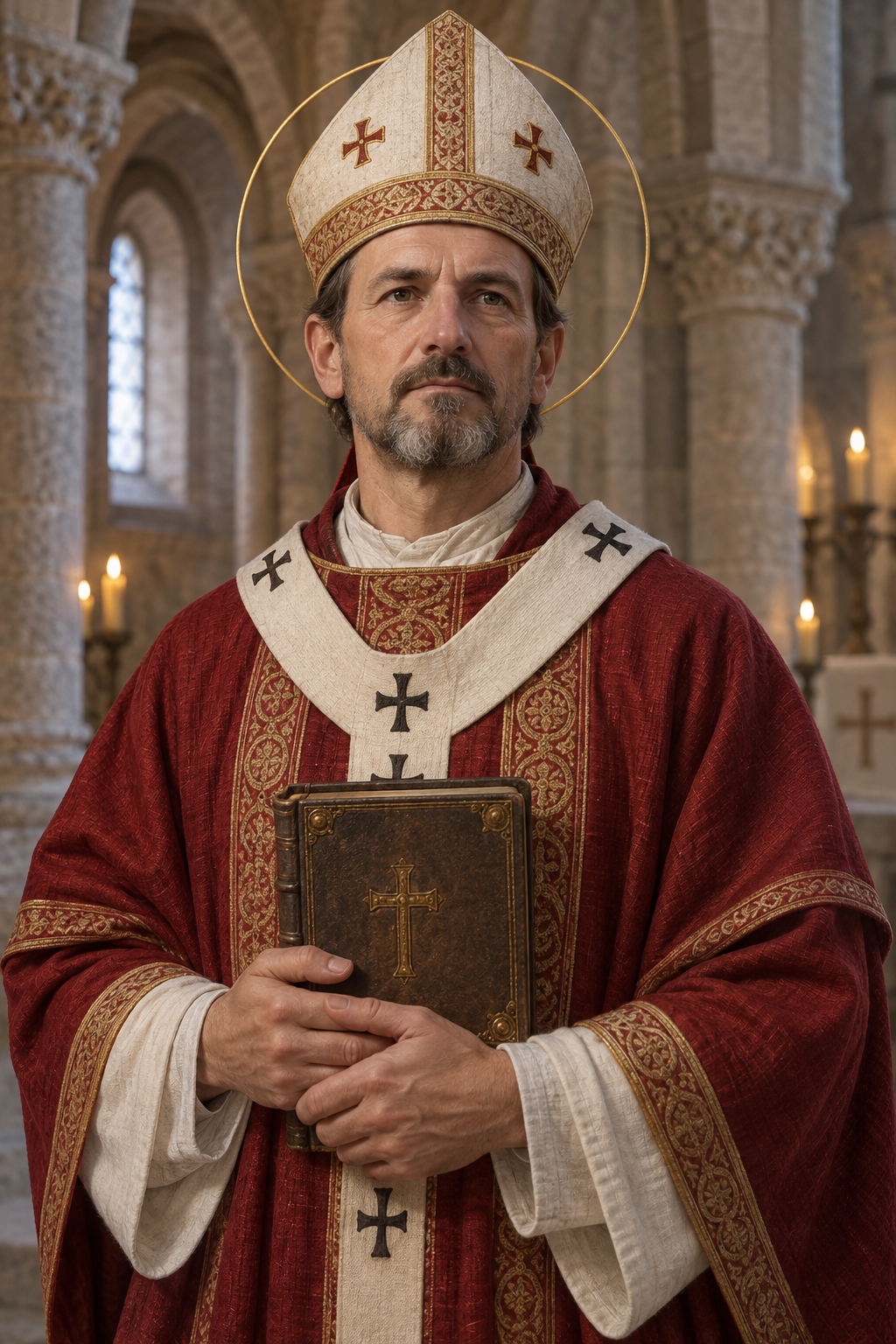
About Thomas Becket
Thomas Becket was born around 1120 in Cheapside, in the City of London, to Gilbert and Matilda, migrants whose families came from Normandy. His father was a well-connected merchant, giving Thomas access to education without placing the family among England's greatest magnates. He studied at Merton Priory and for a time in Paris before entering clerical and administrative service. Cheapside was London's principal market street, placing his childhood within the commercial life that supported his father's career. A later church tradition assigns December 21, 1118, but the catalog follows the curatorial estimate and records only an approximate 1120 birth year.
Becket joined the household of Theobald, Archbishop of Canterbury, where intelligence, authority, and skill in administration advanced his career. In 1155 Theobald recommended him as chancellor to the young king Henry II. The chancellor issued royal documents and became one of the king's closest companions, participating fully in the wealth and display of court life. His surviving appearance as a witness to a royal charter demonstrates the administrative office beneath later stories about companionship and luxury. Their friendship and shared political work make the later rupture more than an impersonal clash between institutions.
Henry nominated his chancellor to become Archbishop of Canterbury after Theobald's death, expecting an ally at the head of the English Church. Becket was appointed on May 23, 1162, and consecrated on June 3. He then resigned the chancellorship against Henry's wishes and increasingly defended ecclesiastical jurisdiction from royal control. This change has often been interpreted as conversion, ambition, principle, or some combination, but the surviving actions do not disclose a single private motive.
The conflict sharpened around the Constitutions of Clarendon in 1164, sixteen articles addressing relations between royal government and the Church. Among the disputed questions were the treatment of accused clergy, appeals to Rome, and authority over ecclesiastical property and offices. Henry presented the articles as inherited custom, while the controversy also turned on whether they expanded royal claims beyond accepted practice. Becket first accepted and then rejected the settlement, while Henry used councils, legal accusations, and demands for property to press him. In October 1164, after refusing the terms imposed at the royal council, Becket fled to France and remained abroad for six years.
Pope Alexander III, French churchmen, and King Louis VII became part of prolonged efforts to resolve the exile. The crisis intensified when Henry's son was crowned by the Archbishop of York in 1170, bypassing Canterbury's traditional role. After a fragile reconciliation, Becket disciplined the prelates involved and returned to England on December 1, greeted by supporters but opposed by royal officials. The settlement had restored his office without resolving the mistrust, jurisdictional claims, or consequences of the young king's coronation.
When news of the excommunications reached Henry in Normandy, the king erupted in anger before members of his household. Four knights crossed to England, confronted Becket on December 29, and initially sought to arrest him on the king's behalf. The confrontation moved into Canterbury Cathedral and escalated until they killed the archbishop during the evening office. Five eyewitness narratives broadly agree on the attack, and Edward Grim was wounded while standing close to Becket. Henry's fury helped set the killers in motion, yet historians cannot establish that he issued a direct command to murder.
Becket's death immediately transformed his contested public career into a rapidly expanding reputation for martyrdom and miraculous healing. Pope Alexander III canonized him as Saint Thomas of Canterbury on February 21, 1173. Henry performed public penance at Canterbury in July 1174 and later treated the saint as a protector, while the shrine drew pilgrims across Europe. Legal scholarship cautions that the controversy produced no simple institutional victory; royal and ecclesiastical courts continued through compromise and changing practice.
In 1220 Becket's remains were translated from the crypt to a major shrine in Canterbury Cathedral, strengthening the city's international pilgrimage culture. Henry VIII's agents destroyed the shrine in 1538 and ordered the saint's name and images suppressed, but devotion to Thomas survived. A contemporary manuscript collection preserves Becket's correspondence, John of Salisbury's life, and one of the earliest known images of the martyrdom. The collection was assembled soon after the conflict and places administrative letters beside narrative memory rather than leaving only later legend. Those records do not erase partisan interpretation, but they keep the story connected to evidence close to the people and conflict involved.
Thomas Becket's witness is therefore best approached without making either king or archbishop a simple emblem for modern political categories. He exercised power, changed loyalties, made severe disciplinary choices, and ultimately refused to abandon what he understood as the obligations of his office. Catholic remembrance calls him bishop and martyr because that refusal ended in death within his cathedral and was received by the Church as faithful witness. Canterbury Cathedral still identifies the site through its worship, history, and memorial spaces while distinguishing the present building from the world Becket knew. His life asks how conscience should resist coercion while remaining accountable for the institutions, conflicts, and people affected by that resistance.
Wondering how to weigh the stories and sources? Learn how to read a saint biography.