Biography
Thurgood Marshall
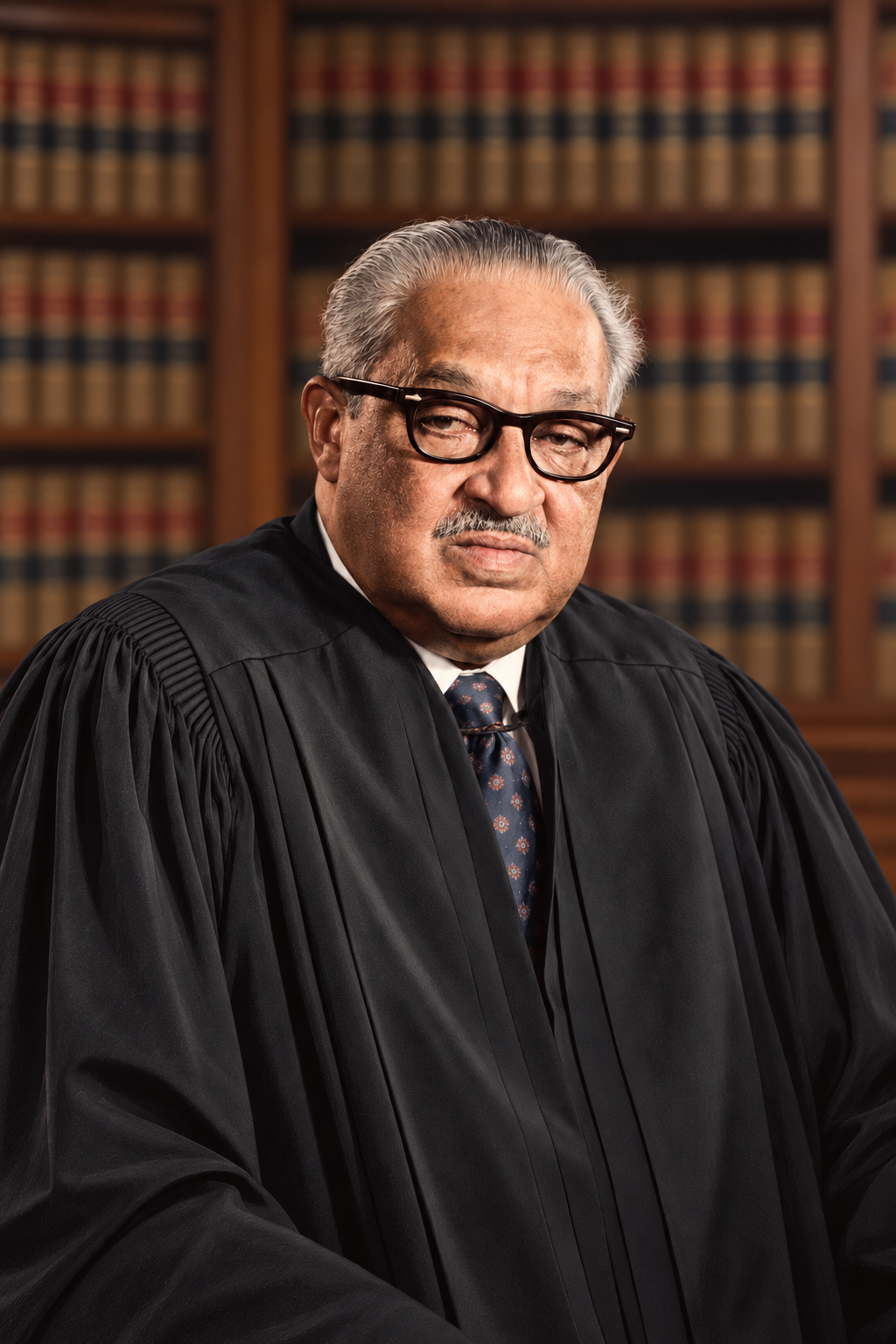
About Thurgood Marshall
Thurgood Marshall spent much of his life challenging racial discrimination through the courts. He was born in Baltimore on July 2, 1908, and first bore the name Thoroughgood. His mother taught school, and his father worked as a club steward. After studying at Lincoln University in Pennsylvania, he wanted to become a lawyer. Segregation barred him from the University of Maryland’s law school. He attended Howard University instead and graduated at the head of his class. He returned to Baltimore to practice law in a society where unequal treatment was enforced by institutions as well as custom.
At Howard, Charles Hamilton Houston had become his mentor. Their collaboration continued in the case of Donald Murray, who was denied admission to the University of Maryland’s law school because of his race. Houston tried the case with Marshall’s assistance, and they won. Marshall joined the national staff of the National Association for the Advancement of Colored People in 1936. The organization’s legal strategy first challenged the inequality of facilities maintained under segregation before attacking the doctrine itself. In Brown v. Board of Education in 1954, Marshall argued before the Supreme Court against segregated public education. The ruling rejected the separate-but-equal doctrine in that field; it did not settle every form of discrimination.
The work of enforcing school desegregation continued after Brown. In 1957, Marshall went to Little Rock, Arkansas, where Governor Orval Faubus was obstructing the integration of Central High School. Marshall and attorney Wiley Branton obtained an injunction, and the Little Rock Nine returned under federal protection. The following year, Marshall represented families opposing the school board’s attempt to postpone integration. The Supreme Court rejected that delay in Cooper v. Aaron. Even then, resistance continued: Faubus closed the city’s high schools for a year. The sequence showed how a court victory could be followed by further efforts to prevent its implementation.
Marshall’s professional life also included service within the Episcopal Church. At St. Philip’s in Harlem, he served on the vestry and as senior warden. He was a deputy to the church’s General Convention in 1964. After his family moved to Washington in 1965, they joined St. Augustine’s. The Episcopal Archives places these commitments alongside his defense of the separation of church and state. His church membership and his public responsibilities were parts of the same life, without making his judicial office a religious position.
Federal appointments took his work into new settings. President John F. Kennedy gave him a recess appointment to the Court of Appeals for the Second Circuit in 1961; Senate confirmation followed in 1962. He served as solicitor general from 1965 to 1967. President Lyndon Johnson then nominated him to the Supreme Court. The Senate confirmed him in August 1967, and he took the judicial oath on October 2. He remained on the Court until taking senior status in October 1991.
Marshall became the first African American justice of the Supreme Court. His service increasingly included dissenting opinions as the Court’s membership and direction changed. He opposed the death penalty and continued to argue for constitutional protections of equality.
Legal scholar Robert Post connects Marshall’s approach as a judge with his experience representing people whose access to justice was insecure. Post emphasizes that litigation depended on communities willing to support cases despite threats and retaliation. He also describes Marshall’s recognition that court decisions alone could not accomplish desegregation and that public protest had an essential role. On the bench, Marshall repeatedly asked how legal rules affected ordinary lives. In the bankruptcy case United States v. Kras, he disputed assumptions that small filing payments were easily affordable for people living in poverty. In school cases, he opposed decisions that limited remedies for segregation or accepted inequalities in funding. Post also explains the disagreement behind these opinions: other justices feared that flexible standards could give judges too much power to substitute their judgments for those of legislatures. Marshall’s views were influential arguments within a divided Court, not unanimous statements of its law.
In a speech marking the Constitution’s bicentennial in 1987, Marshall challenged celebrations focused only on the framers. He argued that the original document’s exclusions could not be separated from its history. Amendments, the Civil War, and sustained social struggle had changed the meaning and reach of constitutional protections. He credited people who challenged injustice rather than treating later gains as achievements already secured in 1787. His argument presented the Constitution as a living document whose promises still required work. It brought together his confidence in law and his insistence that legal institutions could perpetuate injustice unless people acted to change them.
Marshall died at the National Naval Medical Center in Bethesda, Maryland, on January 24, 1993. The next morning, Chief Justice William Rehnquist announced his death to the Court and recalled both his civil-rights advocacy and his years of judicial service.
The Episcopal Church formally included Marshall in its calendar through a resolution adopted in 2018. His legal career helped make equal protection a more substantial part of American life.
Wondering how to weigh the stories and sources? Learn how to read a saint biography.