Biography
Valentín de Berriochoa
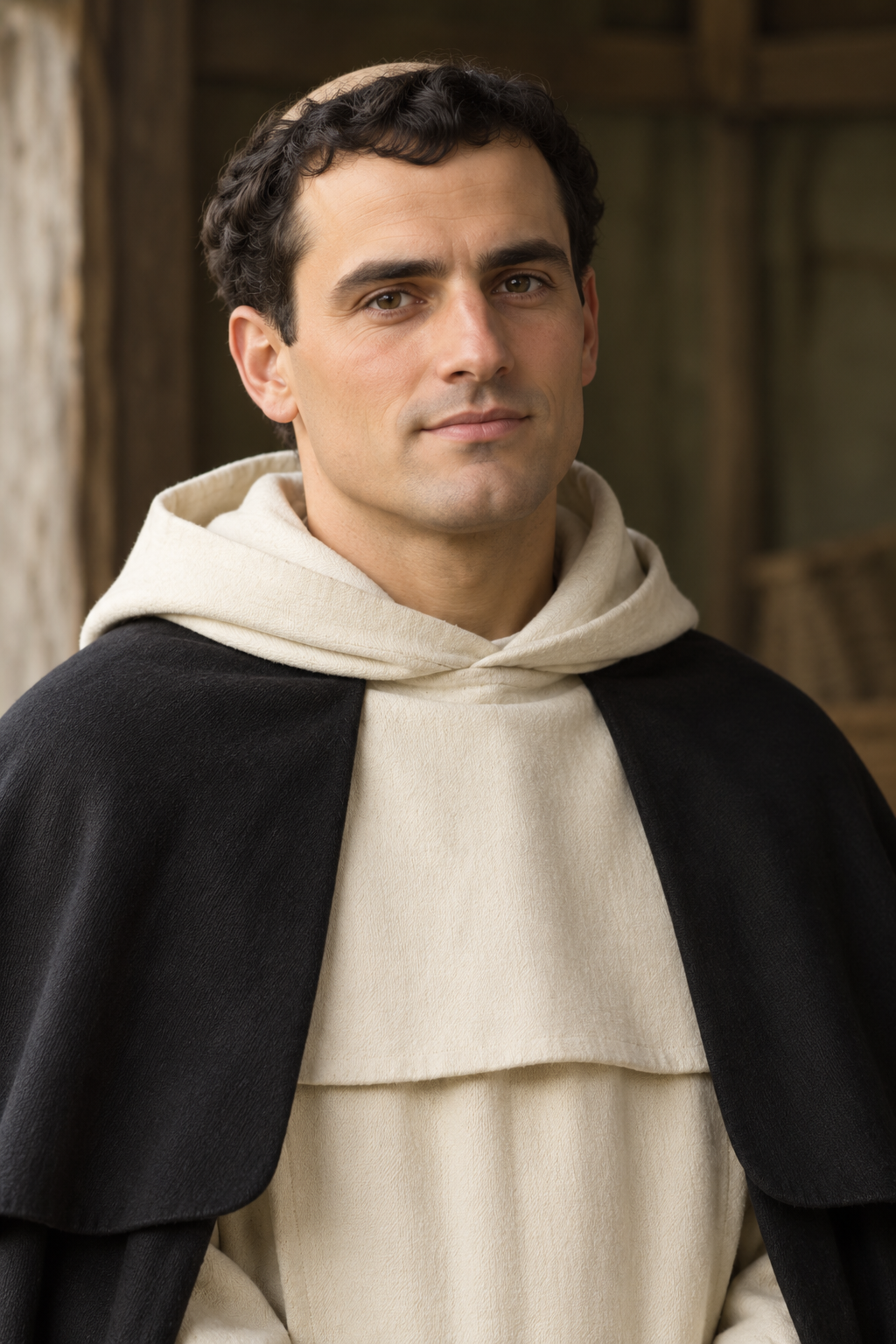
About Valentín de Berriochoa
Valentín de Berriochoa was born in Elorrio on February 14, 1827. He became a priest in 1851 and entered the Dominican novitiate at Ocaña two years later. His missionary calling eventually took him to Tonkin, in what is now northern Vietnam. He arrived there in 1858 and soon became a bishop.
His childhood connected him with both skilled work and parish life. The Diocese of Bilbao recalls his help in his father’s carpentry workshop and his service as an altar boy at the Dominican convent of Santa Ana. He also learned to play the txistu, dance the aurresku and play pelota. At eighteen he entered the seminary in Logroño. These memories place his vocation within the everyday life of his Basque hometown.
His studies did not proceed without interruption. The 2006 biographical introduction explains that his family could not afford his seminary expenses, so he returned home to help his father as a carpenter. After thirty months, he considered walking to Rome to seek the pope’s help. That journey proved unnecessary: the seminary invited him back and provided assistance so that he could resume his preparation for priesthood.
The missionary years were marked by danger and displacement. The Dominican account describes hunger, concealment, flight and repeated news of arrests and deaths. Berriochoa wrote letters and reports about the suffering of the Christian communities and the friars serving them. His ministry lasted only about three years, but these writings preserved an account of what those communities were enduring.
A modern account shared by the churches of Hanoi and Bilbao remembers his episcopal consecration as a secret ceremony held at night. The improvised headwear and bamboo staff associated with it became enduring features of his remembrance. The account identifies the consecrating bishop as Sampedro Xuyen and Berriochoa as his coadjutor. This was leadership exercised under persecution, rather than amid the public ceremonies normally associated with a bishop’s office.
The Vietnamese account preserved at Sở Kiện describes how his ministry continued after Sampedro’s execution. Berriochoa found shelter at Hương La, where a householder prepared an underground refuge in his garden. From this hiding place, he maintained contact with priests and parishes through letters. Four seminarians and a local helper assisted with copying circulars and carrying communications. Such assistance allowed the bishop to continue directing church affairs even when persecution prevented him from returning freely to his own communities.
His concern also extended to preparing future priests. The same account describes his teaching theology to a seminarian while in hiding and requesting books from Macao, including works by Thomas Aquinas and canon law. Occasional journeys took place at night, including visits to the sick and meetings with Bishop Hermosilla. At other times he had to abandon one refuge for another. These details describe a ministry sustained through teaching, correspondence and the help of local Christians, within severe limits on movement.
He remained in contact with his mother through letters written in Basque so that she could understand him. The Diocese of Bilbao’s account recalls his descriptions of pastoral letters written to encourage persecuted Christians. His correspondence joined concern for the people he served with continuing affection for his family at home.
One letter tells his mother that he had gone nearly a year and a half without news from her. He reassures her of his affection and describes remembering her in prayer.
The surviving letters also require careful dating. The scholarly edition published by Labayru in 2006 notes uncertainty about two letters sometimes assigned to August 1859. One lacks a visible date in the recovered original; another was known to the editors through an earlier printed version, with earlier writers disagreeing between 1859 and 1860. Their caution helps distinguish the preserved correspondence from a chronology that appears more exact than the evidence allows.
Berriochoa was captured, questioned and sentenced to death after refusing to renounce his faith. He was beheaded on November 1, 1861, aged thirty-four.
His parents were still alive when news of his death reached Elorrio. In 1862, the General Assemblies at Gernika recorded his martyrdom in their minutes.
He was canonized on June 19, 1988, and proclaimed secondary patron of the Diocese of Bilbao on August 18, 1989. The diocese also identifies him as a co-patron of Bizkaia alongside Ignatius of Loyola. His remembrance therefore belongs both to the place where he grew up and to the church he served overseas.
In August 2025, a relic brought from Bilbao was received by the archbishop of Hanoi at the Vietnamese martyrs’ pilgrimage center in So Kien. The two bishops presented the occasion as an expression of communion between their churches. The event renewed a connection that had begun with Berriochoa’s missionary life and continued through remembrance of his death. The archbishop also recalled Berriochoa’s wish for a church dedicated to the Immaculate Conception, later fulfilled at Phu Nhai.
Wondering how to weigh the stories and sources? Learn how to read a saint biography.