Biography
Walter Rauschenbusch
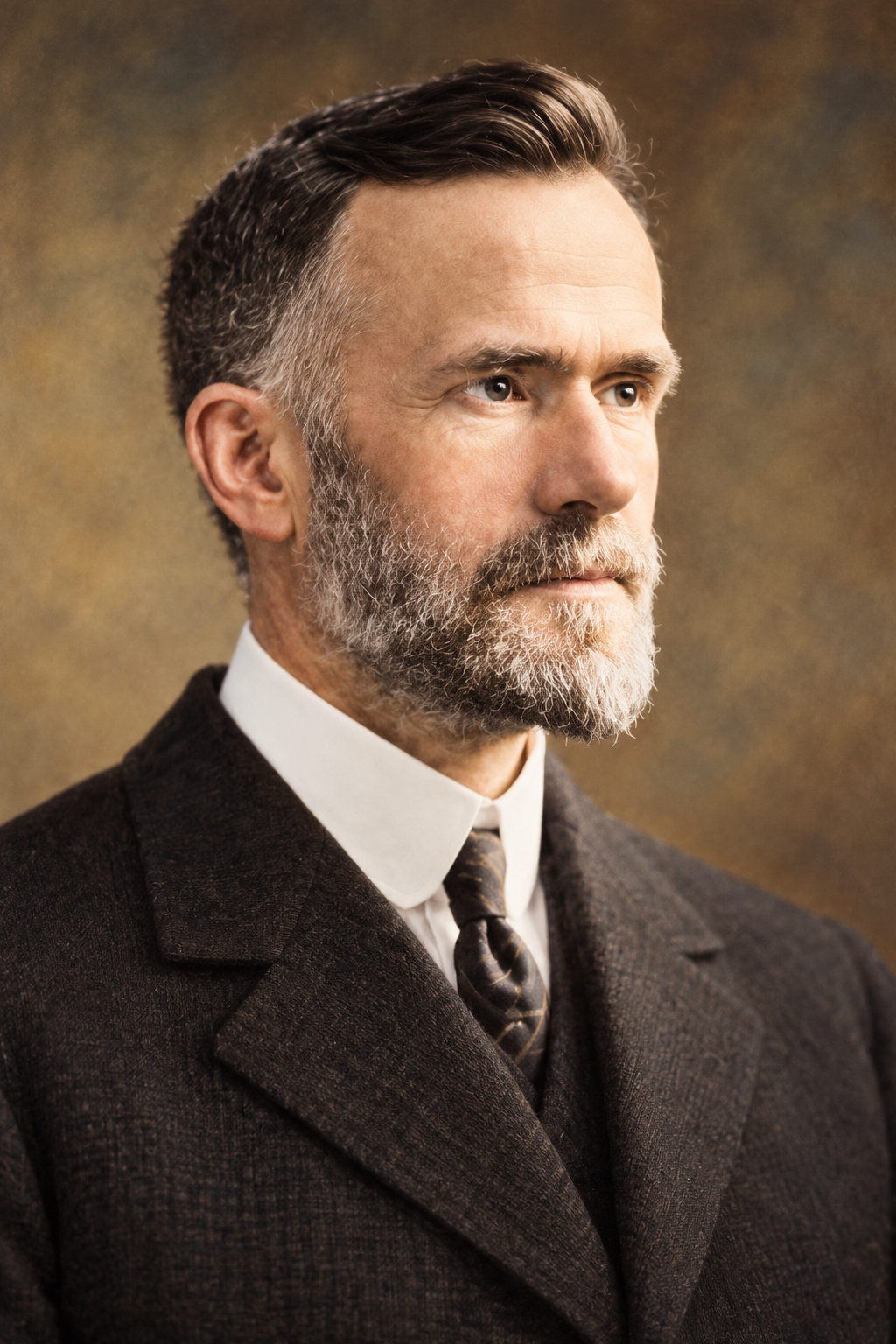
About Walter Rauschenbusch
Walter Rauschenbusch’s work as a Baptist pastor in New York City brought him into close contact with the pressures of industrial life. Serving the Second German Baptist Church in Hell’s Kitchen from 1886 to 1897, he came to question a religious message concerned only with individual conduct and salvation. He wanted Christian teaching to address the conditions under which people worked and raised their families. The kingdom of God became the central idea through which he connected personal faith with social responsibility.
He was born in Rochester, New York, on October 4, 1861. His father, August Rauschenbusch, was a Baptist pastor and teacher. Walter attended school in Germany, studied briefly in Berlin, and continued his theological education in Rochester. In 1892 he helped establish the Brotherhood of the Kingdom with other Baptist ministers. The group carried its understanding of Christian social reform beyond Baptist circles. He married the teacher Pauline Rother in 1893, and they had five children.
Family life also shaped the ministry. His mother, Caroline, supported his work in New York during the years before his marriage, taking on responsibilities that congregations commonly expected of a pastor’s wife. Andrew Scott’s account for the American Baptist Historical Society draws attention to her contribution amid the estrangement of Rauschenbusch’s parents. The pastorate that influenced his theology depended in part on her often overlooked work.
In 1897 he joined the faculty of Rochester Theological Seminary, later becoming professor of church history. His major books included Christianity and the Social Crisis, Christianizing the Social Order, and A Theology for the Social Gospel. He continued teaching until his death in Rochester on July 25, 1918. His career linked a local pastorate, theological education, and a wider public discussion of Christian responsibility.
In Christianity and the Social Crisis, published in 1907, he argued that growing economic inequality threatened democratic life. Formal political rights could not guarantee equal influence when a small group controlled wealth and others depended on that group for employment. He described the distance between employers who directed production and workers who had little voice in their workplaces. Denying the existence of social classes, he argued, did nothing to remove their unequal power.
His argument also concerned ordinary relationships. Wealth, housing, education, and habits could separate people so thoroughly that sympathy across class lines became difficult. He questioned whether individual goodwill could overcome divisions continually reinforced by economic institutions. Those institutions, in turn, generated explanations that made inequality seem natural. For him, the distribution of power was therefore a moral question as well as an economic one.
He also wrote for students. The Social Principles of Jesus was designed for voluntary study groups, with biblical passages, comments, and questions for discussion. Its introduction invited students to examine the social implications of Jesus’ teaching and consider their own response. Rather than presenting a complete biography of Jesus or a systematic account of doctrine, the book concentrated on ethical relationships and responsibilities.
The opening chapter linked respect for human life with concrete questions about childhood, illness, contempt, and exclusion. After discussing Jesus’ welcome of children, Rauschenbusch asked whether child labor and infant mortality offered a test of a community’s moral condition. His discussion of healing turned toward professions that treated or prevented sickness. He interpreted contempt as an injury to a person’s worth and social standing. The format moved repeatedly between a Gospel passage and the institutions or habits through which students encountered other people.
His concern for reform did not free him from the prejudices of his setting. Reviewing Christopher Evans’s biography, historian Jacob Dorn describes a man who combined radical economic criticism with paternalistic attitudes toward workers, limited attention to race relations, and beliefs that confined women to a separate sphere. He also expressed concern about Roman Catholics and some immigrant groups. These limitations belong alongside his advocacy of social responsibility, rather than disappearing from an account of it.
Dorn also notes the tensions within his public position. Rauschenbusch criticized wealthy business interests while maintaining friendships with members of the Rockefeller family and accepting financial help from them. His love of German culture and scholarship made the First World War deeply distressing. Personal piety, confidence in democratic possibilities, and criticism of economic power remained intertwined in his life.
Martin Luther King Jr. later described Christianity and the Social Crisis as an important influence during his theological education. In his 1960 essay Pilgrimage to Nonviolence, King credited Rauschenbusch with helping American Protestantism recognize its social responsibilities. He also criticized what he considered excessive optimism about human nature and the danger of identifying God’s kingdom with a particular economic system. King’s response was an appreciative but critical inheritance, not an acceptance of every part of Rauschenbusch’s thought.
The Episcopal Church commemorates Rauschenbusch on July 2. This is an Episcopal remembrance of a Baptist figure, not a claim that Baptist churches maintain a Catholic process of canonization.
Wondering how to weigh the stories and sources? Learn how to read a saint biography.