Biography
Washington Gladden
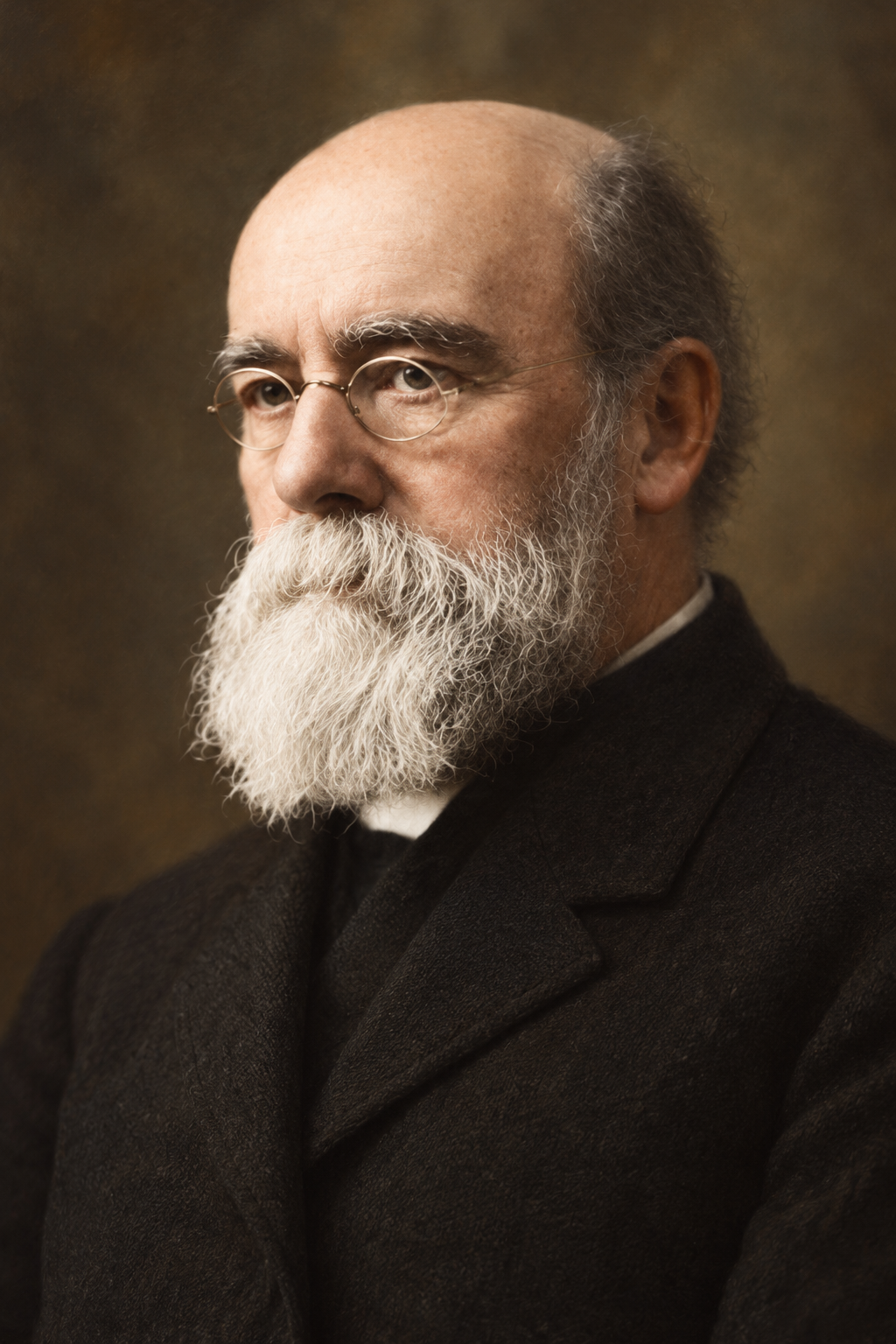
About Washington Gladden
Washington Gladden brought the concerns of industrial workers, excluded neighbors, and religious minorities into the public life of Columbus, Ohio. A Congregational minister, he understood Christian faith as a responsibility to change the conditions in which people lived. His work joined preaching with civic participation: he served on the city council, supported cooperation among religious communities, and challenged the assumption that generosity could excuse harmful business practices.
Born Solomon Washington Gladden in Pottsgrove, Pennsylvania, he grew up on a farm in northern New York. After graduating from Williams College, he worked as a minister, writer, and editor. His pastorates took him through New York and Massachusetts before Columbus. He did not complete a theological degree, but teaching and writing became central parts of his ministry.
He arrived at First Congregational Church in Columbus in December 1882 and preached his first sermon there on Christmas Eve. His active leadership continued until 1914, followed by several years as minister emeritus. This distinction matters because accounts of his long association with the church sometimes treat the entire period as an uninterrupted active pastorate.
At First Church he preached both morning and evening services. His evening addresses examined public questions, and the local newspaper carried them to a wider audience. Subjects included labor, racial inequality, women’s rights, war, and the responsibilities of people with economic power. He encouraged influential church members to consider the effects of their decisions in factories and shops.
Gladden also worked across religious boundaries. He opposed anti-Catholic agitation and joined Catholic, Jewish, and Protestant leaders in civic organizations. His criticism of injustice could bring conflict within his own denomination. He objected to a large donation from John D. Rockefeller because of the business methods through which the fortune had been accumulated. His objection asked churches to examine the origin of charitable gifts as well as the uses to which they would be put.
He supported workers’ organization while criticizing unions that excluded Black members. His civic advocacy also included voting rights for African Americans and women, connecting economic reform with questions of political participation and racial exclusion.
In 1905 he and Celia Jeffrey helped establish a neighborhood mission of First Congregational Church. It developed into Gladden Community House. The organization’s history records its service as an emergency shelter during the 1913 flood and its later incorporation as an independent nonprofit. That history gives the social gospel a concrete local setting: a neighborhood institution created to provide help, rather than an idea confined to books or sermons.
His writing also addressed the fears raised by modern biblical scholarship. In Who Wrote the Bible? he set out to explain the human processes by which biblical writings had been composed, copied, edited, preserved, and translated. He did not regard such inquiry as a denial of divine inspiration. He compared it to studying the growth of a tree without pretending to have exhausted the mystery of life.
Gladden wanted lay readers to encounter findings that ministers often knew but hesitated to discuss. He argued that concealing such knowledge out of fear for people’s faith was unnecessary. His preferred criticism was reverent and sympathetic toward Scripture, yet willing to compare passages and consider discrepancies. He anticipated that some readers would find the discussion unsettling and asked them to withhold judgment until they had considered the evidence. This was his account of how historical study could serve religious understanding.
The Church and Modern Life, published in 1908, began with a call for churches to examine themselves. Gladden acknowledged criticism from both outsiders and committed Christians. He remained hopeful about the church’s future, especially its younger members, but believed that hope required reform. He used the word church broadly for Christian communities across denominational divisions, emphasizing their shared commitments rather than accepting the claims of any one body to represent the whole.
He rejected explanations that dismissed religion simply as deception by priests. He understood religious feeling as a persistent part of human life that could develop through reflection. His openness nevertheless had limits. In the same book, he described religious development through a hierarchy that placed some peoples’ beliefs below those of his own setting. He treated their practices as imperfect stages in a movement toward clearer knowledge of God. Those are Gladden’s judgments, not neutral descriptions of other religions. His support for cooperation should not be confused with an absence of assumptions about religious superiority. He regarded religious feeling and reason as connected elements of human experience.
After a serious stroke in late 1917, he learned to type with his left hand. Ahrens’s account describes continued writing during his illness, including poems and hymns for the congregation in the following spring.
Gladden died in Columbus on July 2, 1918.
The Episcopal Church commemorates Gladden with Walter Rauschenbusch and Jacob Riis on July 2, remembering this Congregational minister as a prophetic witness.
Wondering how to weigh the stories and sources? Learn how to read a saint biography.