Biography
Wenceslaus
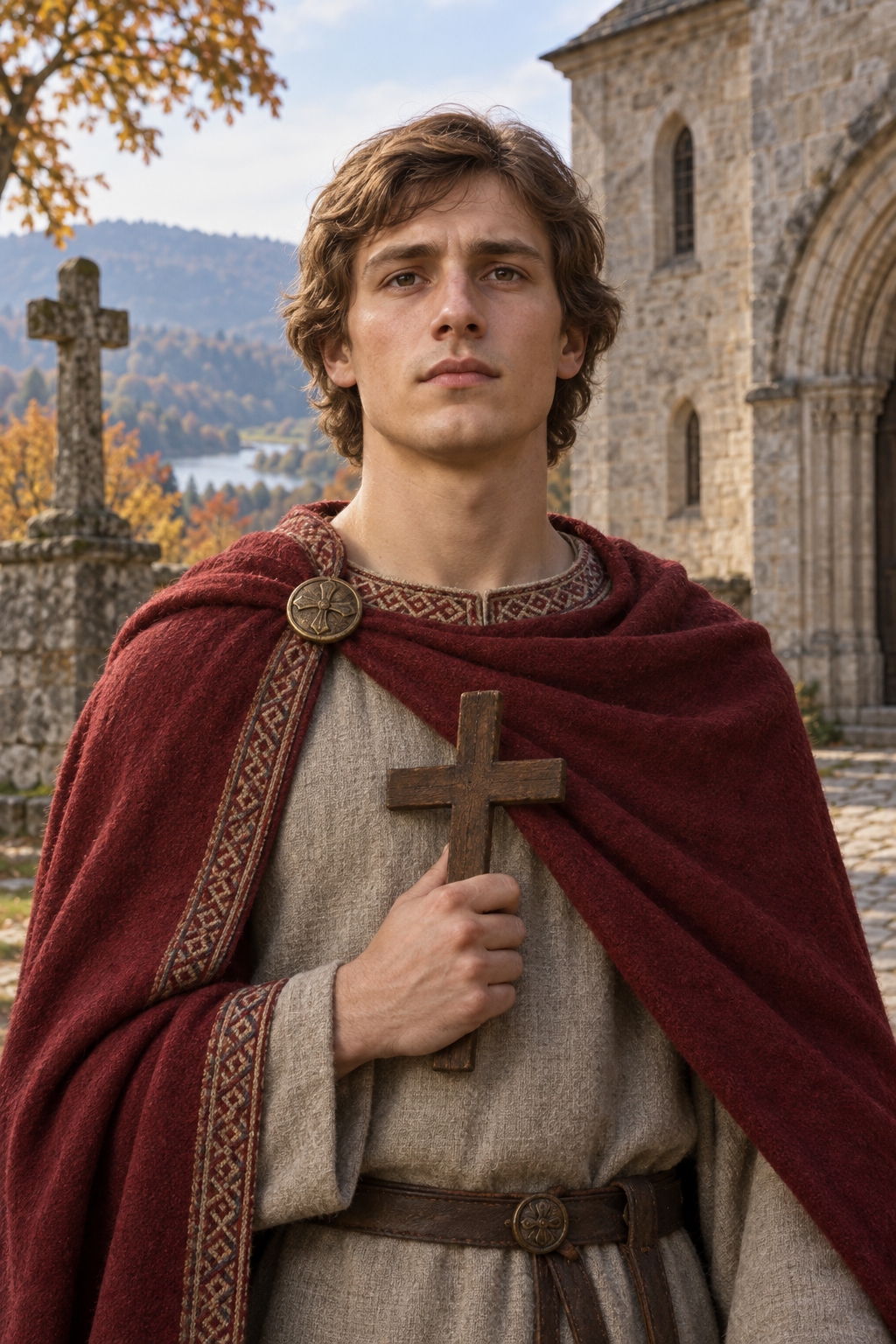
About Wenceslaus
(832 words)
Wenceslaus belongs to the early medieval history of Bohemia, but the sources that shape his remembrance require careful reading. He is honored as a duke, martyr, and patron of the Czech people. The Church’s memory of him is old and powerful; the details of his personal life come through liturgical, hagiographic, and later ecclesial witnesses rather than through a contemporary biography. That does not make the tradition unimportant. It means that a responsible account must say what the tradition affirms while avoiding claims of precision that the evidence cannot provide.
Pius XI’s 1929 apostolic letter *Caritatem docet* calls Wenceslaus a celebrated duke of Bohemia and the people’s patron. The letter connects his Christian formation with his grandmother Ludmila and says that he was sent to Budeč for Latin learning. Benedict XVI likewise described the young prince as faithful to the Gospel he had learned from Ludmila. These accounts give the received memory of a ruler formed within a Christian household, yet they rest on sources later than the events. They support a traditional account of his formation, not a complete record of his childhood or education.
After his father’s death, the tradition presents Wenceslaus as duke while still young. Pius XI portrays him as restoring order and justice, defending his land, and seeking peace without needless bloodshed. Benedict’s homily develops the same moral image: Wenceslaus preferred fidelity to Christ over the attractions of power and acted for a more just and fraternal society. Such papal reflections are significant for the Church’s understanding of his witness. They should not be mistaken for administrative records that would allow modern historians to trace every policy, treaty, or conflict of his rule.
The religious character of his leadership is central to the tradition. The 1929 letter says he restored churches, recalled clergy, and built new churches, including an early church of Saint Vitus at Prague Castle. Benedict refers to an Old Slavonic narration that pictures him assisting ministers, adorning churches, feeding hungry people, clothing those without clothing, welcoming pilgrims, and protecting widows. These stories express why Christians remembered him as a ruler whose public authority was bound to worship and mercy. They are best presented as the early Christian tradition about him, not as a ledger of individually verified acts of charity.
The same caution applies to personal ascetic details. *Caritatem docet* recounts that he wore a hair shirt, practiced chastity, prepared bread and wine for the liturgy, and cared for people in distress. These features helped later devotion understand him as a ruler with monastic seriousness. The underlying witnesses are identified in the letter’s notes, but they are not contemporary observation. A biography may describe them as received hagiographic tradition; it should not present them as physical facts known with the certainty of an archival record.
The core martyr tradition places Wenceslaus’s death at Stará Boleslav after a conflict involving his brother Boleslaus. Pius XI says that he was killed there after being received for a feast and while praying at a church door. Benedict XVI states that his brother tried to kill him and describes the death as martyrdom for Christ. The papal sources agree on the lasting meaning of the episode: the Church remembers a ruler who did not abandon Christian allegiance when power was contested. They do not establish an exact date or permit a dramatic reconstruction of every word and movement surrounding the killing. This packet therefore leaves the exact year and any detailed scene-setting unfilled.
His cult spread quickly in the received history of Bohemia. The 1929 letter says that his body was moved to Prague after three years by order of Boleslaus and that his name appeared in tenth-century liturgical books. It also recounts the later extension of his feast to the universal Church. Those claims describe the history of veneration as it was transmitted to Pius XI, and they help explain why Wenceslaus became so deeply woven into Czech religious and civic imagination. Benedict’s 2009 homily calls him the “eternal” prince of the Czechs and notes the national feast held on his memorial.
The legacy is not merely political. Benedict uses Wenceslaus to address leaders, calling them to the common good, integrity, and a refusal to treat success or power as ultimate. This is a homiletic interpretation rather than a new historical source, but it accurately reflects why a medieval ruler could be remembered as a saint. His example became a way of imagining authority shaped by faith, justice, mercy, and peace.
Wenceslaus’s September 28 observance keeps that memory in the Roman calendar. It should not be used as an exact death date, and national patronage should not be broadened into unsupported universal patronage claims. What can responsibly be said is substantial: Christian tradition remembers a Bohemian duke formed by Ludmila, associated with church-building and care for vulnerable people, killed in a conflict linked to his brother, and honored across centuries as a martyr. The gaps in the early record remain real. Naming them allows the depth of the received tradition to be respected without making it carry more historical weight than it can bear.
Wondering how to weigh the stories and sources? Learn how to read a saint biography.