Biography
William Lloyd Garrison
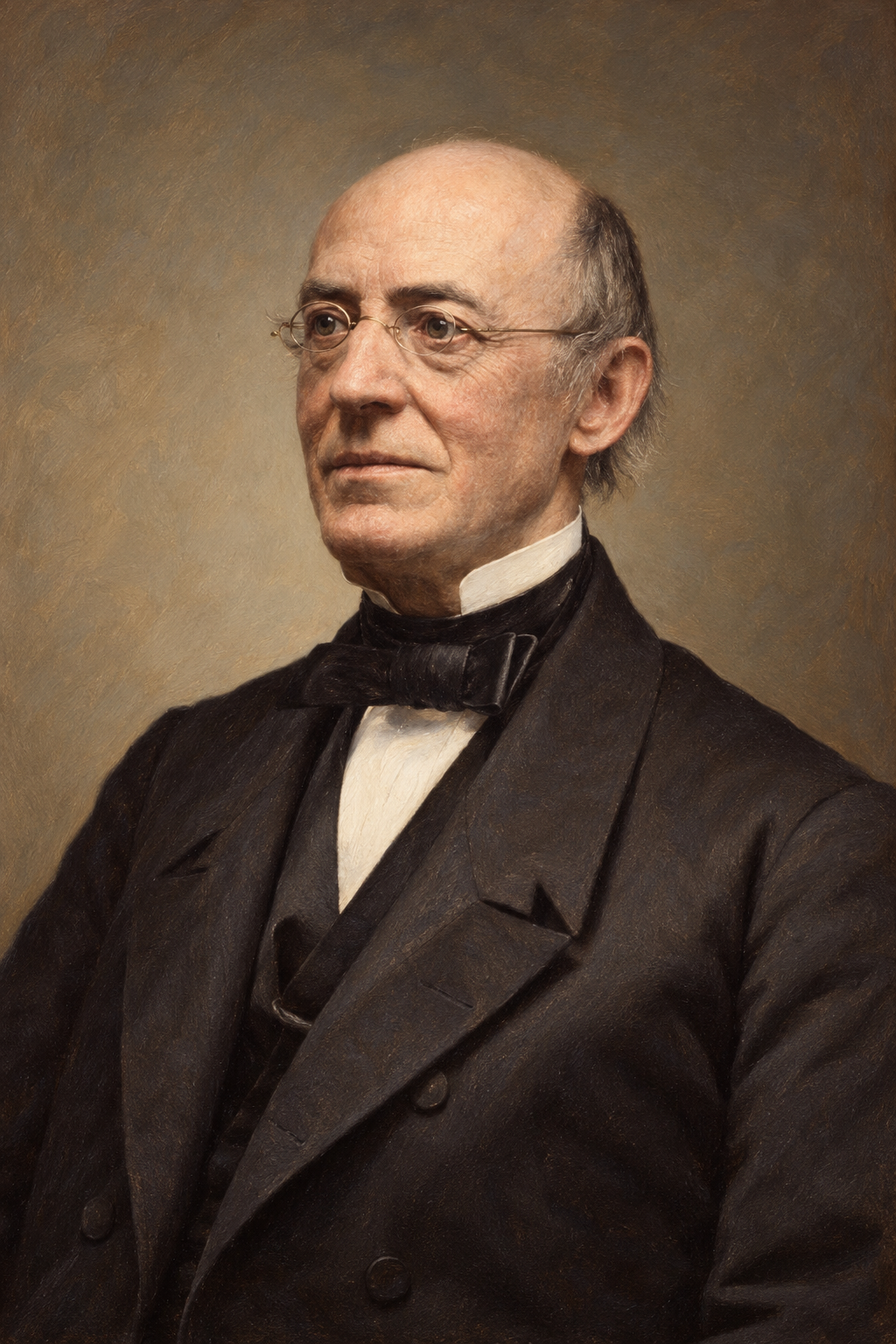
About William Lloyd Garrison
William Lloyd Garrison was an American printer and abolitionist who demanded an immediate end to slavery. Born in Newburyport, Massachusetts, in December 1805, he grew up in poverty after his father left the family. A printer’s apprenticeship gave him a trade through which he could address public questions. His convictions developed through contact with other abolitionists, including Black Americans in Boston and Baltimore who opposed both gradual emancipation and schemes to remove free Black people to Africa. Their influence helped him abandon positions he had initially supported.
In the first issue of The Liberator, published in Boston on January 1, 1831, Garrison publicly repudiated his earlier support for gradual abolition. He asked forgiveness for an argument he now regarded as unjust. The editorial also challenged Northern prejudice and indifference, refusing to treat slavery as a problem belonging only to the South. He intended his newspaper to draw help from people of different religions and parties while remaining independent of a particular political leader. His urgent language was deliberate: he argued that a grave wrong required immediate action, even when readers objected to his tone.
His protest exposed him to violence. On October 21, 1835, a mob disrupted a meeting of the Boston Female Anti-Slavery Society. Its original target, the British abolitionist George Thompson, had left; Garrison had offered to speak instead. The crowd assaulted Garrison and dragged him through the streets by a rope. The women’s response was an important part of the episode. They refused simply to abandon their work, walked together from the threatened meeting place, and continued their meeting in a member’s home. Their organization had already been active for several years.
Garrison’s religious commitments extended beyond opposition to slavery. The declaration adopted by the Boston Peace Convention in 1838 grounded nonresistance in the example of Christ and the duty to forgive enemies. It rejected warfare, retaliation, and public offices that required coercion. It also rejected electing others to exercise powers the signers would not exercise themselves. Such convictions did not mean refusing to speak or organize. The declaration proposed lectures, publications, voluntary societies, and petitions as means of changing public opinion. Its authors expected opposition and suffering, but insisted that moral and spiritual action could challenge injustice without physical force.
His rejection of electoral politics also reflected a judgment about the Constitution’s protection of slavery. Historian Paul Finkelman explains that Garrison and his allies regarded participation in that system as both morally compromising and practically ineffective. They argued for separation from slaveholding states. This position was one response within abolitionism, rather than a principle shared by everyone working for emancipation.
Frederick Douglass publicly announced a different constitutional interpretation in 1851. He argued that the Constitution could be read and used in the cause of emancipation, and that citizens should employ political as well as moral power against slavery. In his account, Garrison reacted with suspicion. Douglass nevertheless expressed gratitude and continuing respect for him. The disagreement reveals a movement whose members could share an objective while disputing the means to reach it. Douglass’s statement also records his own intellectual independence, rather than merely a departure from another man’s leadership. He named Lysander Spooner, Gerrit Smith, and William Goodell as writers whose arguments had changed his mind. He also explained why he had announced the change publicly: the society was considering whether to recommend antislavery newspapers, and his own North Star no longer met its stated constitutional test.
Garrison’s papers preserve concerns that reached beyond emancipation. An account of the Brandeis archival collection describes his advocacy of women’s suffrage, criticism of churches that sustained slavery, interest in spiritualism, and commitment to temperance. These positions could bring disagreement with fellow reformers as well as with opponents of abolition. His demands for loyalty to a broad range of causes strained friendships. When a testimonial sought support for his retirement in 1866, some former allies hesitated because of recent disputes, while others offered praise and assistance.
He ended The Liberator and resigned the presidency of the American Anti-Slavery Society in 1865. Yet his surviving writings show that he did not regard the abolition of slavery as the end of racial injustice. The Brandeis collection includes warnings about continuing hostility toward Black freedom and correspondence urging further political change. The end of the newspaper therefore marked a change in his work, not the end of his concern for equal rights.
Garrison died in New York on May 24, 1879. His burial took place at Forest Hills Cemetery in Boston.
His later religious commemoration requires a distinction. In 2015, the Episcopal Church’s General Convention removed his entry from Holy Women, Holy Men while retaining Maria Stewart.
The Episcopal Diocese of Los Angeles nevertheless lists Garrison and Stewart together on December 17 in its December 2025 prayer calendar. This entry records that local Anglican observance.
Wondering how to weigh the stories and sources? Learn how to read a saint biography.