Biography
William Worrall Mayo
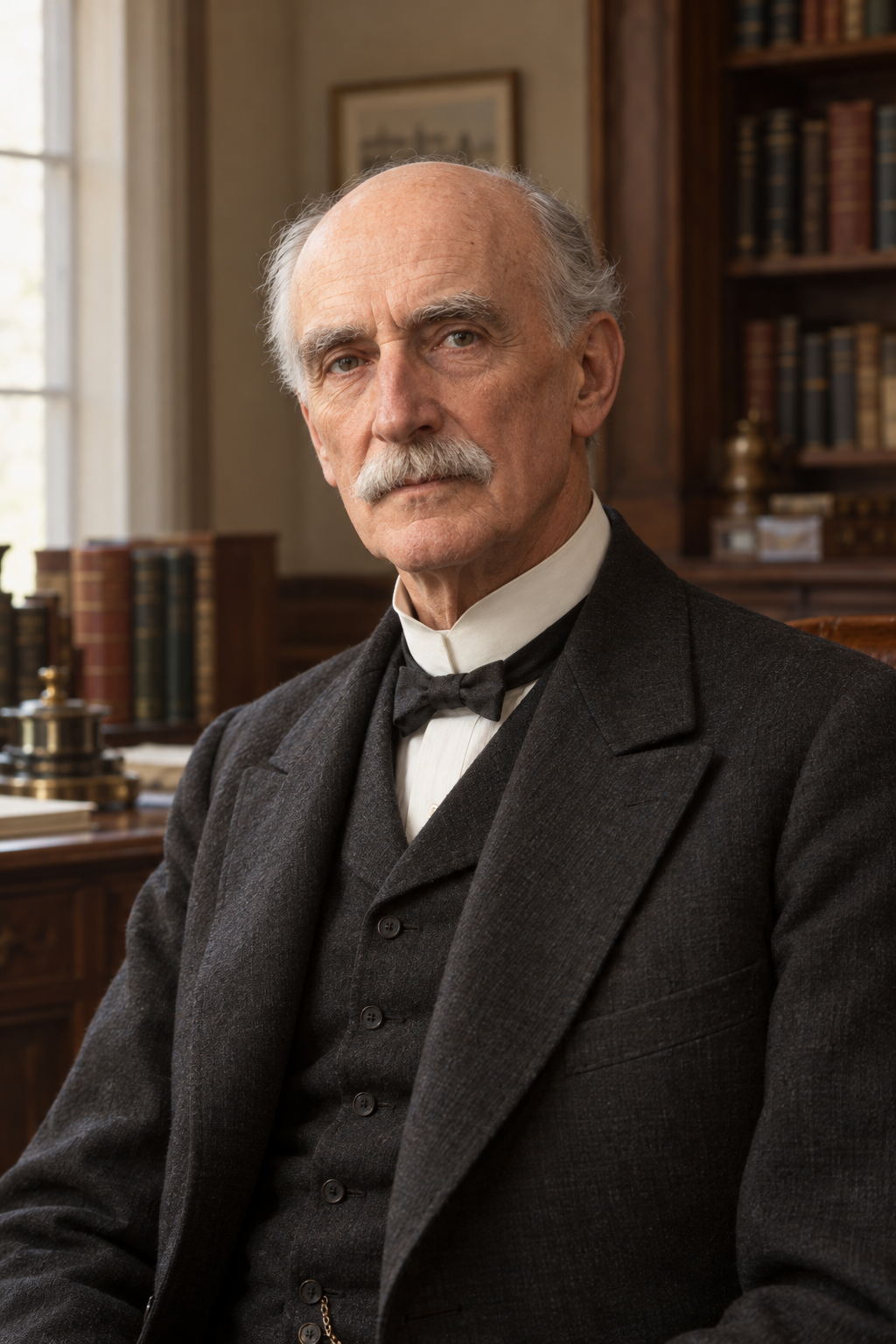
About William Worrall Mayo
William Worrall Mayo was born in England and became a physician in Minnesota. His father, a cabinetmaker, died when William was seven. Mayo trained as a tailor before pursuing the opportunities that eventually took him across the Atlantic. His later medical career grew from years of varied employment rather than a direct passage into an established practice. He married Louise Wright, who brought business experience to their partnership, and they raised a family whose work would become closely connected with his own.
Before leaving Britain, Mayo studied medicine in London and Glasgow without obtaining a license there. In the United States he worked as a chemist in New York, moved west and briefly returned to tailoring in Indiana. He received a degree from Indiana Medical College in 1850. His subsequent practice included short partnerships with other physicians and a period of seeing patients from his home. The medical books he collected are now held by the Mayo Clinic’s historical library, preserving evidence of the knowledge and interests of a nineteenth-century practitioner. The collection preserves books from his private library alongside those of another Minnesota physician, Charles Nathaniel Hewitt. Such collections show which authors doctors consulted and which subjects interested them. They also place Mayo within a larger medical world, connected through reading to colleagues and to European medicine. The library’s account suggests that these collections helped form the nucleus of the later institutional library. Archival records cited by the library also place him on the Minnesota State Board of Health from 1884 to 1887, alongside his medical practice.
Mayo built a house in Le Sueur in 1859, using an upstairs room for medical work. During the United States–Dakota War of 1862, he went to New Ulm to care for wounded people. Louise stayed behind and sheltered eleven refugee families in their home and barn.
After the execution of thirty-eight Dakota men in Mankato in December 1862, doctors including Mayo removed bodies from their graves for medical study. Mayo took the remains of Marpiya te Najin, also known as Stands on a Cloud or Cut Nose. The remains were later used to teach the younger Mayos. This was not a voluntary contribution by a patient: their anatomical education included a Dakota man’s body taken from his burial place.
Mayo had earlier sought a commission as a regimental surgeon but had been rejected. In 1863 he obtained an appointment as examining surgeon for a draft enrollment board in Rochester. His family joined him there the following year. The move gave him a lasting base for his medical practice and public life. A later crisis brought a new opportunity for collaboration: after a tornado devastated Rochester in 1883, he worked with Mother Alfred Moes of the Sisters of St. Francis. She persuaded him to help establish a hospital.
The Mayo family also belonged to Calvary Episcopal Church. William and Louise were among its early members in 1864, and their children grew up in the parish. Louise made robes for the boys’ choir. Calvary itself sheltered some of those injured by the tornado. Mayo’s partnership with Mother Alfred brought a Protestant physician and a Roman Catholic religious community into a shared undertaking. The church’s history remembers their cooperation as an important part of the relationship between the parish and the emerging medical institution.
The medical practice drew on the work of the whole household. Louise taught botany to the boys in the garden, while their father introduced them to chemistry and anatomy. Family members sometimes accompanied him when emergencies required help. William James and Charles Horace later trained at different medical schools and returned to join the practice. The Sisters of St. Francis, originally teachers, had helped care for tornado patients in a temporary hospital. Mother Alfred continued working toward a permanent institution after that emergency ended. St. Mary’s Hospital opened in 1889 with room for twenty-seven patients.
Mayo’s interests extended into government. He served as mayor of Rochester and later represented Olmsted County as a Democrat in the Minnesota Senate. His legislative term ran from January 1891 to January 1895. His committee assignments included education, railroads, university matters and hospitals for people with mental illness. He also served as president of the Minnesota State Medical Society. These roles placed him in public institutions beyond his private medical practice. Voters elected him to the Senate on November 4, 1890, representing the fourteenth district.
He died in Rochester on March 6, 1911, and was buried in Oakwood Cemetery.
Later memorials emphasized his influence on the next generation. In 1929 his sons dedicated a stained-glass window in the Salford church where he had been baptized. The window survived the bombing of Manchester during the Second World War. His legacy includes both the institution his family helped build and difficult questions about the means by which medical knowledge was obtained.
Wondering how to weigh the stories and sources? Learn how to read a saint biography.