How Is Mary Honored Among the Saints?
Explore Saints · 3 min read · Updated
Mary’s place in Catholic faith, the difference between honor and worship, and where to begin in the Gospels.
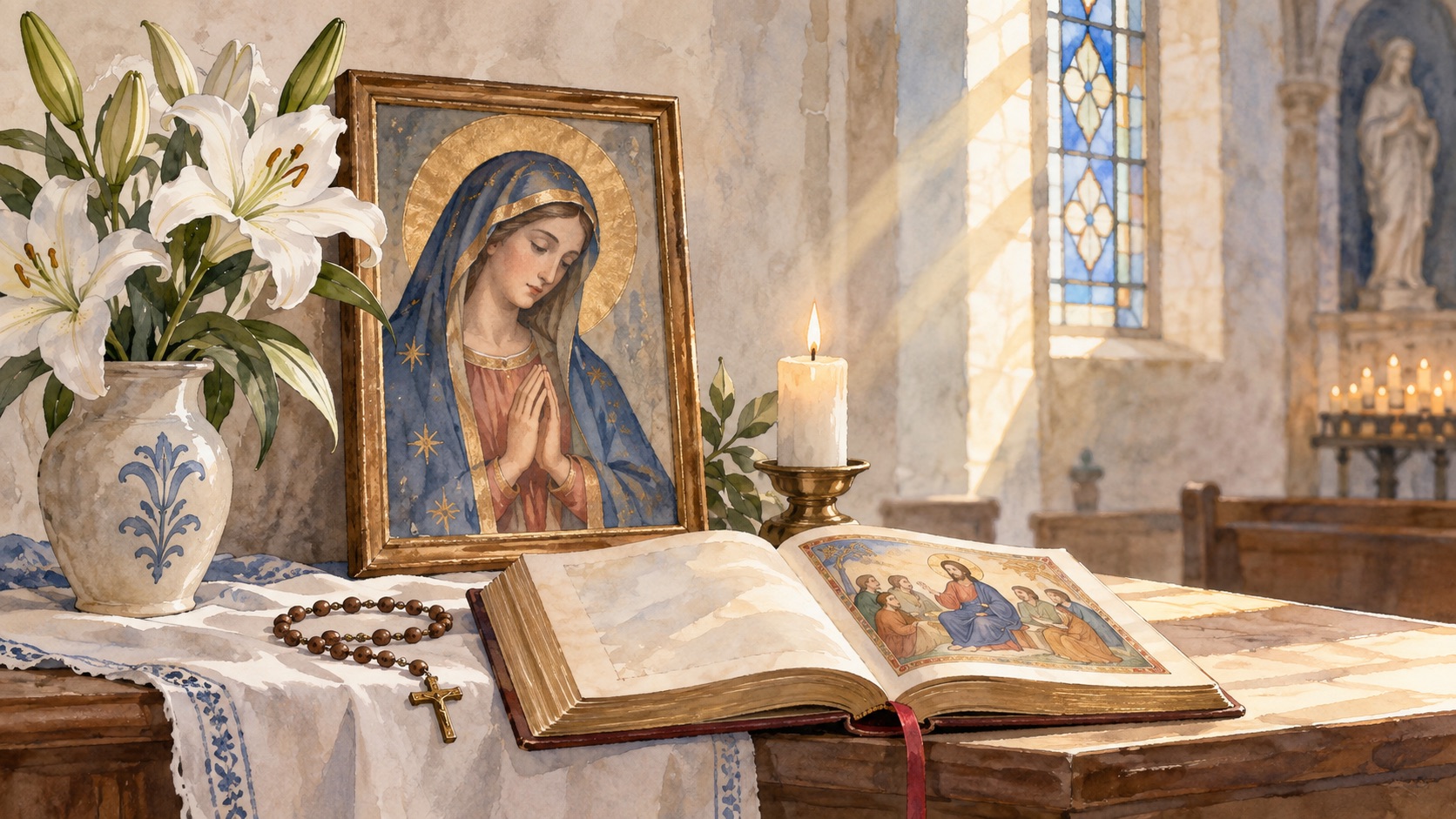
Start with Mary’s story
Mary is the mother of Jesus. That simple fact is why Catholic teaching gives her a distinctive place among the saints: her story is inseparable from his. The Church calls her Mother of God because the child she bore is Jesus Christ, truly God and truly human. It also speaks of her as mother of the Church and a model of faith. Those titles can sound like a lot when heard all at once. There is no entrance exam in Marian vocabulary.
The Gospels give a human starting point. Mary receives an unsettling announcement, visits Elizabeth, ponders events she cannot fully explain, and remains among Jesus’ followers after the Resurrection. Catholic devotion grows from those scenes and from the Church’s reflection on Christ. It does not require imagining that Mary knew every future detail of her life in advance.
Explore further
Sources: Catechism 963–970 · Lumen gentium 53–58
Honor is not worship
Catholics worship God alone. The Second Vatican Council says that devotion to Mary is special but essentially different from the adoration given to the Father, Son, and Holy Spirit. This is the distinction to keep in view when someone asks whether Catholics ‘pray to Mary.’ A request for her intercession asks her to pray with and for someone; it does not treat her as a rival source of grace.
The Council also cautioned against both exaggeration and an overly narrow account of Mary. A useful test for a Marian prayer or image is where it directs attention. If it seems to leave Jesus out of the story, read the Church’s explanation rather than guessing from one phrase on a prayer card.
Explore further
Sources: Lumen gentium 66–67 · Catechism 970–971
A practical way to read a Marian prayer
Take the Hail Mary slowly. Its opening draws on the angel’s greeting and Elizabeth’s blessing in Luke’s Gospel; its later request asks Mary to pray for sinners. The first half recalls what God has done, and the second asks for help living in that light. If you are new to the prayer, it is fine to pause over each line rather than race to keep up with someone else’s beads.
Then read John’s account of the wedding at Cana. Mary notices a need and points the servants toward Jesus. Catholics often find in that scene a shape for her intercession: attention to human need and trust in her Son. Jesus performs the miracle. Mary’s words direct the servants to him, a pattern that helps explain Catholic devotion.
Explore further
Sources: Catechism 2675–2677 · John 2:1–11, USCCB Bible · Lumen gentium 58, 66
Begin where you are
A newcomer can start with Luke 1–2 and John 2, then read the Catechism’s short section on Mary in the Church. Ask three questions: What does this passage say Jesus does? What does Mary do? What, if anything, does the Church ask believers to imitate? Those questions are more useful than trying to memorize every title in one sitting.
People from other Christian traditions may honor Mary differently. The Catholic account is clearest when it says what it actually teaches: she is singularly honored, wholly dependent on Christ, and never the object of the worship due to God. The distinction deserves more than a hurried argument in a comment thread.
- Read Luke 1–2 or John 2 before a devotional explanation.
- Name Mary’s action in the passage.
- Notice what the passage says about Jesus.
- Check an unfamiliar title against the Catechism.
Sources: Catechism 963–972 · Lumen gentium 66–67