Biography
Acacius of Armenia
About Acacius of Armenia
This catalog entry is resolved as Acacius the Centurion, a military martyr remembered at Byzantium. The inherited label “of Armenia” is retained as the stable public name, but it must not control the biography. Several saints called Acacius or Akakios appear in ancient and medieval calendars. The Orthodox Church in America distinguishes the centurion commemorated in May from a bishop-confessor of Melitene commemorated on March 31. Basil Watkins likewise lists separate figures at Byzantium, Melitene, and Ararat. The earlier record mixed the centurion's military story with the Melitene bishop's calendar and an Armenian location. This packet separates them and does not claim that the original catalog label represents a documented ancient epithet.
The received account describes the centurion as a native of Cappadocia serving in the Roman army. Cappadocia was a large region of Asia Minor, not a precise birthplace, and the story gives no family, childhood, education, or enlistment record. Even the personal name occurs in several forms. Akakios reflects the Greek name behind the Latinized Acacius; neither form proves a relationship to other saints who bore it. The surviving profile is therefore not a conventional life from birth onward. It begins with a military identity preserved by ecclesiastical tradition, while leaving his birth date and home settlement unknown.
According to the passion summarized by the Orthodox source, Acacius served under an officer named Firmus during an imperial persecution. He was denounced as a Christian, questioned at Pyrrinthus in Thrace, and pressed to sacrifice. The narrative gives him extended defenses of Christian belief and presents him refusing both threats and persuasion. These speeches express the religious meaning later communities found in his witness; they are not a surviving interrogation transcript. The source's opening places the persecution under Maximian in 305–311, while its conclusion assigns the death to 303. Because those statements conflict, no exact year or emperor is treated as established here.
The story next sends Acacius under guard toward Byzantium. It describes beatings, confinement, and a difficult journey, followed by further questioning before a governor named Vivian. The names and sequence belong to the received passion and are retained with traditional confidence. They permit broad map references to Pyrrinthus and Byzantium, but not a reconstructed route. No coordinates are supplied, and no straight line should imply a documented itinerary. The journey matters chiefly because the narrative portrays Acacius continuing to profess Christianity while military and civil authorities moved him from one jurisdiction to another.
The passion culminates at Byzantium, where Acacius is said to have been beheaded. It credits his steadfastness with influencing other prisoners or witnesses and describes Christians recovering his body. Such conversion and burial details are common features of martyr narratives and cannot be independently verified from the sources reviewed. The basic association of Acacius the centurion with martyrdom at Byzantium is a longstanding liturgical tradition, but the method, exact site, date, and immediate aftermath remain traditional rather than documented history. The database therefore removes the inherited March 31 death day and the country label Armenia as a death place.
Calendar evidence helps identify the intended figure but does not turn the passion into contemporary history. The Orthodox Church in America commemorates the centurion on May 7. Watkins reports that the Roman Martyrology listed an Acacius at Byzantium on May 8 and marks the year 303 as uncertain. These are distinct jurisdictional observances and are stored separately. By contrast, March 31 belongs in the OCA source to Acacius the Confessor, bishop of Melitene, who endured Decian persecution and was released. He was not the executed centurion. An April 17 bishop and a legendary martyr associated with ten thousand soldiers are also separate entries in Watkins.
The centurion's status is consequently recorded as soldier and martyr according to tradition. “Layperson” is retained only as a broad vocation category subordinate to the more precise military title. No evidence reviewed supports patronage of soldiers as a formal observance, an exact birth around 250, a canonization date, or a personal relationship with the bishops and martyrs who share his name. His virtues are tied to actions inside the passion: courage in facing punishment, faithfulness in refusing sacrifice, and perseverance during transfer and imprisonment. They describe what the tradition teaches through his story, not psychological facts independently known about him.
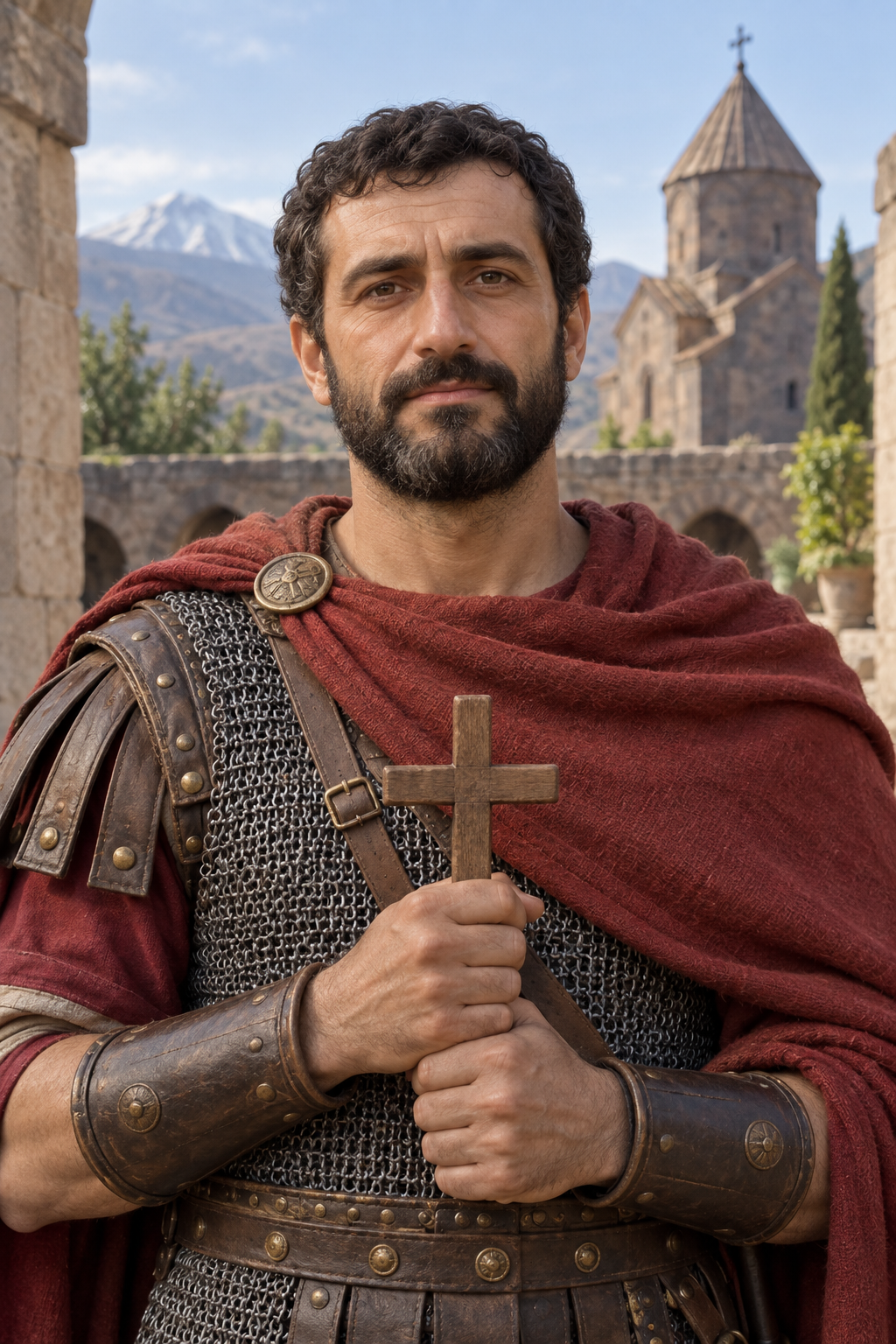
The artwork made for this catalog is modern AI-generated devotional imagery. Armor, cloak, cross, mountains, facial features, and architecture are artistic choices rather than evidence about Acacius's appearance or historical surroundings. No traditional prayer is included because no text with verified provenance and reusable rights was established. A direct quotation is also omitted: the surviving speeches are transmitted within the later passion and would risk presenting hagiographic dialogue as Acacius's recoverable words.
Acacius remains significant as one of the military martyrs through whom Christian communities reflected on conflicts between imperial service and religious allegiance. Historical care changes the way that significance is told. It requires acknowledging that the centurion's story survives as tradition, that its chronology is internally inconsistent, and that his public catalog name once drew details from another Acacius. Separating the figures does not diminish their veneration. It gives the Cappadocian centurion a coherent identity, preserves the bishop-confessor's distinct memory, and lets readers encounter courage without mistaking a devotional passion for a complete archival biography.
Wondering how to weigh the stories and sources? Learn how to read a saint biography.