Biography
Acacius of Kavsokalyvia
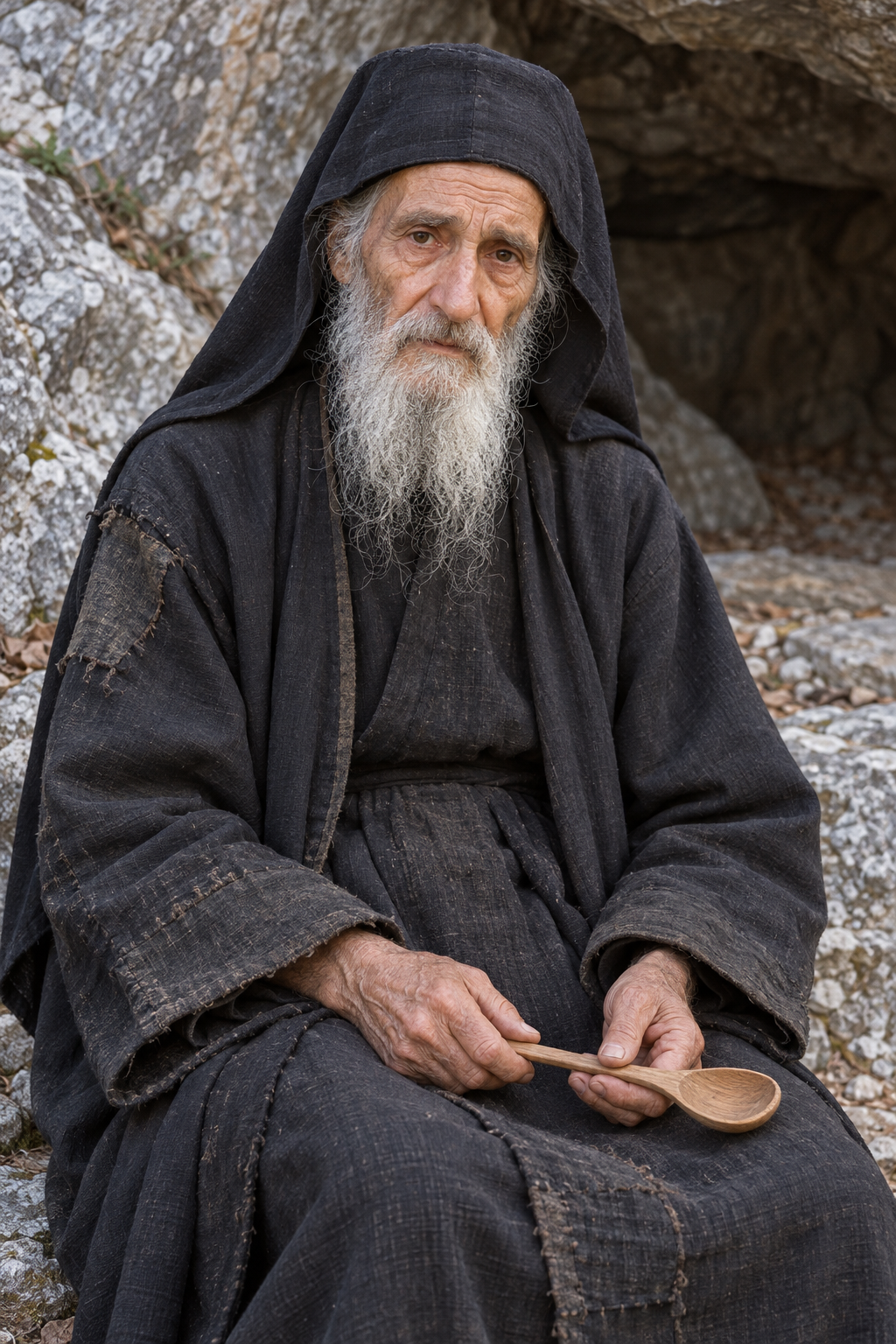
About Acacius of Kavsokalyvia
Acacius of Kavsokalyvia was an Athonite monk whose search for solitude eventually drew other ascetics around him. He was born at Golitsa, the village now called Agios Akakios in the Karditsa region, and was baptized Anastasios. The local church places his birth in 1630. Since accounts differ about his age at death, that year is best treated as approximate.
As a young man he refused the marriage his family wanted for him and entered the monastery of the Holy Trinity at Sourvia, near Makrinitsa. There he received the name Acacius. His desire for a more secluded life later took him to Mount Athos. The Orthodox Encyclopedia describes his eventual settlement near the church of the Transfiguration at Kavsokalyvia, following advice from experienced monks.
His religious life was closely connected with the memory of Maximos of Kavsokalyvia, an earlier ascetic of the same region. Accounts of Acacius describe visions in which Maximos encouraged him during periods of distress. These stories express the place of the earlier saint in his devotional life; they are not independently verifiable encounters. His reputation gradually attracted disciples, although the traditions continue to emphasize his preference for silence and prayer.
The OCA life preserves an episode about leadership within the community. Neophytos, the superior, offered Acacius his staff and asked him to guide the brothers for the remainder of his life. Acacius accepted, but afterward stopped carrying a staff himself, despite his age. The story presents his response as an act of humility. The same account describes unusually severe fasting and sleep deprivation.
Much of his remembered life comes through Jonah, a disciple who wrote his biography. In his devotional study, Nikolaos Gkalios explains that Jonah drew on what he had heard himself and what earlier disciples had told him. Gkalios also distinguishes that written inheritance from local traditions about Acacius’s youth. This distinction matters: proximity to the subject gives Jonah’s account historical value, but does not make every vision or miracle it recounts independently established.
Jonah also composed a liturgical service in his teacher’s honor. Gkalios describes a manuscript that joins accounts of recent martyrs with Acacius’s life and service. His own study principally follows another manuscript booklet in the library of the skete’s central church. These details show how biography and worship helped preserve Acacius’s memory.
Acacius died on April 12, 1730. The local church remembers him as a founder of the community at Kavsokalyvia and dates its organization as a skete to around 1700. His feast is April 12, with additional local observances. At his birthplace, a celebration on Bright Thursday includes a procession with his relics toward the cave associated with his early ascetic life.
His regional commemoration is shared with seven other saints. A 2025 announcement from the Metropolis of Thessaliotis and Fanariofersala explicitly lists Acacius among its eight patrons, honored on the Sunday after the Exaltation of the Cross. The announcement invited the faithful to services and the veneration of relics at the cathedral in Karditsa. This is a collective patronage of the local church, and should be distinguished from the leading place assigned to Seraphim among those saints.
Wondering how to weigh the stories and sources? Learn how to read a saint biography.