Biography
Acca of Hexham
About Acca of Hexham
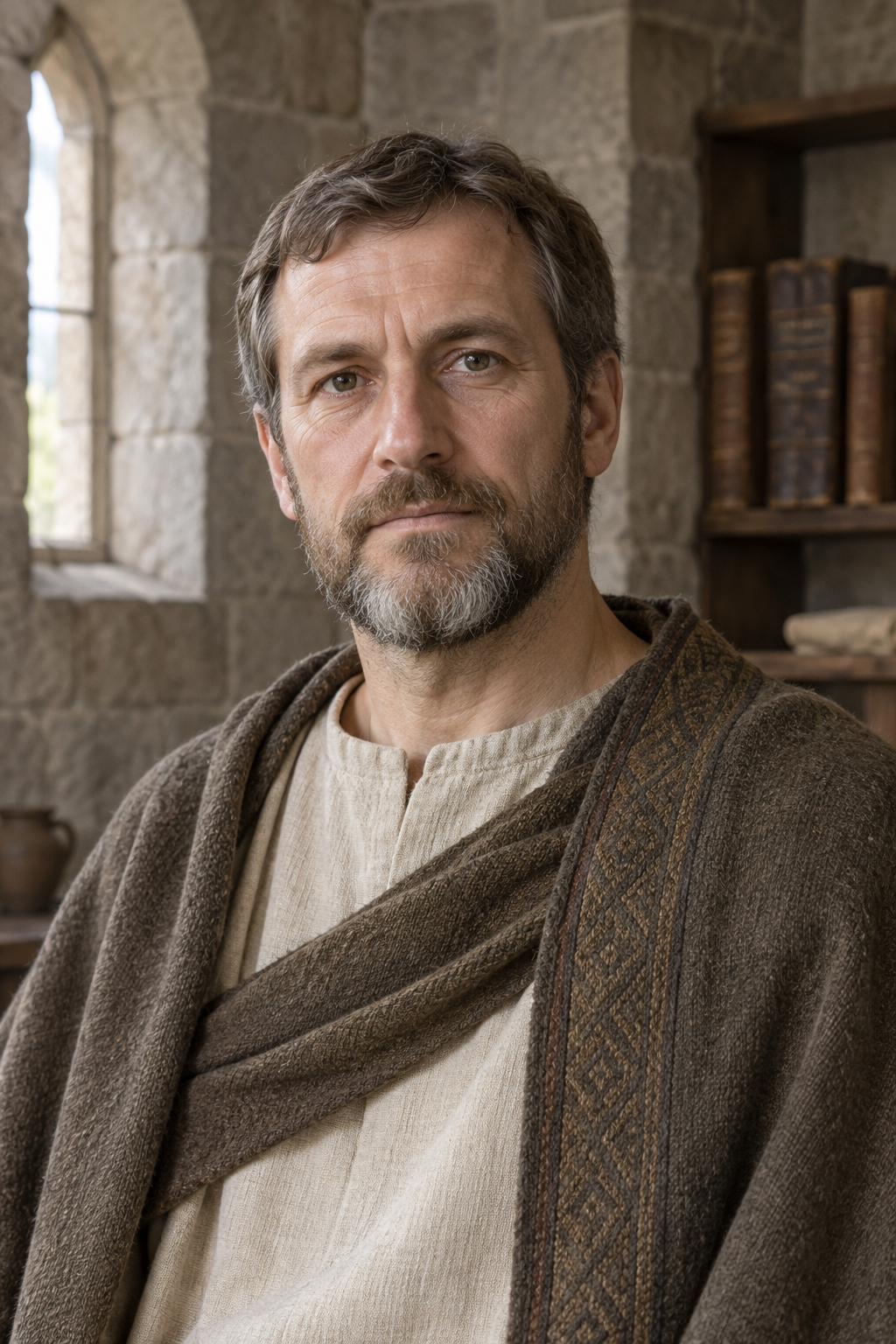
Acca was a Northumbrian churchman whose work at Hexham joined the care of a church with the study of Scripture. Later accounts place his birth around 660. His contemporary Bede describes his early formation among the clergy of Bosa, bishop of York. Acca then joined Wilfrid and remained with him until Wilfrid’s death.
The approximate birth year comes from later biographies rather than Bede’s personal account. Acca’s beginnings can be placed in Northumbria, but the consulted sources do not identify a birth settlement.
Bede records that Acca accompanied Wilfrid to Rome, where he learned about church administration. Acca subsequently succeeded him as bishop of Hagulstad, now Hexham. Bede’s description gives particular attention to his work on the church dedicated to Andrew. He enlarged and adorned it, collected relics of apostles and martyrs, and provided vessels and lights for its worship.
Acca also gathered accounts of the martyrs and other church writings into a substantial library. Learning and worship were connected in his ministry. He invited the singer Maban, trained in Kent in the musical tradition associated with Gregory’s disciples, to teach him and his clergy. Maban stayed for twelve years, teaching unfamiliar chants and restoring songs whose practice had deteriorated. Bede himself describes Acca as a skilled singer and student of Scripture.
His encouragement extended to authors. Herbert Thurston’s account notes that Bede dedicated several important works to Acca, especially writings about Scripture. A letter from Acca to Bede survives. The Norwegian church biography describes it as urging Bede to make earlier learning on Luke’s Gospel more accessible to readers.
Sarah Foot’s study of Bede’s commentaries shows the practical character of Acca’s encouragement. Bede had hesitated to undertake the explanation of Luke. Ambrose had already written on the Gospel, and Bede feared being seen either as a compiler or as someone replacing respected earlier authors. Acca answered that drawing on predecessors was an accepted practice. Some passages of Ambrose were too difficult for less learned readers, so there was a place for a clearer treatment. He pointed to Augustine’s practice of taking a passage from Ambrose and explaining it. When Bede finally completed his commentary, he included Acca’s letter before his own preface. The exchange preserves a specific instance of Acca asking for scholarship that people could use. His patronage also appears in Bede’s later dedication of the commentary on Ezra and Nehemiah, addressed to Acca as his bishop.
Acca and Tatberht commissioned Stephen of Ripon’s Life of Wilfrid. That work also helped explain their succession to Wilfrid’s responsibilities. Historian Richard Sowerby cautions that its private conversations and prophetic assurances cannot be checked against independent witnesses. The account of Wilfrid’s wishes for Hexham depended on Tatberht, while a reported vision depended on Acca. Both men had an interest in the explanation the biography offered.
Sowerby also distinguishes the monastery’s transfer from a clear public appointment to the bishopric. Stephen’s wording leaves the jurisdictional arrangement undefined. His repeated references to Acca’s later building work helped present the succession as natural in retrospect. These questions concern the explanation of Acca’s appointment; they do not erase Bede’s contemporary record of his work at Hexham.
Sowerby contrasts Acca’s interests with those of Tatberht at Ripon. Tatberht concentrated on repeated commemorations of Wilfrid, while Acca increasingly looked toward the cult of Oswald at nearby Heavenfield. This difference cautions against treating Wilfrid’s successors as a single group with identical priorities. Acca participated in remembering his predecessor while developing interests particular to Hexham.
Acca lost his bishopric in 732, for reasons that remain uncertain. Accounts of a subsequent appointment at Whithorn are not securely established. His death year is also disputed: the Norwegian biography discusses 737, 740 and 742, preferring around 740. It records his burial near the eastern wall of the church at Hexham.
The carved stone traditionally called Acca’s cross survives in fragments. The sculpture corpus describes parts recovered from a cottage lintel at Dilston, the church’s eastern end, and warehouse foundations near St Mary’s. It dates the carving to the second quarter of the eighth century. Its association with Acca’s grave is a scholarly hypothesis, rather than a clearly readable surviving name. The proposed reading of Acca in the inscription has been convincingly challenged.
The surviving sculpture carries plant scrolls, leaves and bunches of berries arranged in elaborate interlaced patterns. The corpus finds its design distinctive, while recording debate over the artistic influences behind it. Much of the head and central shaft is missing, and the surviving lettering is mostly illegible. It is therefore important to distinguish the visible early medieval object from later attempts to assign it to a particular grave.
His commemoration is given as 20 October in the Norwegian church biography. That source also notes his absence from the 2004 Roman Martyrology. His lasting importance rests on the unusually concrete contemporary record of his church, library and musical teaching, alongside the later traditions that remembered him at Hexham.
Wondering how to weigh the stories and sources? Learn how to read a saint biography.