Biography
Adalbero II of Metz
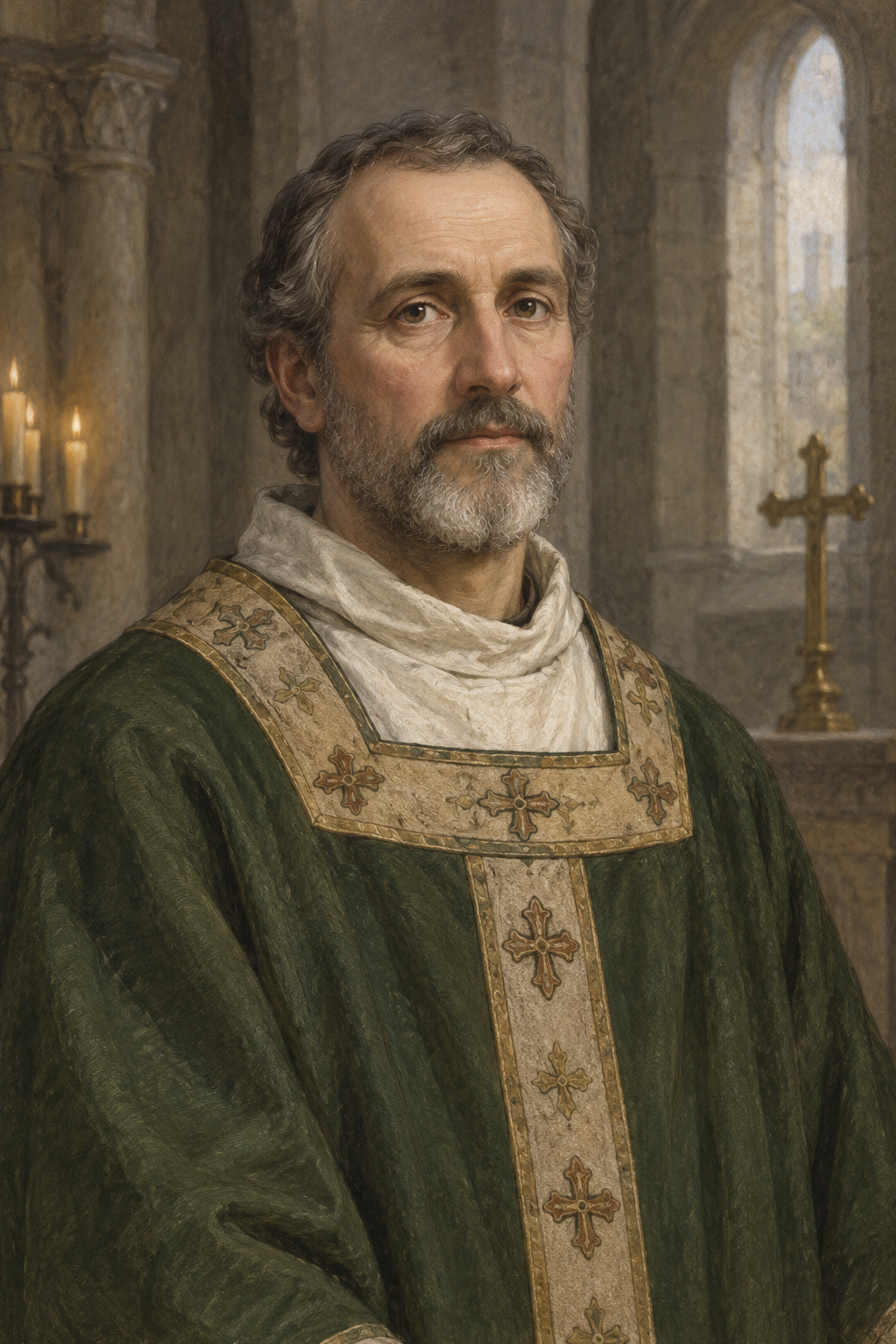
About Adalbero II of Metz
Adalbero II was bishop of Metz from 984 until 1005. Before taking that office he had briefly been bishop of Verdun. Germania Sacra records both appointments and distinguishes him as Adalbero II. His life belongs to the history of episcopal leadership in Lorraine around the turn of the eleventh century.
Eugen Ewig’s scholarly biography identifies his father as Frederick I, duke of Upper Lorraine, and his mother as Beatrix, daughter of Hugh the Great and sister of Hugh Capet. Adalbero received his education at Gorze. He was elected bishop of Metz on 16 October 984 and consecrated by Archbishop Ekbert of Trier on 28 December.
His advancement was closely connected with his family’s influence. Parisse and Hari describe his mother’s efforts to obtain Verdun for him with the support of the empresses Adelaide and Theophanu, followed by his move to Metz when its bishopric became vacant. They identify him as a nephew of Hugh Capet and cousin of Otto III. Religious formation and aristocratic connections were therefore both part of his path to episcopal office. The family connection does not make Adalbero himself duke of Lorraine; that title belonged to his father and then his brother Thierry.
Ewig associates him with the Lorraine monastic reform. His work included rebuilding the ruined abbey of Saint-Symphorian in Metz and founding the Benedictine women’s abbey of Saint Mary in 995, together with women’s houses at Epinal and Neumünster. Ewig also records his support for Henry II’s opposition to marriages between close relatives at councils in Mainz and Aachen.
At Saint-Symphorian he renewed a much older religious site. The University of Lorraine’s historical project locates its first church in the area of an ancient cemetery outside the later city center. Adalbero rebuilt the church and made it a Benedictine men’s abbey. A settlement subsequently developed south of it around the parish church of Saint-Goery. His restoration thus belonged to the history of Metz’s inhabited outskirts as well as to that of its monks.
Constantine gives a more personal picture. He says that he often shared the bishop’s table and that Adalbero took pleasure in eating with monks. At Epinal he describes the bishop washing wounds and feeding sick people, claiming to have helped him for seven days. The testimony conveys close acquaintance, though its admiring description is not a medical record. The same writer admits that some contemporaries thought Adalbero excessively attached to monks.
His pastoral reputation did not mean that his authority was exercised without force. Constantine reports the destruction of fortified places whose occupants, he says, preyed on church dependants. He presents the action as protection of others rather than revenge. He also portrays Adalbero sending money to Otto III instead of joining expensive military expeditions. These episodes show the practical and sometimes coercive responsibilities which the Life seeks to reconcile with its picture of a gentle bishop.
Historian Ryan Kemp reads the latter episode within a wider pattern of episcopal biography. Such works often praised bishops for preserving lives and limiting warfare, while minimizing their direct participation in fighting. Royal service was not automatically treated as virtuous. In this setting, Constantine’s portrayal explains how a bishop could fulfill obligations to a ruler while trying to reduce their cost to his community. This helps explain the Life’s argument, without converting every expression of its praise into an independently established fact.
Constantine, abbot of Saint-Symphorian, wrote an early account of Adalbero. The medieval-source catalogue dates it to about 1015 and identifies personal knowledge behind it. The work survives through a manuscript tradition and later editions. It is a substantial narrative of episcopal conduct, not a contemporary diary recording each event as it happened.
A document attributed to Adalbero illustrates another limit of the evidence. It purports to confirm earlier grants to Senones and to regulate the payments owed by children of a dependent man of Senones and a free woman of Saint Stephen’s. But the French original-charter database classifies the document as doubtful and as a pseudo-original. Its claimed date of 985 cannot therefore make this arrangement a secure event in Adalbero’s life. The text preserves a claim made in his name, not reliable proof that he personally issued the settlement.
Constantine says that Adalbero became gravely ill after intervening in a property dispute involving his brother. He describes prolonged paralysis, gifts to churches and the poor, and burial at Saint-Symphorian, the community that had marked the beginning of his episcopal work.
Ewig gives Adalbero’s death as 14 December 1005, a year also used by Germania Sacra and the medieval-source catalogue. The Catholic Church in Norway lists him as Blessed and places his commemoration on 15 December. His commemorative day should therefore be distinguished from his recorded death date.
The abbey he restored survived as a community through later displacement: after destruction in the siege of 1444, it moved inside Metz’s walls in 1449. Its later buildings should not be mistaken for his original church.
Wondering how to weigh the stories and sources? Learn how to read a saint biography.