Biography
Adalbero of Würzburg
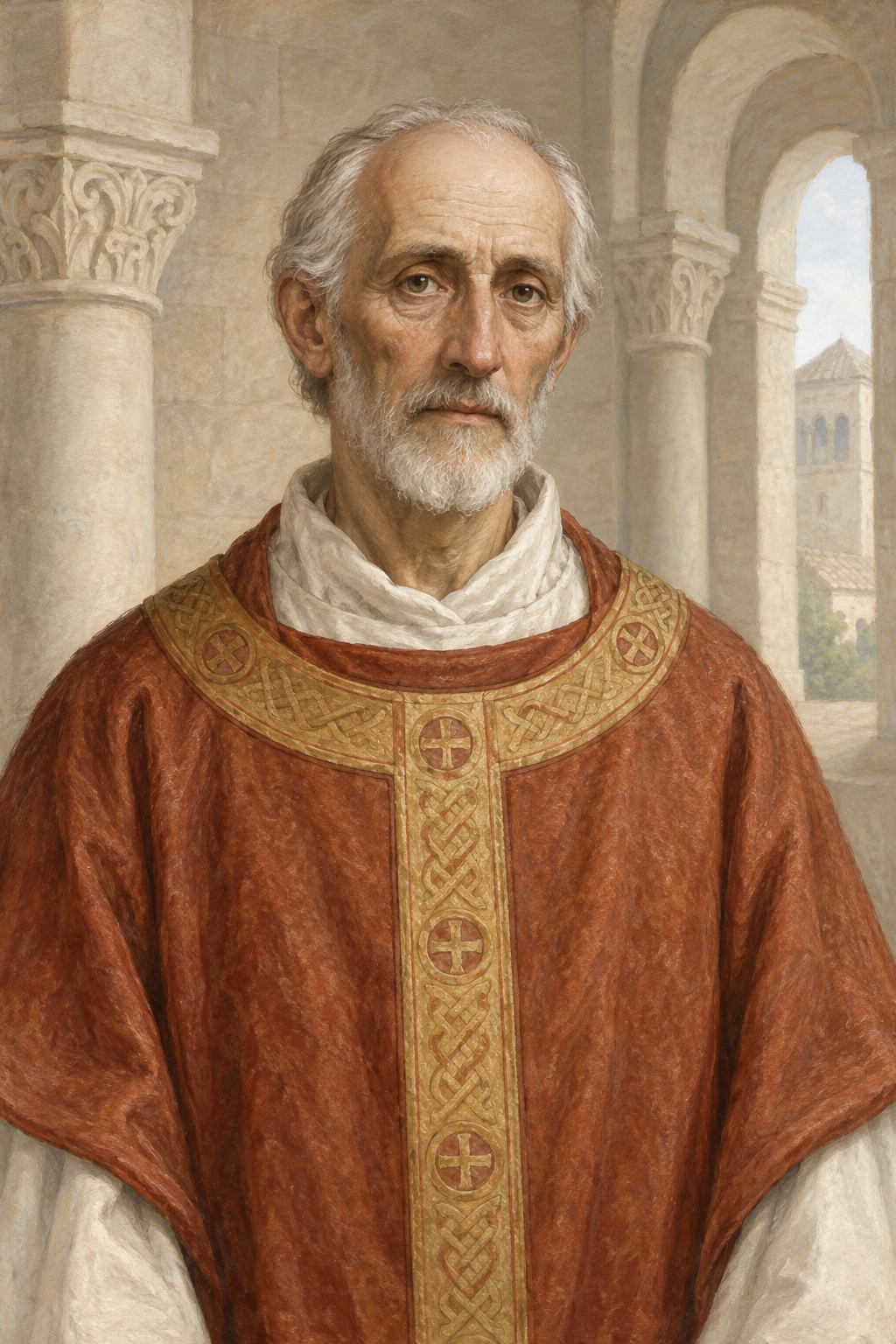
About Adalbero of Würzburg
Adalbero of Würzburg was an eleventh-century bishop whose work joined monastic renewal with the political struggles of his time. The diocese that remembers him dates his birth to about 1010 at Lambach and his death to 6 October 1090 in the same place. His Catholic feast is kept on 6 October. His memory is attached both to Würzburg, where he served as bishop, and to the Benedictine abbey at Lambach, where he was buried after his final exile.
He belonged to the counts of Lambach. Engel names his parents as Arnold and Reginlind and places his education at Würzburg’s cathedral school. Henry III appointed him bishop in 1045. He supported reform and was initially loyal to the emperor, later becoming a confidant of Henry IV. Engel dates his eventual break with the king to the winter of 1075–1076.
Lambach’s foundation history gives a more specific account of his family’s religious undertaking. Around 1040, Arnold and Reginlind established a collegiate community of twelve secular priests at their ancestral castle. Adalbero converted that foundation into a Benedictine abbey in 1056. Egbert came with monks from Münsterschwarzach to become its first abbot. The abbey associates this community with the reform movement originating at Gorze, which sought a renewal of monastic life. The institutional beginnings therefore preceded the Benedictine house: Adalbero inherited and changed a foundation already established by his parents.
The abbey’s account also records Henry IV’s confirmation of Adalbero’s gifts to Lambach in 1061. It connects the monastery with other Benedictine communities and states that Lambach monks went to Melk in 1089. On 15 September of that year Adalbero and Bishop Altmann of Passau dedicated the first Romanesque church. These details place Lambach within a network of communities and patrons rather than treating its foundation as an isolated event.
His later episcopate was marked by the Investiture Controversy. Engel places him among Gregory VII’s principal supporters and records his role in the election of Rudolf of Rheinfelden as rival king at Forchheim in March 1077. The royalist city of Würzburg excluded him. A Mainz synod excommunicated and deposed him in 1085; he briefly returned in 1086 but was expelled again. Engel also records disputes with Bamberg and Fulda over tithes and rights. His reforming activity thus unfolded alongside contested authority and concrete struggles over ecclesiastical property.
The diocese’s narrative includes the violence of this conflict. Rudolf and Adalbero attempted unsuccessfully to take Würzburg by siege, and it places the bishop at the battle of Mellrichstadt in 1078. His public life cannot be reduced to a simple account of peaceful opposition. After renewed expulsion he withdrew to Lambach, where the abbey preserved his burial and memory. The later devotional presentation praises his constancy; the political narrative also records the force and division surrounding his commitments.
The surviving medieval Life requires particular care. The Bavarian Academy’s source catalogue dates it to around 1200, more than a century after Adalbero’s death, and attributes it to a Lambach monk. It describes a work concerned mainly with the founder’s family, the abbey’s establishment and miracles, with little knowledge of his episcopal career. It also warns that the nineteenth-century printed edition is unreliable. This source is evidence of the monastery’s remembrance, but its late stories should not be treated as contemporary observation.
Modern research has also challenged claims about Adalbero’s early career. Enno Bünz examined the suggestion that he invented the medieval mathematical game rithmimachia under the name Asilo. Similar names do not establish identity: Bünz identified other Würzburg clerics who could fit the evidence better. He also questioned whether Adalbero had belonged to the cathedral chapter before becoming bishop, because that claim rests on the late Life. The game’s authorship and a pre-episcopal canonry therefore remain unproved, and neither belongs among his secure achievements.
Bünz places the game within the intellectual culture of the cathedral schools. Arithmetic and music theory formed part of their teaching, and Würzburg and Liège were important centres for the education of future bishops. The game used numerical relationships and offered a learned contest between players. This context explains why its inventor’s identity attracted scholarly attention, but it supplies no missing link to Adalbero. A plausible educational setting cannot by itself establish that a particular student wrote a surviving text.
Lambach remembers a long history of veneration. Its account places the medieval Life around 1200 and dates the first healing reported there to 1181. These are reports of a developing cult, not independently established medical events. Abbot Plazidus Hieber erected a raised tomb in 1659, after which the abbey pursued recognition in Rome. The abbey records Leo XIII’s recognition of the cult on 5 July 1883 and authorization for the ceremonial elevation of the relics the following year. Its annual procession commemorates that later translation in September, a distinct observance from Adalbero’s October feast.
Wondering how to weigh the stories and sources? Learn how to read a saint biography.