Saint profile
Adelaide, Abbess of Vilich
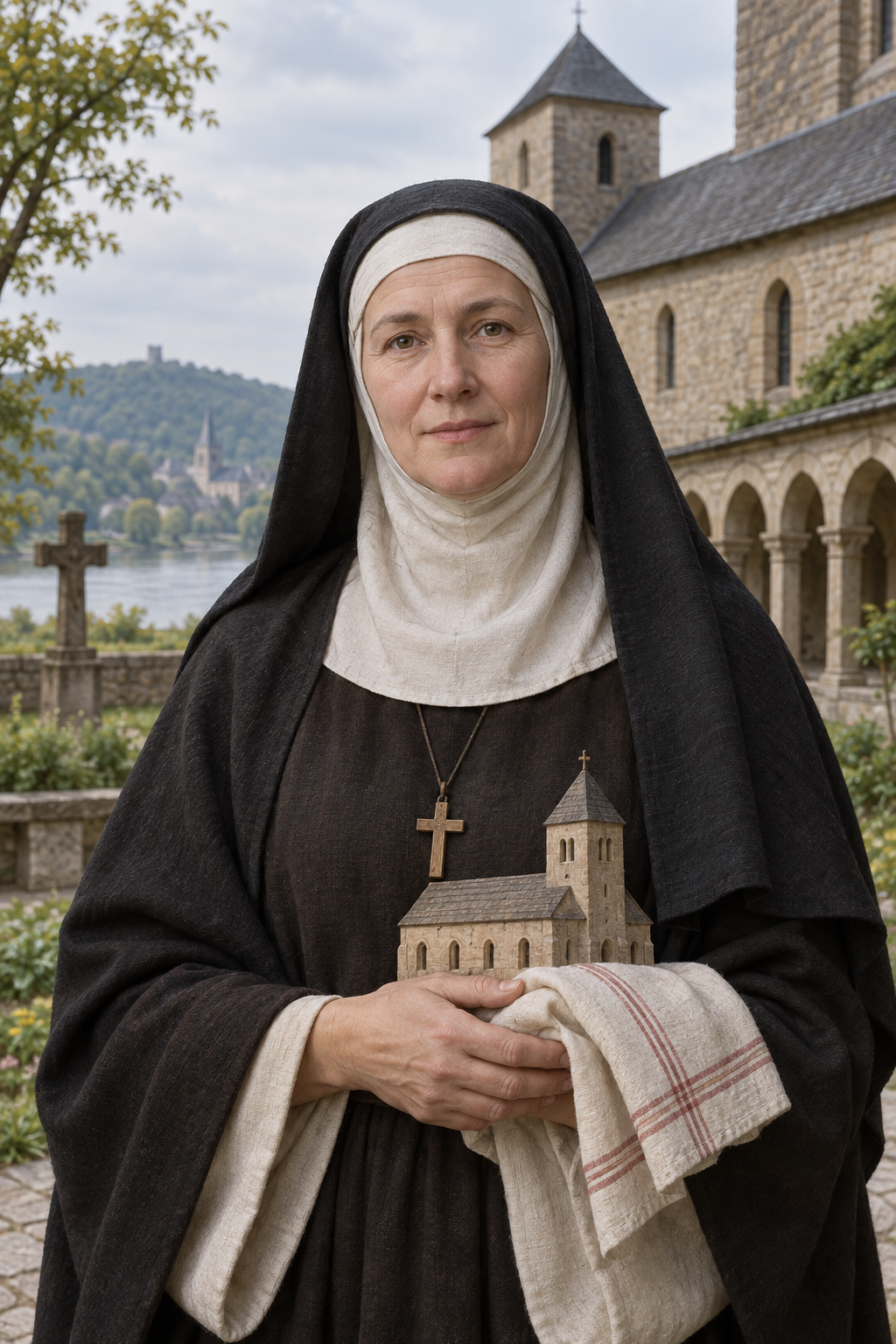
About Adelaide, Abbess of Vilich
Adelaide was born into a noble family of the lower Rhine region in the later tenth century. Her life is known chiefly from the Vita Adelheidis, written around 1057 by Bertha, who said she had known Adelaide as a child. The work is near enough to preserve memories of the community, but it was also written to support the abbess’s veneration. That purpose calls for care when reading its descriptions of holiness or miracles. The clearer institutional story begins with Adelaide’s parents and their foundation at Vilich near Bonn after the death of their son.
Adelaide first entered the religious community of St Ursula in Cologne. Her parents’ new foundation at Vilich needed a leader, and she became its first abbess. The Vilich community initially had the looser form of a women’s collegiate foundation. Later, after her mother’s death, Adelaide introduced Benedictine observance. The timing matters: the later monastery should not be projected unchanged back onto its foundation. A royal privilege issued in 987 supplies early documentary evidence for Vilich and helps distinguish the institution from episodes known only through the Vita.
The sources remember Adelaide as attentive to learning and to the women in her care. They also associate her with relief for people affected by hunger. These accounts show how her community wanted to remember its first abbess; individual scenes in the Vita cannot always be independently checked. Adelaide later took responsibility for St Mary in the Capitol at Cologne as well as Vilich. The two houses placed her work in both the city and the Rhine community from which her later cult developed.
The Archdiocese of Cologne says Adelaide died in Cologne on February 5, probably in 1015. The year is less certain than the day on which she is commemorated. Her body was taken to Vilich for burial, despite a wish attributed to the archbishop that she be buried in Cologne. Later pilgrims came to her grave, and a local cult formed. A story about a spring appearing when she struck the ground with her staff belongs to devotional tradition; it should not be reported as an independently observed historical event.
The charitable memory of Adelaide continued long after the Middle Ages. In a statement for the thousandth anniversary of her death, the archbishop of Cologne described her care for poor and sick people and for the education of women in her charge. This modern church assessment is evidence for the values attached to her cult, though it cannot supply new eyewitness facts about the tenth century. Her story is therefore both a history of women’s religious leadership and a history of how a local community remembered its founder.
The City of Bonn identifies Vilich’s collegiate church as a continuing place of veneration. It says Pope Paul VI confirmed her sainthood in 1966, and that the Vatican agreed in 2008 to her designation as a patron of Bonn. Her February 5 feast remains locally observed. The city’s account also notes uncertainty about the fate of the relics once associated with her tomb. These later facts document a long-lived local devotion, while leaving the precise circumstances of many episodes in the medieval Vita open to historical judgment.The 2015 Bonn church dossier gives a useful account of the difference between Vilich’s early communal form and its later Benedictine rule. It reports that Adelaide did not immediately follow her mother’s wish for stricter observance. After her mother died, she changed the community’s rule. This detail is more informative than a smooth story of a convent founded fully formed: it shows a woman making institutional decisions amid family expectations. It also explains why later descriptions of Adelaide as a Benedictine abbess require attention to the stage of her life being discussed.
The Catholic Church in Norway’s biographical notice records that Adelaide was associated with both Vilich and St Mary in the Capitol and describes care for people affected by famine. It also gives the traditional death year as 1015 while acknowledging a broader possible range. For that reason, the catalog records an approximate year rather than turning the tradition into a precise date. The notice’s description of a healing well belongs to the later cult. Its value here is to show the form of that devotion, not to establish a miracle as a modern historical finding.
Bonn’s account of the church at Vilich shows how Adelaide’s memory remains tied to a place. The church contains a reliquary bust and continues the February 5 observance, but the city also reports that the whereabouts of the bones once associated with her grave are unknown. The distinction matters: a present site of veneration can be documented even when a claim about the physical remains cannot. The city’s record of her designation as Bonn’s patron in 2008 likewise describes a modern act of recognition, not an event from Adelaide’s own century.
Wondering how to weigh the stories and sources? Learn how to read a saint biography.