Biography
Agnes of Assisi
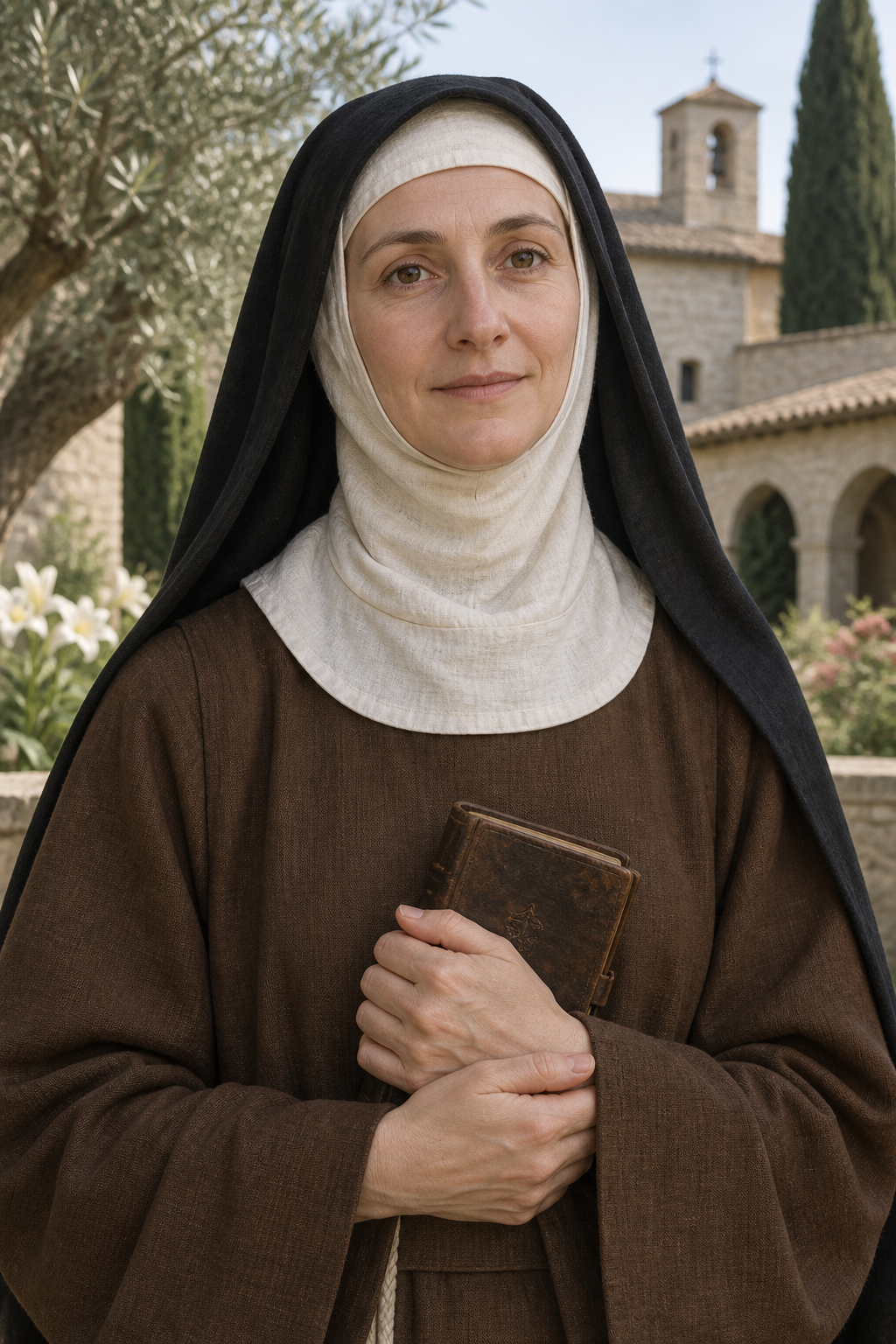
About Agnes of Assisi
Agnes of Assisi was the younger sister of Clare of Assisi and an early member of the community that developed at San Damiano. A scholarly biographical dictionary identifies their father as Favarone and says Agnes received the baptismal name Caterina. The same reference places her birth in Assisi around 1197, but no surviving birth record establishes an exact day.
Agnes entered religious life during the first years of the movement gathered around Clare and Francis of Assisi. The near-contemporary Legend of Saint Clare says she joined Clare sixteen days after Clare left home in 1212. It places the sisters together at Sant'Angelo in Panzo before their move to San Damiano. Because this account was written as hagiography rather than as a modern critical biography, its sequence is valuable early testimony but not a complete contemporary record.
The Legend describes male relatives trying to force Agnes home while Clare prayed nearby. It says Agnes became impossibly heavy, that her uncle's raised arm lost its strength, and that the attackers finally withdrew. These details belong to the text's miracle narrative and cannot be independently verified as physical events. Historically, the episode still preserves the memory that Agnes's choice met serious family resistance.
At San Damiano, Agnes shared a demanding form of communal religious life rather than pursuing an individual ministry. Clare's approved Form of Life required poverty, manual work, common decision-making, prayer, and attentive care for sick sisters. That rule reached final papal approval only in 1253, yet it records practices and commitments shaped through the community's earlier experience. It required the abbess to consult others on major decisions rather than govern by private will. Able sisters were directed to work faithfully without extinguishing the spirit of prayer. The abbess also had to ask what sick sisters needed and provide for them according to the community's means. It should therefore be used to describe the house Agnes belonged to, not to invent undocumented personal routines for her.
Agnes later left San Damiano to lead women at Monticelli near Florence. Riccardo Pratesi's biographical entry dates that mission to 1219, while the modern editor Regis Armstrong dates Agnes's surviving letter to about 1230 and places it roughly a year after her arrival. The chronology is therefore not secure enough to claim an exact departure year. What is well supported is that Agnes served as abbess at Monticelli and maintained her bond with Clare across the separation.
A letter from Agnes to Clare is the clearest surviving evidence in Agnes's own voice. Its Latin text and an English translation are preserved in the University of Siena's Epistolae database. Agnes addresses Clare and the San Damiano community with affection, describes the pain of bodily separation, and asks for their prayers. She also asks that Brother Elias visit and console her, evidence that her relationships extended across the women's and men's branches of the early Franciscan movement. The letter does not present a program of achievements; it reveals leadership carried with homesickness, dependence, and continuing friendship.
Later accounts credited Agnes with helping Franciscan women's communities beyond Florence. Treccani judges activity at Mantua and Venice probable, but the surviving evidence cited there does not establish precise foundation dates or a personal role at every house. Claims that she founded a long list of monasteries should therefore remain qualified. Her documented leadership at Monticelli is enough to show that the San Damiano experiment was already connected with another community during Agnes's lifetime.
Agnes eventually returned to Assisi. Later tradition links her return to Clare's final illness, although the sources reviewed here do not document a summons or its exact date. Arnaldo Fortini's archival study reports that Agnes died on 27 August 1253. Pratesi places her death in Assisi and calls the traditional date of 16 November less reliable. The packet therefore keeps 27 August as a probable death date while treating November dates as observances rather than proof of death.
Agnes's remains were later transferred from San Damiano to the new monastery beside the church of Santa Chiara, following the transfer of Clare's body. Benedict XIV later permitted the Franciscan Order to celebrate Agnes's feast. Treccani dates that permission to 1752; it was a recognition of longstanding veneration, not evidence for a separate modern canonization ceremony. A Vatican City State feature commemorates her on 16 November. An English Franciscan proper instead assigns her memorial to 19 November. Treccani's 1960 entry instead reports a 15 November feast, confirming that one undifferentiated feast field cannot represent every usage.
Agnes is remembered as a religious woman and abbess whose life cannot be reduced to being Clare's sister. The Monticelli mission placed her in responsibility for another community, and her letter records the emotional cost of that service without turning it into heroic legend. Her surviving words also provide rare direct evidence of affection and mutual dependence among women in the earliest Franciscan network. That combination of leadership, separation, and fidelity is her clearest historical significance.
Wondering how to weigh the stories and sources? Learn how to read a saint biography.
Explore similar vocations
Prayers for Agnes of Assisi
Agnes: collect excerpt
Lord God, who gave the holy Virgin Agnes as an example