Biography
Agatha Han Sin-ae
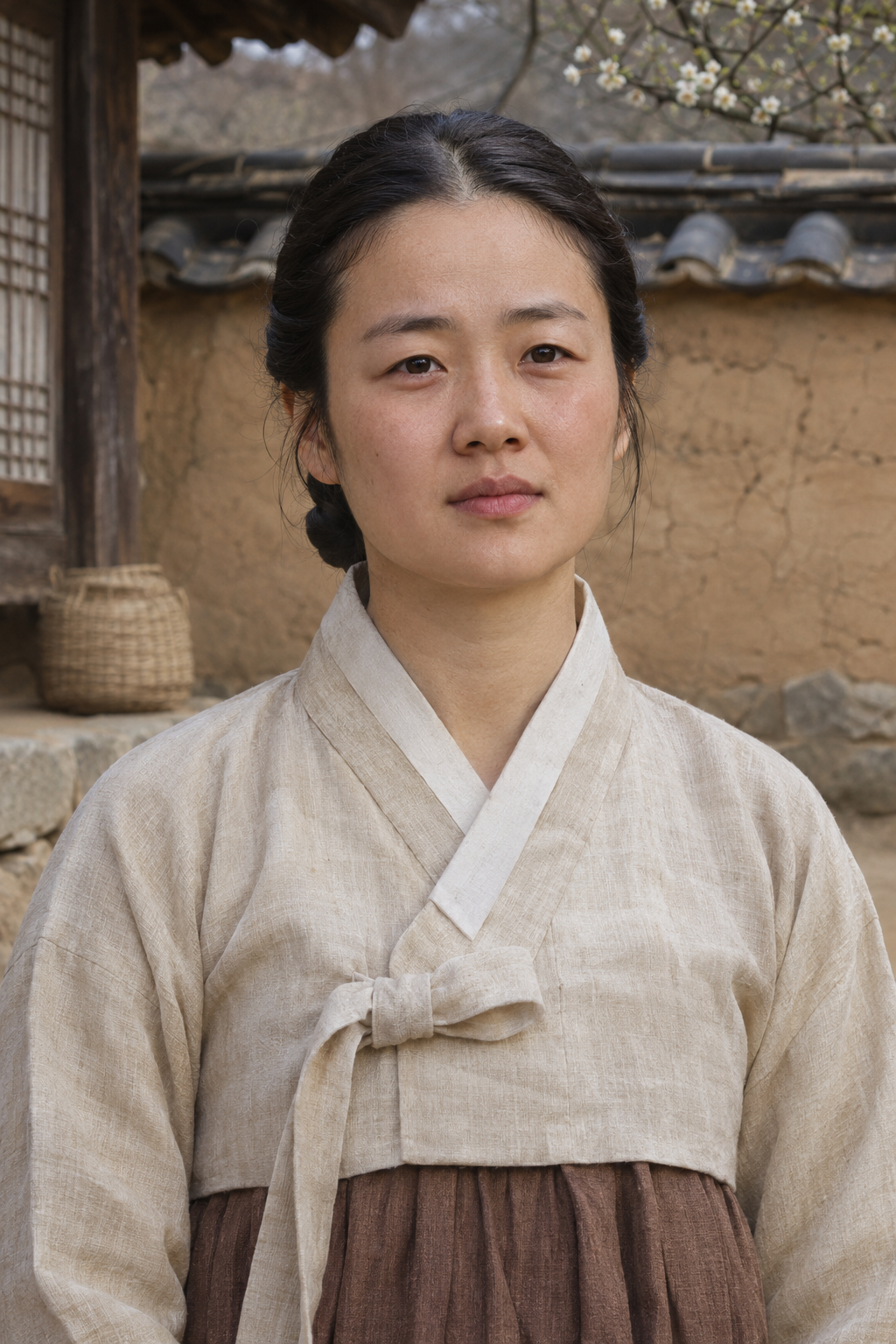
About Agatha Han Sin-ae
Agatha Han Sin-ae came from Boryeong in Korea’s Chungcheong Province. The daughter of a yangban father and a secondary wife, she later became a second wife in a Seoul household. The official biography names her husband as Jo Rye-san.
The Korean Catholic Encyclopedia calls her husband Jo Si-jong and names his daughter by his earlier marriage as Jo Hye-ui. Agatha and her stepdaughter learned Catholic doctrine together through Columba Kang Wan-suk around 1795–1796.
Agatha visited Kang’s house and helped with Church work alongside Candida Jeong Bok-hye. She sent her servant So-myeong there for instruction and practical assistance. James Zhou Wen-mo baptized her in the summer of 1800, several years after she began learning the faith.
Historian Jeong Min follows So-myeong’s later service in Kang’s household, where she helped with errands and daily work. Her years there link Agatha’s assistance with the labour that sustained the concealed Catholic community.
Her efforts to arrange instruction for her household met resistance. When she hoped to invite knowledgeable Catholic men to teach her servants, her son prevented the plan. Among other women, her work had greater success: Juliana Kim Yeon-i was among those she helped bring to Catholicism.
Candida was the person Agatha turned to when she wanted help teaching at home. Jeong Min identifies three of the men Candida brought there at Agatha’s request. One was Yi Hap-gyu, who had brought Candida herself into the Church. Another was Barnabas Jeong Gwang-su, who made religious objects with his wife. The third was Hong Mun-gap, the childhood name of Philip Hong Pil-ju. For Agatha, a friendship with a woman who moved readily between households opened a way to reach teachers she could invite into her own.
Yun Bok-jeom, Juliana and Candida all visited Agatha’s household.
After persecution began in 1801, Candida brought Agatha religious books and devotional objects gathered from believers. Agatha hid them in her storeroom. The encyclopedia records her arrest in the second lunar month and the confiscation of the materials.
Lee Min-hui compares the Chinese text read by Kim Geon-sun in 1789 with the Korean version found at Agatha’s house. For Lee, the Korean edition opened a book once read by scholars to women who read the vernacular.
The book was Ferdinand Verbiest’s Gyoyo seoron. The Jesuit had first published it in Beijing in 1670 as an introduction that a reader could follow step by step. It set out teachings about creation and the soul, then explained the Ten Commandments and the Apostles’ Creed before turning to prayers and baptism. By sheltering the Korean text, Agatha was protecting a book that could take someone through much of the instruction she and her stepdaughter had themselves received.
Even the way the authorities described the things they took can be misleading. In his annotated list, Ahn Gyo-seong explains that what looks like one long book title actually describes a Korean text copied inside an almanac with a blue cover. Another entry for things seized by the police refers to Korean writings tied together with a cord. Agatha had agreed to keep materials of different shapes and sizes, including manuscripts that someone had copied and bound by hand.
The list survives because the Ministry of Justice preserved a record of the pictures and books destroyed in the persecution. The Korean Catholic Encyclopedia distinguishes this record from an earlier order about a different case, printed in the same collection. Agatha and Barnabas Jeong both appear among the people from whom objects were taken. What the officials meant to remove from circulation can still be traced in the record of its destruction.
The range of books connected with her house also interested historian Cho Gwang. He singled out Cheokjoe Jeonggyu, a guide to examination of conscience and confession by the Jesuit Giulio Aleni. Cho explains its progression from examining conduct in light of the commandments to repentance, amendment and preparation for confession. His discussion helps explain why protecting religious texts mattered for Catholic practice. The presence of a title among confiscated materials does not establish that Agatha herself read every volume brought to her.
Park In-hui later used Agatha’s case in a wider argument about women and Korean-language religious literature. Park considers women likely participants in copying and circulating the Gospel commentary known as Seonggyeong Jikhae Gwangik. This is a scholarly inference about the community, not proof that Agatha personally copied that work. The distinction keeps her documented responsibility for sheltering books separate from an activity that the surviving notice does not individually assign to her.
Taken to the Ministry of Punishments, Agatha underwent repeated interrogation and punishment. The official account remembers her refusing to betray fellow believers. She was condemned with Kang, Juliana and other companions, then beheaded outside Seoul’s Small West Gate on July 2, 1801.
The historical dictionary names both the police office and the Ministry of Justice as places where Agatha was questioned. The two offices had taken up matters that began in the privacy of her home, from the people she welcomed to the objects she agreed to shelter. In 2014 Pope Francis beatified Agatha, whose work as a custodian of these books is still visible in the history of Korean Catholic reading.
Wondering how to weigh the stories and sources? Learn how to read a saint biography.