Biography
Agatha Yun Jeom-hye
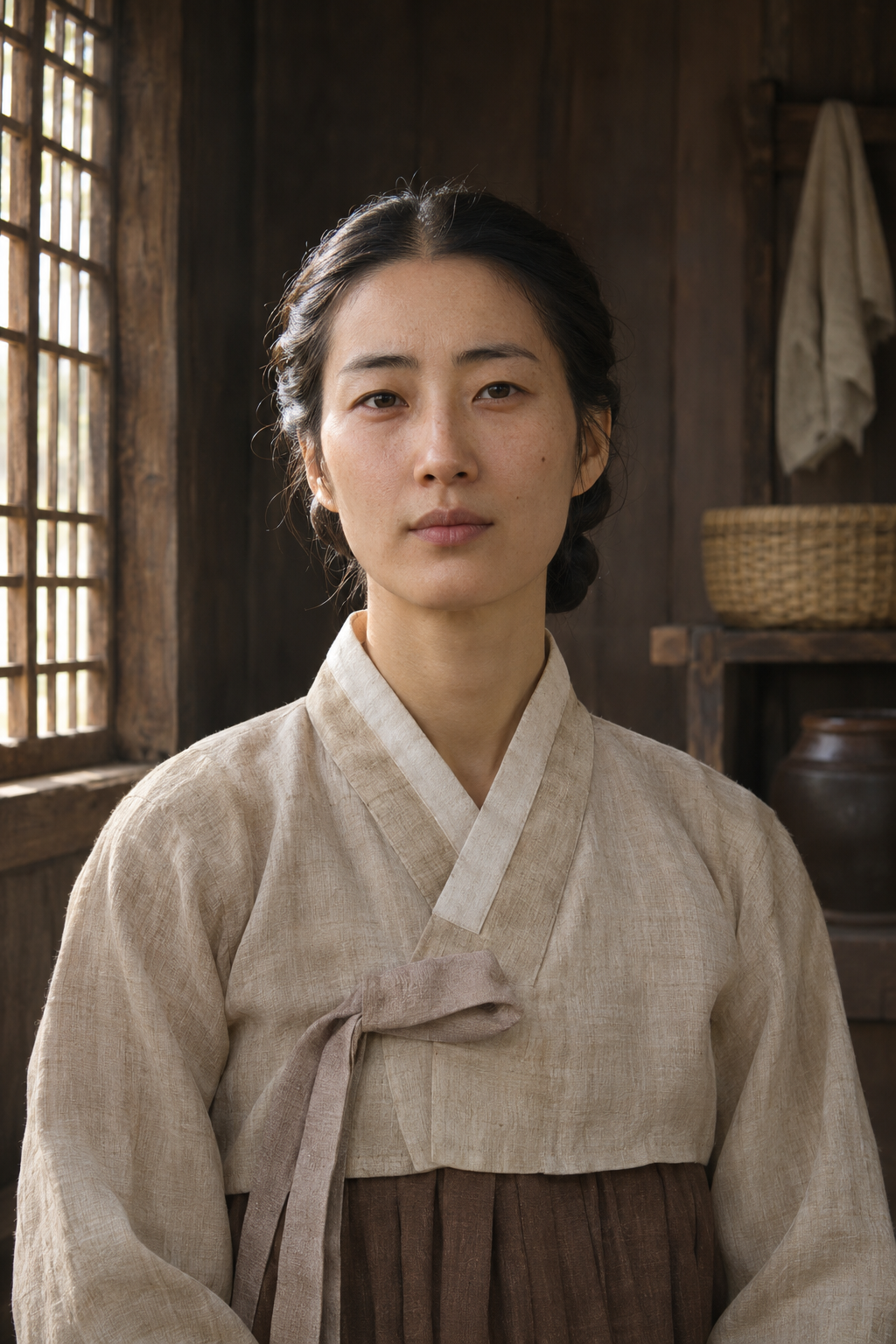
About Agatha Yun Jeom-hye
Agatha Yun Jeom-hye secretly made a man’s outfit from cloth prepared for her marriage and wore it to leave home. According to the Church’s biography, she sought refuge with her cousin Paul Yun Yu-il, determined to remain unmarried and devote herself to God.
She had learned Catholic doctrine from her mother, a woman of the Yi family. Paul Yun Yu-il was her cousin, and Lucy Yun Un-hye was her younger sister. The encyclopedia places her early home at Jeomdeul in Yeoju and records a later move with her father to Hangamgae in the Yanggeun area.
The first flight did not free her from these pressures. The encyclopedia relates that her cousin persuaded her to return after a few months. Back at home, she met criticism of her choice to remain unmarried, but did not abandon it. A more lasting move became possible after she heard of the arrival of the Chinese priest James Zhou Wen-mo. In 1795 she and her mother went to Seoul, where she could live closer to the Catholic community.
In Seoul she presented herself as a widow. Song Ji-yeon places this practice in its social setting: an unmarried woman was expected to marry, while a widow could be expected to remain unmarried. The appearance of widowhood offered Agatha a way to protect her commitment to chastity. Accounts differ about her first refuge: Song names Kang’s son’s house, while the official biography names her cousin’s home. Both describe her returning.
After her mother died, Agatha moved into Columba Kang Wan-suk’s household. She received baptism from Zhou in 1797. At his direction she became responsible for a community of unmarried women, teaching and guiding its members. The encyclopedia describes her as the group’s leader and stresses her attention to religious discipline.
One surviving notice shows another woman finding her way to the community Agatha led. The encyclopedia entry on Yu Han-suk mentions his help in introducing a relative named Agatha. Kim Gil-su’s account identifies her as Agatha Lee and says Yu protected her religious commitment before taking her to Agatha Yun in Seoul. The two Agathas should not be confused. The notice preserves a small but concrete example of the support offered through Yun’s community: a relative could help a woman reach a household in which she could continue unmarried religious life.
Her participation extended beyond the women’s household. Yeo Jin-cheon describes a gathering at the home of her brother-in-law, Barnabas Jeong Gwang-su. Jeong and neighboring Catholics had opened their adjoining properties and prepared rooms for Zhou’s teaching. Agatha joined Zhou, Kang and other believers there for three days and nights of religious observances and instruction. The named participants included Philip Hong Pil-ju, Anthony Hong Ik-man and Simon Kim Gye-wan. The account places her among people who sustained a network of meetings and teaching across Seoul.
Ri Gil-jae’s account places that work under the leadership of Kang and Zhou. Agatha’s religious practice included reading Scripture, meditation and self-discipline. The women met repeatedly through the month for prayers and observances, and took part in gatherings for religious instruction. The account describes her responsibility for other women alongside the routines by which she maintained her own faith. These were continuing duties in a shared household.
Her attachment to her mother continued after bereavement. A passage in the Korean Catholics’ 1811 letter to the bishop of Beijing recalls Agatha worrying that her mother had died without receiving the sacraments. It recounts a dream in which she saw her mother near Mary, followed by the priest’s advice to pray for her. The letter says she then prayed for her mother daily. The dream is a devotional recollection.
In 1801 the persecution reached the women’s community. Agatha was arrested with companions, questioned and punished in Seoul, and refused to abandon her faith. She was condemned and sent to Yanggeun for execution.
Go Eun-im’s study interprets the choice of women such as Agatha as a wish to practice their religion in daily life. It cautions against assigning them an elaborate modern political program. That reading distinguishes their own religious purposes from the authorities’ view that their conduct threatened the moral order.
She was beheaded on July 4, 1801. The official account preserves a fellow woman prisoner’s memory of her calm conversation and eating as death approached. That recollection accompanies the account of a life spent finding, and then helping to sustain, a place for women committed to unmarried religious life.
The Yanggeun shrine now includes Agatha among the Catholics remembered for lives rooted in that region. Its account places her execution there alongside those of other members of her extended religious network, including her cousin Yun Yu-o. The shrine identifies the former local government office, prison and riverside execution area as distinct places. Agatha’s story is thus preserved both in the memory of the household she helped lead in Seoul and in the region to which she was returned to die.
Wondering how to weigh the stories and sources? Learn how to read a saint biography.