Biography
Agathius
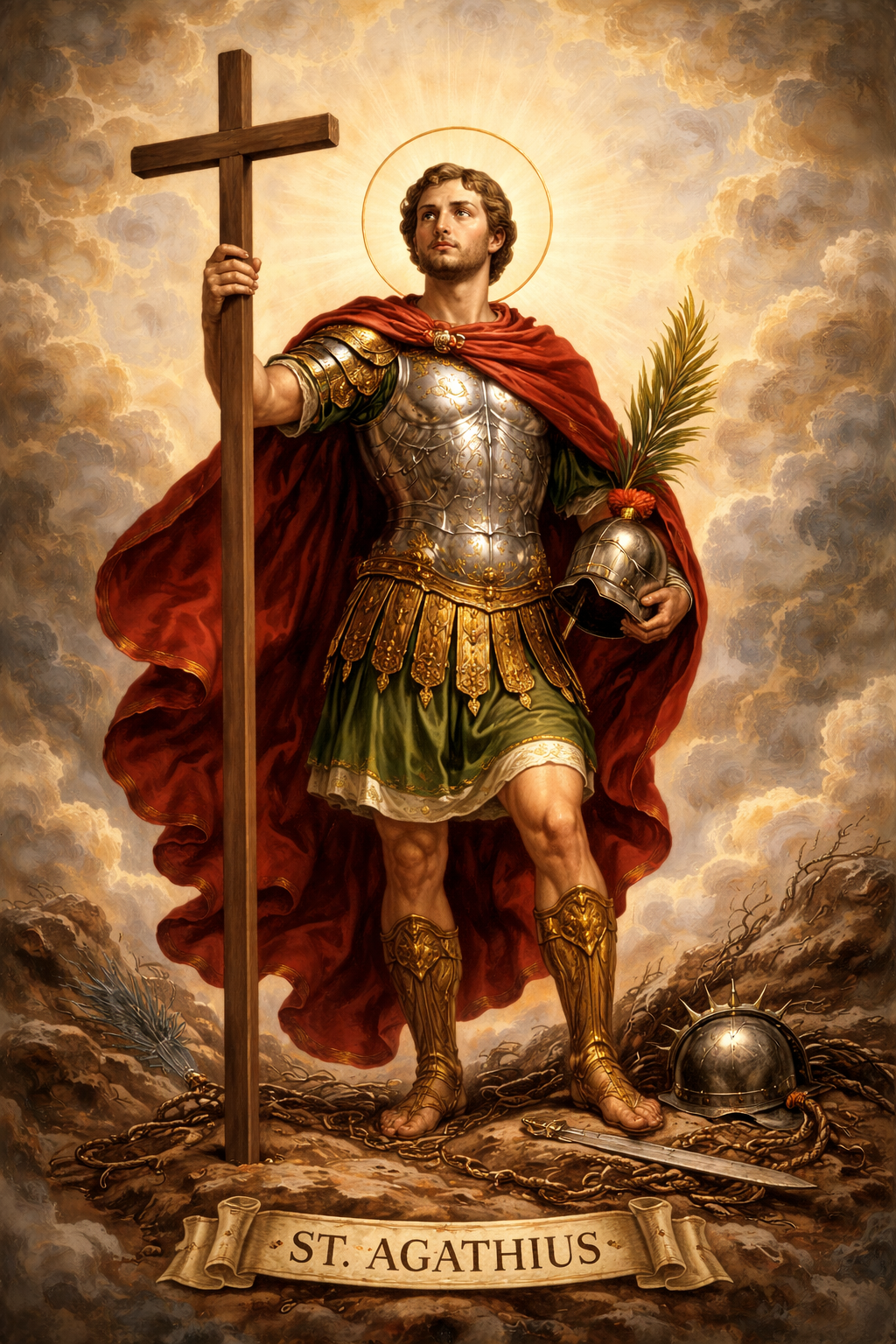
About Agathius
Agathius is the Western form used in this catalog for the martyr more often called Acacius or Achatius, a soldier associated by Christian tradition with Cappadocia, Thrace, and Byzantium. The surviving sources used here are liturgical and hagiographic, not contemporary military or judicial records. They agree on a centurion who refused to abandon Christianity and was executed, but they do not establish his childhood, family, exact age, or an independently verified service record. His story is therefore told as received martyr tradition, while the calendars that preserve his memory are treated as documented evidence of later commemoration.
The Orthodox Church in America’s life calls him Acacius and says he was born in Cappadocia and served as a centurion in the Martesian regiment under an officer named Firmus. It places the episode during persecution ordered by Maximian Galerius, whose reign it dates to 305–311, although the same life assigns Acacius’s death to 303. That chronological tension warns against pretending that the narrative is a precise dossier. The catalog clears the former birth year of 290 and records 303 only as a traditional approximate death year, without inventing a month or day from a feast.
According to that life, Firmus questioned soldiers about their religion and Acacius openly identified himself as a Christian. Firmus sent him to a superior named Vivianus, who subjected him to torture. The older Roman Martyrology similarly remembers a centurion denounced by the tribune Firmus and cruelly treated at Perinthus by a judge named Bibian. These parallel names and places show a stable outline within the tradition, yet agreement between later commemorative texts is not contemporary corroboration. The violence should be acknowledged without multiplying physical details beyond what the sources actually say.
The Eastern account continues that Acacius was chained, imprisoned, and marched with other prisoners toward Byzantium. It says the guards drove them rapidly and that wounds, chains, hunger, and thirst left him weak. During an overnight halt he offered thanks for being allowed to suffer in Christ’s name. This itinerary is useful as narrative geography only: Perinthus and Byzantium can be named at settlement level, but the source gives no recoverable road, stopping point, or coordinates. An interactive map must not draw a verified route from this compressed hagiographic movement.
Vivianus, the life says, sent the prisoner onward with a letter to the prefect Flaccinus. Flaccinus was irritated that the case had been prolonged and ordered beheading. The Roman Martyrology also locates the condemnation at Byzantium under a proconsul named Flaccinus. The OCA narrative portrays Acacius giving thanks at the execution place before bowing beneath the sword. Because no securely contemporary transcript survives in these sources, the packet presents only the traditional substance of his confession, not polished last words. It records steadfastness as a received action rather than inventing dialogue.
Later remembrance extends beyond the execution. The OCA says that under Constantine the Great the martyr’s relics rested in a Constantinopolitan church dedicated to him and were later transferred to Calabria, at Scillatio. The Roman Martyrology likewise says his body was brought to Syllacium and honored there, while adding a miraculous manner of transport. Transfer and cult are received ecclesiastical memory; miraculous transport is legendary, and no date for either movement is supplied here. No map event is created for the relic journey because its path and chronology are not responsibly recoverable.
Acacius became one of the Fourteen Holy Helpers in later Western devotion, commonly under the form Achatius. The catalog’s former patronage claims, including headaches and soldiers, are not retained because these sources do not adequately document their scope or jurisdiction. A devotional association should not be mistaken for evidence about his historical occupation beyond the centurion tradition. No prayer is imported: a helper-cult text would need an exact edition, tradition, translation, and rights review before entering the separate prayers table.
The two calendars also preserve a small but important difference. The OCA page commemorates Acacius on May 7, while the Roman Martyrology places Acathius on May 8. Neither date should be converted into an exact anniversary of death. They identify distinct liturgical observances, not competing modern historical measurements. Recording both keeps jurisdiction and calendar attached to the claim and avoids collapsing Eastern and Western practice into one supposedly universal feast.
Agathius remains significant because the tradition remembers a person whose public confession carried institutional and bodily consequences. His courage is not eagerness for violence; he is portrayed as refusing coercion, enduring transfer and deprivation, and maintaining gratitude when legal power was used against conscience. Historical restraint is part of honoring that witness. Readers can distinguish the durable outline of commemoration from names, chronology, speeches, and relic stories preserved only in later accounts. A practical imitation is modest: support someone facing pressure to violate a well-considered conviction, without exaggerating either the danger or one’s own role.
Wondering how to weigh the stories and sources? Learn how to read a saint biography.