Biography
Agnes of Prague
About Agnes of Prague
Agnes of Prague was born in Prague in 1211, according to the . The Vatican source presents her as a daughter of the Bohemian royal house and places her early formation in religious settings connected with her family and region. The existing catalog fields for birth year, Prague birthplace, female sex, and the alternate names Agnes of Bohemia and Agnese di Boemia are therefore supported by the reviewed source.
Agnes's early life was shaped by the dynastic expectations of a royal daughter. The Vatican biography describes marriage negotiations involving powerful families and rulers. A careful profile should not treat this only as court romance. In the reviewed source, these negotiations form the background for Agnes's religious decision: she chose consecrated life, poverty, and service instead of becoming a political bride.
That decision should be described without exaggerating private motives. The Holy See source presents Agnes as actively seeking a religious vocation and as receiving ecclesial support for that choice. The profile can say that she resisted dynastic marriage expectations, but it should avoid invented dialogue or inner scenes. What is secure is the public outcome: Agnes did not enter the planned marriages and instead founded works of charity and religious life in Prague.
The Holy See biography also describes Agnes's charitable and institutional work. In Prague she supported a hospital and helped form the religious community that became the Crosiers of the Red Star. This matters for the public profile because Agnes was not only a woman who refused marriage. She used her position and resources to build lasting structures of care, especially for the poor and sick.
This hospital work belongs near the center of the biography. It shows how royal resources were redirected into public mercy rather than only into private piety. The catalog should not reduce Agnes to a symbol of renunciation. Her holiness in the reviewed source also appears through administration, foundation, and durable service to vulnerable people.
In 1234 Agnes entered the monastery of Poor Sisters in Prague. The Vatican source connects this monastery with the Franciscan movement and with the model of Clare of Assisi. The profile can describe Agnes as a Poor Clare or Franciscan woman religious, while remembering that the exact terminology of early Franciscan women's communities developed over time. For the catalog class field, Monk / Nun and Virgin remain appropriate.
Agnes's relationship with Clare of Assisi is one of the most important features of her spiritual profile. The preserves letters attributed to Clare to Agnes. Those letters should not be mined for long quotation in this base packet, but they support the fact of a serious spiritual correspondence. The final profile can say that Agnes and Clare were linked by Franciscan friendship and shared commitment to poverty.
The letters also help future editors avoid treating Agnes as isolated in Prague. Her vocation belonged to a wider Franciscan movement in which women corresponded across distance about poverty, fidelity, and religious life. The base profile should mention the relationship while deferring exact excerpts until the letters themselves receive passage-level citation review.
The reviewed sources present Agnes as an abbess and founder whose religious life remained tied to Prague. A careful biography should avoid romanticizing poverty as aesthetic minimalism. In Agnes's case, poverty was bound to a concrete Franciscan vocation, institutional charity, and community leadership. She did not simply abandon the world; she redirected royal status into a religious form of service.
Agnes died in Prague on March 2, 1282. The Holy See biography supports the existing death date and place. It also records later recognition of her cult in 1874 and her canonization by Pope John Paul II on November 12, 1989. Those later recognition events should be kept distinct from the medieval life itself, but they explain why her profile belongs in a modern Catholic catalog.
The 1989 canonization also should not be treated as a medieval event. It is a modern act of recognition after centuries of local and Franciscan memory. A good event set can therefore include both the medieval foundations and the modern canonization, while keeping them in their own chronological layers.
The final record should present Agnes as a royal Bohemian woman who became a Poor Clare, founded works of charity, corresponded spiritually with Clare of Assisi, and governed a religious community in Prague. It should leave exact feast observance, patronage, coordinates, long excerpts from Clare's letters, and detailed political genealogy for separate review. This gives readers a clear and cited life without turning the page into either royal legend or a history of medieval diplomacy.
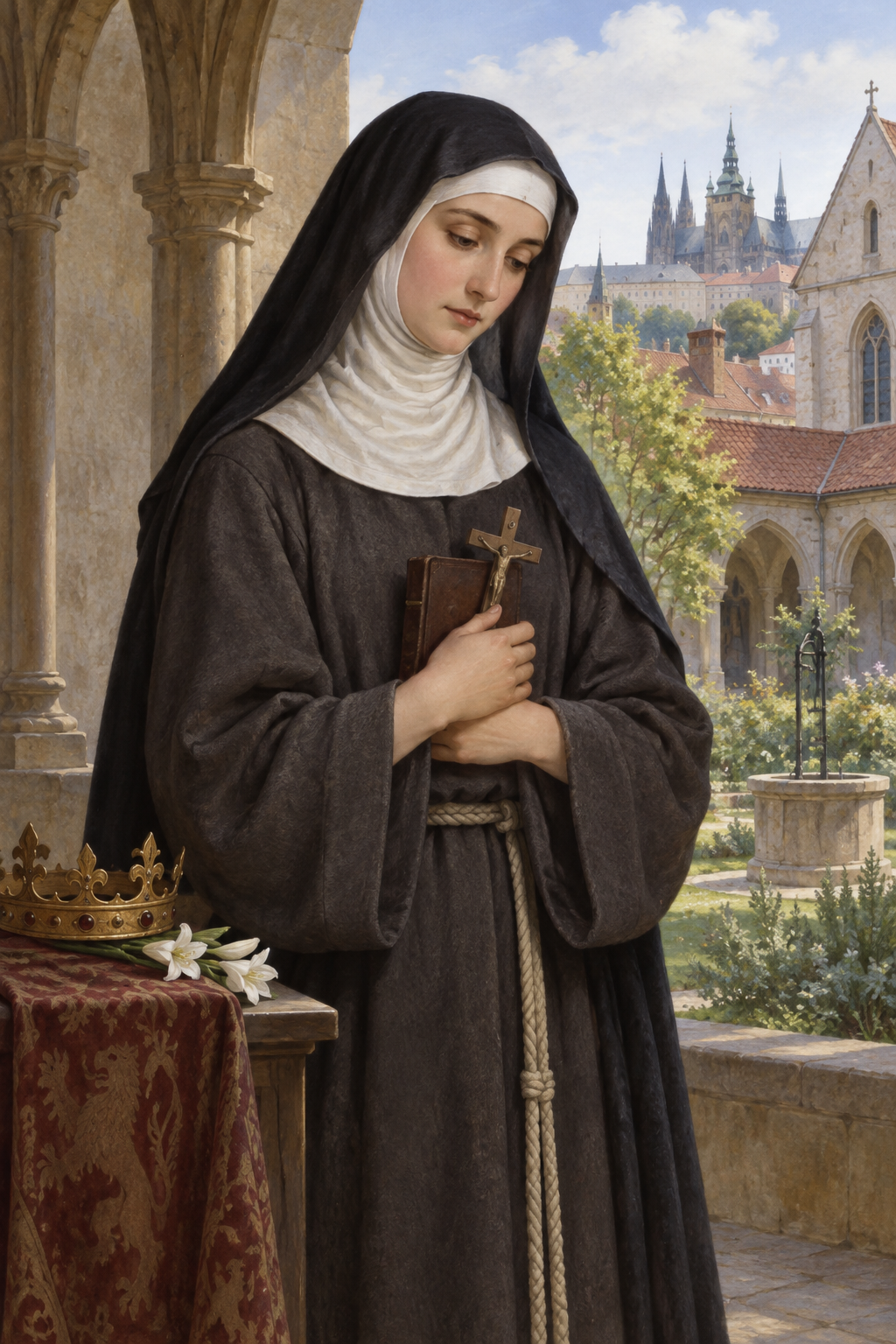
The artwork and public events should reflect the same balance. A crown set aside is useful as a visual shorthand only if the prose makes clear that Agnes's life was more than rejected royalty. The strongest profile will show conversion of status into service: hospital care, Franciscan poverty, religious leadership, and spiritual friendship.
Wondering how to weigh the stories and sources? Learn how to read a saint biography.