Biography
Agnes of Rome
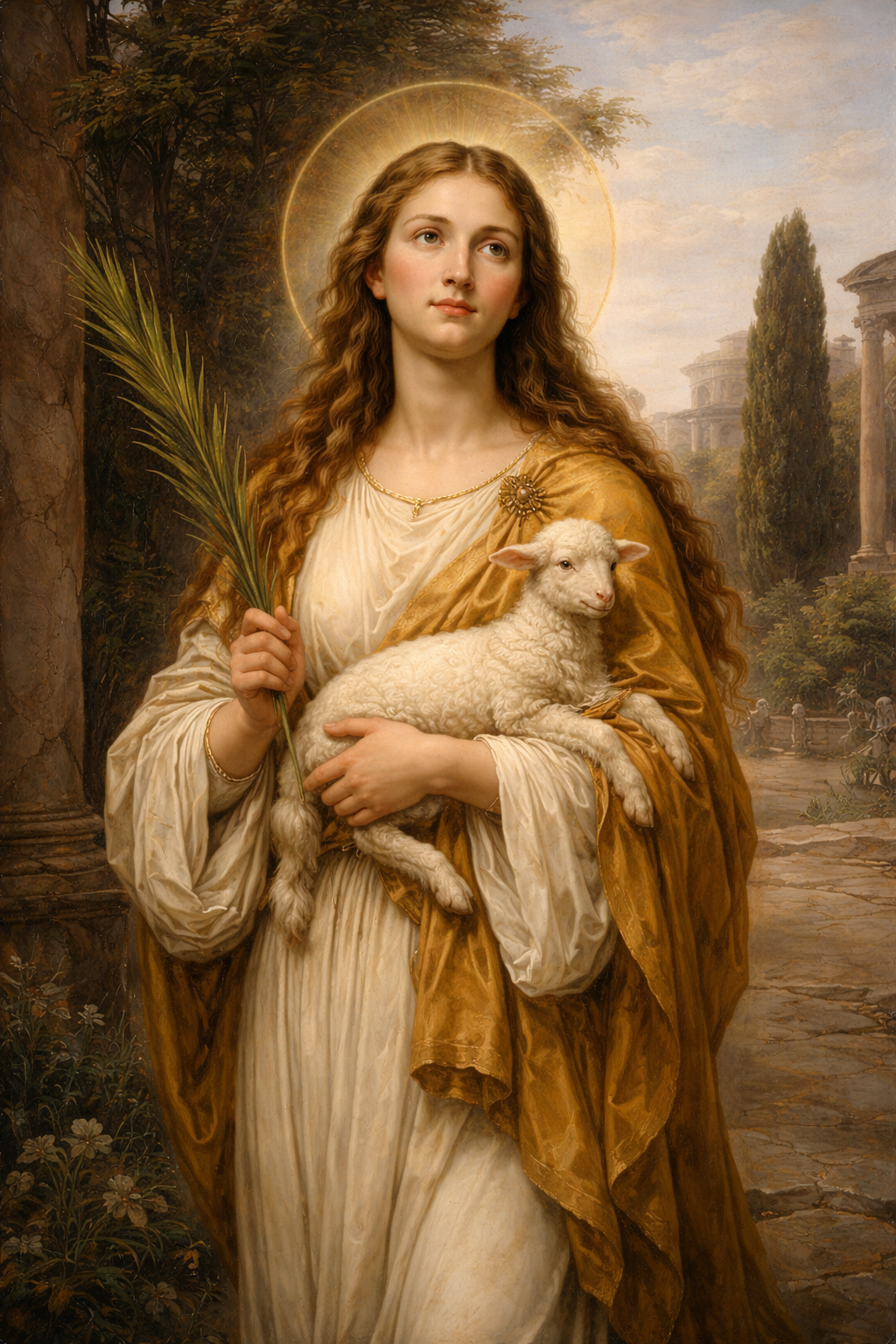
About Agnes of Rome
Agnes belongs to the generation of Christians remembered after the last great imperial persecutions, but no contemporary account identifies her family, birth year, education, or the officials who condemned her. What can be said with confidence is narrower and more important than the elaborate story later attached to her name. By the later fourth century, Christians at Rome honored Agnes as a young virgin who had died for her faith. Pope Damasus composed an inscription for her burial place, Ambrose of Milan preached about her on her feast, and the poet Prudentius wrote a hymn about her tomb and martyrdom. These witnesses are early, yet they wrote decades after the death they commemorated.
Damasus's epigram is the briefest of the three early narratives. He says that a report handed down by parents told how Agnes left the care of a nurse when a trumpet announced the moment of violence. She faced threats and chose, in the poem's Christian language, to overcome the tyrant. Damasus also says that she covered herself modestly when fire surrounded her. The inscription documents what Roman Christians of Damasus's day were saying at Agnes's shrine. It does not function as a court transcript, and its reference to fire differs from later accounts of death by the sword. Even so, it firmly associates her memory with Rome, youth, resistance, and martyrdom.
Ambrose wrote about Agnes in 377, presenting her at the opening of a work on consecrated virginity. He calls the day her heavenly birthday and describes her as both virgin and martyr. His famous statement that she was twelve years old is the source of the familiar image of a child facing adult power. He depicts her refusing threats and promises, approaching execution without fear, and maintaining bodily modesty when spectators watched. Ambrose's purpose was exhortation rather than detached biography. His evidence shows that Agnes's youth and chosen virginity were already central to western Christian memory, but it cannot establish her exact age as a modern civil record would.
The same sermon emphasizes a striking reversal of expected roles. Ambrose asks how a child could have learned to answer danger with such steadiness when children ordinarily trembled before an angry parent. He portrays executioners as fearful while Agnes remains composed. That rhetoric should not be mistaken for access to her private thoughts. It does, however, preserve the action for which she was remembered: she did not abandon her Christian commitment when threatened with death. No authentic words spoken by Agnes survive. Quotations assigned to her in later passions therefore belong to literary tradition, while Ambrose's own description can be quoted as a witness to her fourth-century reception.
Prudentius wrote around the turn of the fifth century and knew Agnes's tomb as a place of prayer near Rome. His poem says that she was scarcely old enough for marriage, resisted commands to worship idols, and was exposed publicly before being killed by a sword. It adds a threatening brothel, a protective radiance, the blinding of an aggressive young man, and his restoration through prayer. These dramatic episodes became influential, but they are hagiographic scenes in a poem written roughly a century after the presumed persecution. They should be read as evidence for the developing tradition, not as independently verified events. The poem and Damasus also disagree about the instrument of death.
Later retellings supplied still more detail: noble parents, rejected suitors, a prefect's angry son, miraculous hair, and links to named emperors. None appears consistently in the earliest evidence used here. Even the familiar year 304 is a conventional placement during the persecution associated with Diocletian, not a date stated by Damasus or Ambrose. January 21 is secure as Agnes's long-established liturgical commemoration, but a feast day is not by itself proof that she died on that civil date. Historical care therefore leaves her birth unknown and marks the death year approximate while retaining Rome as the setting of both martyr memory and burial cult.
Agnes's burial place on the Via Nomentana became a durable center of devotion. Prudentius opens his hymn by locating her tomb at Rome and describing people who came there in prayer. Modern scholarship catalogues this passage as evidence for a late-fourth-century cult site. The precise archaeology and successive church buildings require separate study, so this account does not assign an exact map coordinate or claim that every visible structure dates to Agnes's lifetime. The safe geographic conclusion is that Roman Christians commemorated her at a burial shrine outside the ancient city's walls. Her story was carried outward through preaching, poetry, calendars, and the naming of churches.
Agnes remains significant because her memory can be traced unusually early even though her personal biography is sparse. Damasus, Ambrose, and Prudentius do not give one seamless report; together they show a Roman martyr tradition growing through inscription, preaching, pilgrimage, and poetry. Churches continue to distinguish her as virgin and martyr, and the Church of England calendar calls her a child martyr at Rome. Responsible remembrance neither dismisses that tradition nor repeats every late marvel as history. It recognizes a young Christian whose refusal became central to Roman devotion, while allowing the gaps and disagreements in the evidence to remain visible.
Wondering how to weigh the stories and sources? Learn how to read a saint biography.