Biography
Albert of Genoa
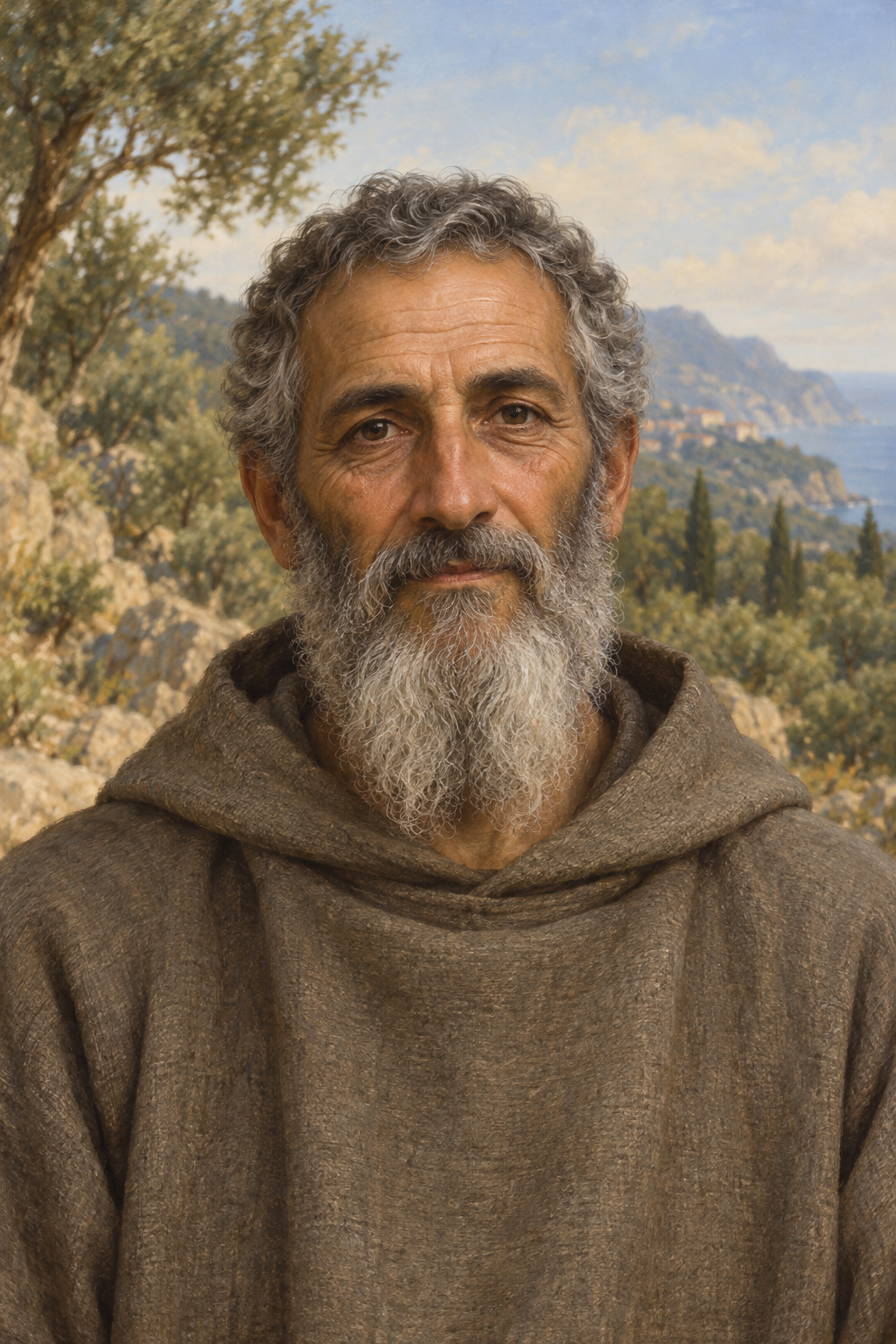
About Albert of Genoa
Albert of Genoa is locally venerated as a religious brother and hermit associated with Sestri Ponente. The Genoese diocesan proper remembers his service in the kitchen of Sant’Andrea, a Benedictine monastery that later adopted the Cistercian reform, and his care for poor people. It describes his later solitary life on Monte Contessa. This is the Church’s received account of his life; it does not provide contemporary evidence for every episode.
The sanctuary’s account acknowledges that few historical details are certain. It preserves traditions of prayer, penance and hospitality, together with stories of extraordinary provision and a sea crossing on a cloak. The account itself notes that the cloak story occurs in different settings in different biographies. These are devotional narratives whose changing forms should remain visible, rather than descriptions of independently verified miracles.
The sanctuary also presents a presumed canonization by Pope Innocent IV in 1244, while its opening chronology states that claim more firmly. No corresponding papal act was reviewed here. The proposed record therefore recognizes Albert’s documented local veneration without assigning a formal canonization date. Precise birth and death dates are likewise left out of the structured record.
There is an earlier witness to his local remembrance. Arturo Ferretto’s 1904 edition of the historical annals of Sestri summarizes a testament dated 30 September 1216 in which Aidela, wife of Alberto Negrino, left five soldi to Sant’Alberto de Sesto. Ferretto cites the notarial register and uses this entry to challenge later accounts placing Albert’s life in the thirteenth century. The evidence reviewed is the published summary and commentary; the original notarial manuscript was not independently inspected.
That distinction helps keep the account proportionate. The testament supplies evidence about local remembrance, while later lives describe the saint’s character and wonders. Ferretto’s criticism does not establish an exact birth year, age or death date. Those separate kinds of evidence can be read together without making the later narrative into a contemporary biography.
In the diocesan proper, his observance on 8 July is an optional memorial across the archdiocese and a solemnity in Sestri Ponente, where he is named patron. The local sanctuary preserves his memory and the prayers associated with it. Albert’s continuing place in Genoese Catholic life is clearer than the details of his personal chronology.
Wondering how to weigh the stories and sources? Learn how to read a saint biography.