Biography
Alberto Adamo Chmielowski
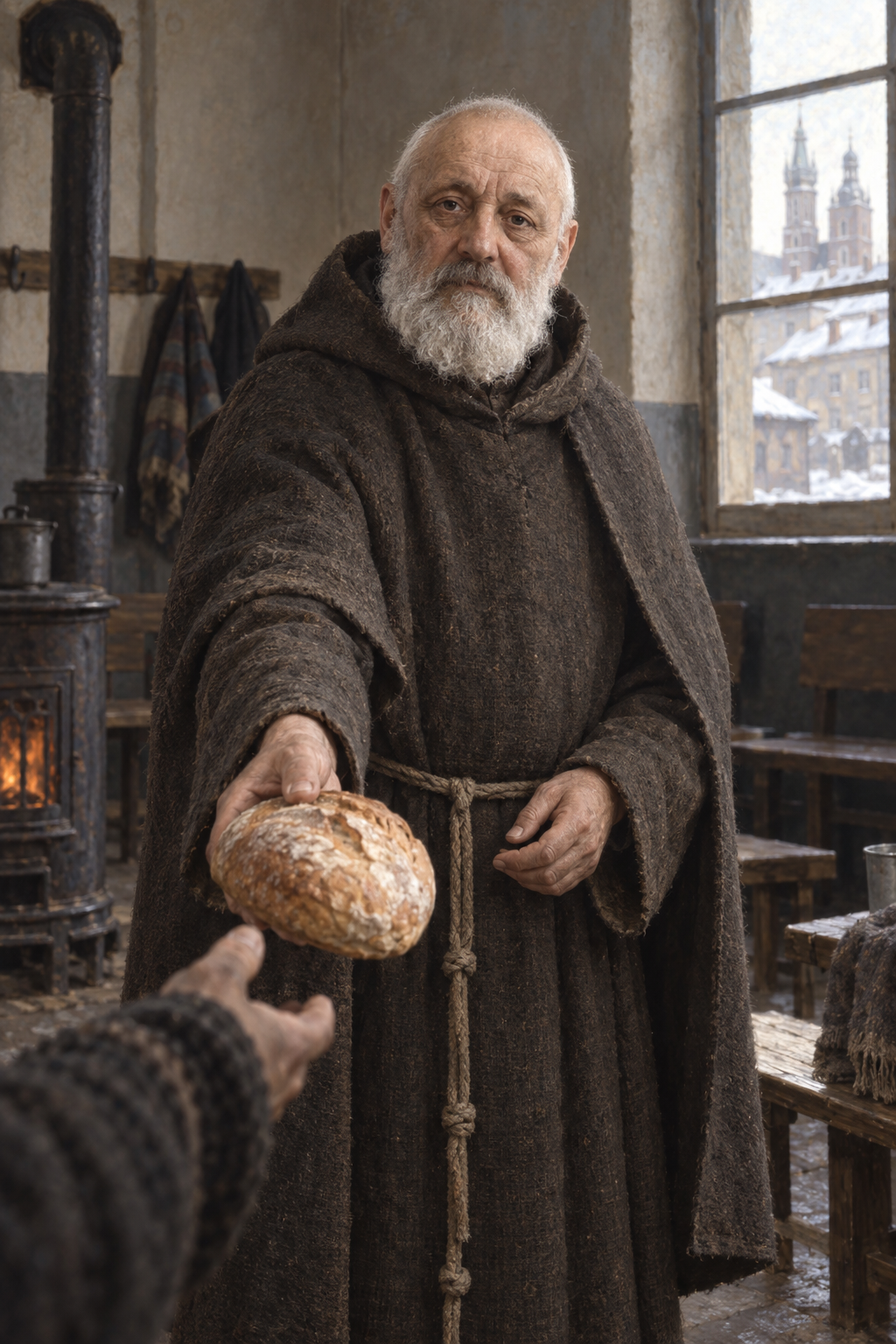
About Alberto Adamo Chmielowski
Albert Adam Chmielowski was born Adam Hilary Bernard Chmielowski on 20 August 1845 at Igołomia, near Kraków. His parents came from a family of limited landed means, and he was the oldest of four children. After both parents died, relatives and guardians helped direct his education. A Kraków parish biography traces his moves through school in Warsaw and agricultural study at Puławy. This beginning does not predict an inevitable future as either an artist or a religious founder. It places him among young Poles whose lives were shaped by a divided country, constrained opportunities and a family struggling to care for children after early loss.
As a student at Puławy, Chmielowski joined the January Uprising against Russian rule in 1863. The Polish Institute of National Remembrance hosts a detailed account by Sister Krzysztofa Babraj describing student organization, training and successive insurgent groups. It distinguishes stages that short saint biographies compress. Chmielowski fought with fellow students and later under other commanders; his participation was part of an armed political struggle, with casualties and imprisonment, not merely a picturesque episode on the way to sanctity. He was wounded at Mełchów on 30 September 1863, lost a leg and subsequently left the country. This injury remained a physical fact throughout his adult artistic and charitable work.
After exile, he studied and pursued painting in several European cities, including Paris and Munich. Art historian Irena Kossowska describes his Munich circle, his attention to older masters, and his engagement with realism and poetic historical subjects. He also painted memories of insurgent life without making every scene into a grand heroic tableau. In Warsaw, fellow artists visited a shared studio, and he wrote an essay on art's purpose in 1876. The surviving works cover portraits, landscapes and religious themes. His artistic career was therefore sustained and intellectually serious, not a passing hobby that can be dismissed once he later changed course. Some works were lost, so the surviving catalog cannot provide a complete record of his production.
The painting *Ecce Homo* became a point of reflection in later accounts of his life. The John Paul II Documentation Center says he began it in Lviv in 1879, worked further on it after moving to Kraków in 1884, and completed it over a long period. It depicts the suffering Christ. The center traces the painting's later place at a Kraków sanctuary with the remains of Brother Albert and an Albertine leader. Interpretations of the image connect his view of Christ with his later choice to live among poor people. The painting itself is a documented work; a neat causal claim that one afternoon of painting instantly produced his vocation would go beyond the chronology of its making and his gradual choices.
After a brief Jesuit novitiate and illness, Chmielowski resumed painting and served poor residents in Kraków. In 1887 he took the name Brother Albert; the brothers' community developed with collaborators.
A Lublin charity named for Brother Albert describes how he and his companions took responsibility for a municipal warming room and made it into a shelter. The account says he first imagined associations shaped by Franciscan Third Order practice, rather than setting out with a detailed plan for a new order. The shelters offered warmth and company as well as food. Poor and unhoused people were not only recipients of goods from a distant benefactor; Albert lived under the same roof. The movement later formed communities of brothers and sisters and reached other Polish towns. Its institutional history needs care: a beginning in 1887, vows and organization in 1888, and a women's branch in 1891 name distinct stages of the work.
The Dicastery describes shelters as places for both material support and work, with residents and religious members sharing a dwelling. That model could offer more than a bed for one night, though the sources do not allow a numerical claim about how many lives it changed. Accounts of Brother Albert insist that his choice to stay with people in severe poverty was central to the work. A present-day Brother Albert Aid Society remembers his service as presence as much as distribution. That is an institutional interpretation, but it reflects the documented fact that he moved into the warming house rather than remaining a visitor. The residents' own voices are less visible in these sources, a limit to what the narrative can claim about individual outcomes.
John Paul II later wrote personally about Chmielowski in *Gift and Mystery*. He said the painter and one-legged veteran had influenced his own discernment as a young man interested in theater and art. The pope also recalled writing a play about Brother Albert, *Our God's Brother*. These statements tell us about the saint's reception in twentieth-century Poland and in Wojtyła's life, not about Albert's private motives in the 1880s. The pope saw in him a choice to give himself to people in Kraków's public dormitory, and used that example to explain his own decision to leave artistic ambitions for priesthood. The historical link is one of later influence, not a claim that their life paths were identical.
Brother Albert died in Kraków on Christmas Day 1916. He had served in poor shelters for almost three decades. Later community memory emphasizes the funeral's wide attendance, including people who had depended on his work. That is a retrospective account and cannot substitute for a list of every person present. The Church opened his cause in Kraków in 1934, paused during the Second World War and resumed inquiry in 1949. John Paul II beatified him on 22 June 1983. These dates show how a local reputation developed through investigation into an official public cult. The Church's approval does not erase the broader political and artistic phases of his life.
John Paul II canonized him on 12 November 1989 at the Vatican Basilica. In the homily, the pope recalled the youthful uprising, the mature artist and the brother who made himself a companion to people without homes. He spoke of sharing bread and shelter through service, giving the charitable work a Franciscan and biblical interpretation. The memorial date is 17 June, not the day of Albert's death. A responsible account of Chmielowski keeps these strands together: the disabled veteran of a failed uprising, a serious painter, a man who tested different religious paths, and a founder whose community still names itself for the poorest people it serves.
Wondering how to weigh the stories and sources? Learn how to read a saint biography.