Biography
Aldegund of Maubeuge
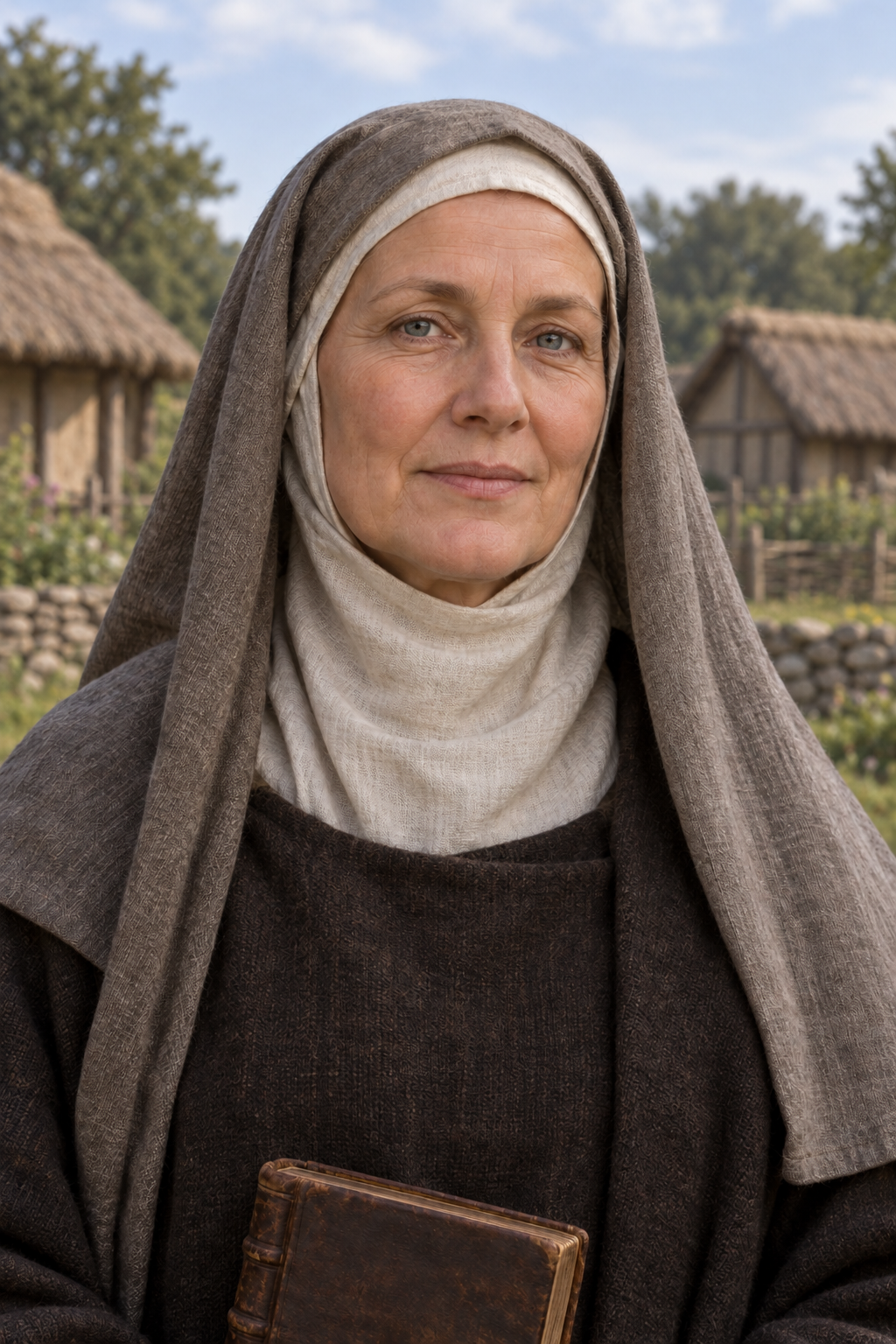
About Aldegund of Maubeuge
Aldegund of Maubeuge was a seventh-century abbess remembered for organizing a religious community in the region of the Sambre. Catholic tradition honors her as a saint and commemorates her on 30 January. Nominis presents her as the founder of Maubeuge and the sister of Waudru, whose own religious life influenced her. Its account also tells of a rejected marriage and a flight to an isolated place where other women joined her. That received story should be read alongside the earlier evidence, which is less explicit about how the community began.
Her earliest life presents a woman of noble family. It names her parents and praises her fasting, prayer, charity, vigils and attention to reading. The author gives her a speech explaining her desire to serve Christ instead of marrying. This is a hagiographer’s account, written to commend a holy life; the speech is not a surviving transcript of a family conversation. Its purpose is visible from the opening invitation to celebrate the saints and learn from their examples.
The same work says that Aldegund related her visions to Subne, an abbot of Nivelles, and had an account read in the author’s presence. Its final chapter reports wonders associated with her death and says that the author came to the community three days afterward. These statements belong to the narrative’s own claim to proximity. They preserve an early tradition of her religious experience without independently establishing supernatural events.
Anne-Marie Helvétius’s critical study argues that this first life was written in the early eighth century by a learned religious man who had met Aldegund. She challenges readings that make its author a little girl or treat the visions as demonstrably written in Aldegund’s own hand. Other scholars have dated or interpreted the text differently. The distinction matters because the date and character of a biography affect how much weight its details can bear.
Helvétius also separates the first life from later accounts of escape from a suitor. It does not name Maubeuge or explicitly recount the foundation. Her study nevertheless treats Aldegund’s role in organizing the community as credible and identifies evidence for women and men living in a double monastery. She cautions against assigning it one precisely defined monastic rule: its arrangements drew on the varied practices of its time.
Helvétius discusses a reconstruction placing her death around 684.
Her exact chronology remains unsettled. H. Dressler’s New Catholic Encyclopedia entry places her death in 695 or 700. That entry also describes the biographies as substantially legendary. Those disagreements make a precise life timeline less secure than her identity as Maubeuge’s early abbess. Her successor Aldetrude appears in that reference as a niece whom she had helped form in religious life. The family setting is part of the received historical picture, even where exact years remain uncertain.
Dressler distinguishes these difficulties from the strength of her continuing cult. His account describes long-standing veneration and the invocation of Aldegund by people facing illness, including cancer. Such devotional patronage records how communities sought her intercession; it does not establish a retrospective medical diagnosis or document a cure. Her remembrance holds together the image of a woman directing a community and the prayers of later generations who found hope in her example.
Wondering how to weigh the stories and sources? Learn how to read a saint biography.