Biography
Alessandro Sauli
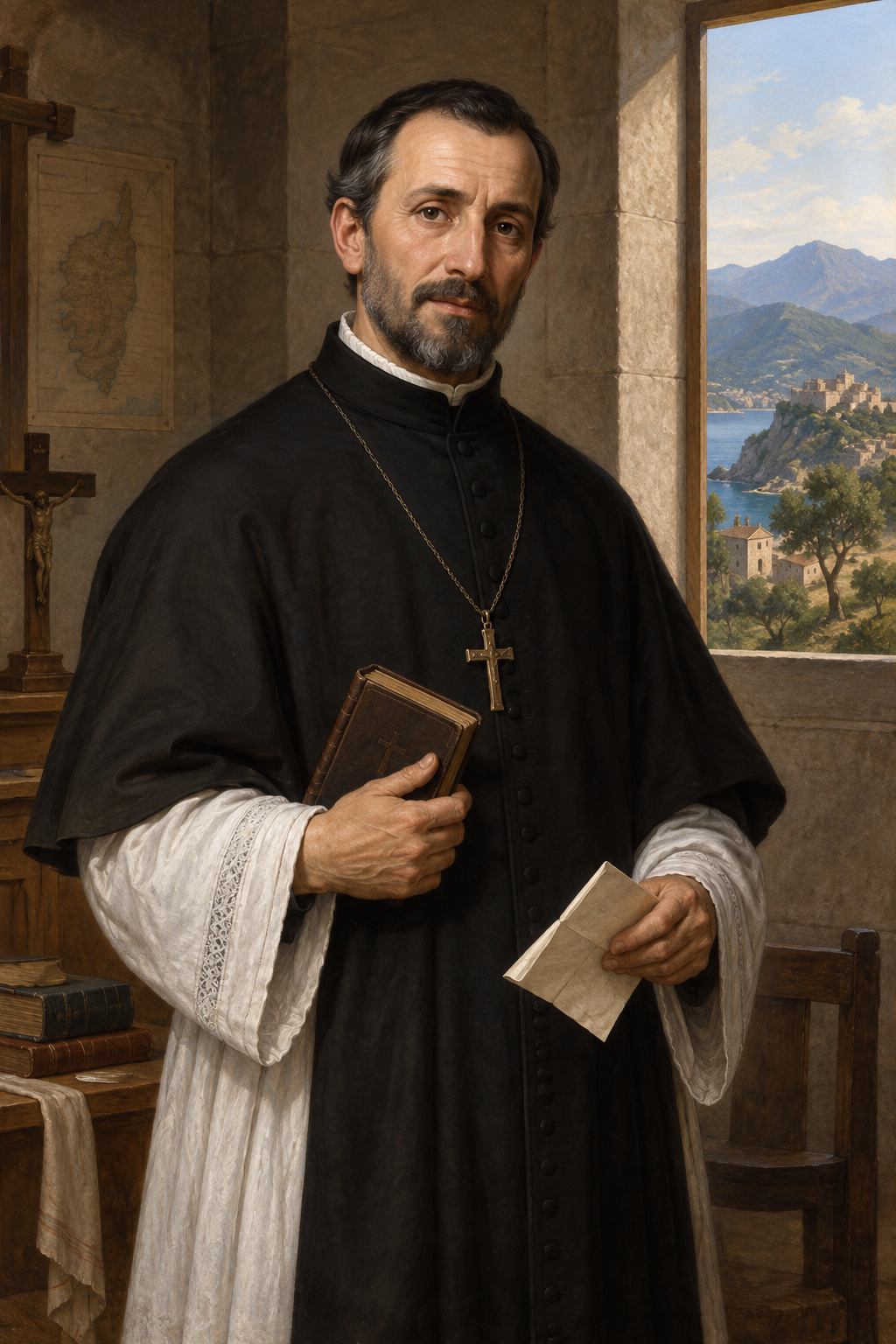
About Alessandro Sauli
Alessandro Sauli was born on 15 February 1534 in Milan to a family with Genoese roots. He studied at Pavia and spent time as a page at the imperial court. That path could have led him into public service through family connections. Instead, at seventeen he sought admission to the Clerics Regular of Saint Paul, known as Barnabites. His education was useful in the ministry he later undertook among students and fellow clergy. The reference account places those choices in a well-connected household; Sauli's decision to enter religious life did not erase the learning and relationships formed there.
The Barnabites remember a public test of Sauli's resolve in May 1551: he carried a cross through Milan while dressed as an imperial page. Their institutional narrative says he was accepted as a postulant, received the habit on 15 August 1551 and professed vows on 29 September 1554. The cross episode has the shape of a lesson about renouncing status; the dated stages of entrance and profession are more useful for chronology than the drama alone. He was ordained a priest in 1556 and worked at Pavia. The congregation's account recalls children gathering for religious instruction and university students seeking help. These activities joined public ministry with a demanding program of study.
In Pavia, Sauli taught and preached among a developing Barnabite community. Orazio Premoli's reference entry describes him sometimes substituting for university teachers while he pursued theology. The account dates his doctorate to 1563, while a later biographical dictionary gives 1560; neither disputed year is needed to understand his work. He became known for instruction that linked learned subjects to care for lay people and new clergy. Pavia was not simply a stop before Corsica. It was the place where he helped shape courses for fellow Barnabites, met students and formed relationships that would matter when he returned as bishop decades later.
Sauli was elected superior general of the Barnabites at thirty-three. In that office he continued forming younger members and donated his library to the college. He also resisted a proposed union with the Humiliati. The choice shows a leader considering the character and capacity of a small congregation while larger institutions were changing around it. Charles Borromeo, archbishop of Milan, counted Sauli among his collaborators in reform. Sauli's years as general were short, yet they placed him at the center of decisions about education and the order's future. The exact election date, 7 April 1567, comes from the separately cited biographical dictionary.
Pius V appointed Sauli bishop of Aleria in Corsica in February 1570. Charles Borromeo consecrated him in March, and he reached Bastia on 30 April. His own letters, quoted in a scholarly biography, describe damaged buildings, difficulty finding a settled residence and the limited education of some local priests. Those letters are evidence of what Sauli observed and reported, not a warrant to describe every Corsican cleric or layperson in the same terms. Corsica was then under Genoese rule and had endured conflict, food shortages and disease. The bishop's work needed both ecclesiastical reform and practical attention to communities whose infrastructure was fragile.
Sauli used visits, synods, letters and instruction to build a more stable diocese. Educational historians Marie-Madeleine Compère and Dominique Julia trace his seminary from early movable sites to a purpose-built home at Cervione in 1578. Their study names Tallone, Bastia, Algajola and Corte among its earlier locations. Clerical students were received without charge, while some others paid for boarding. That detail places formation inside a practical economy; buildings, teachers and food were necessary before decrees could have an effect. The authors also show that the seminary's later life was uneven. It should not be described as a permanently solved problem simply because Sauli established it.
The 1579 famine tested a different part of the bishop's work. A Barnabite account says he brought supplies from Genoa to Corsica and helped distribute them. During the plague of 1580, he stayed while members of his household became ill. These descriptions should not be inflated into a claim that his presence ended disease or hunger. They show his effort to move food and remain responsible during public distress.
In 1591 Gregory XIV transferred Sauli to Pavia. Simona Negruzzo's study describes the city as familiar from his earlier teaching years yet changed after more than two decades. She argues that the brief Pavia episcopate continued reform through pastoral letters and visits, drawing on experience in Corsica and the work of his predecessor Ippolito de' Rossi. The available university record provides an abstract rather than the full article, so it supports this broad interpretation without supplying every local episode. Sauli entered Pavia on 19 October 1591 and soon began visiting the diocese. His short tenure is best understood as a continuation of established methods rather than a new, fully developed program.
He died on 11 October 1592 at Calosso, while on a pastoral visit as bishop of Pavia. The town's history of its castle says he became ill on that journey and died after being taken into the castle. A room associated with the death was later adapted for religious use. The local record makes clear why a biography should distinguish the city of his episcopal office from the place where he died.
His writings, letters and rules continued to circulate. The biographical inventory notes pastoral letters, catechetical work and regulations for the Aleria seminary, alongside manuscripts kept in religious archives. This written record permits more than a collection of miracle stories: it shows how he tried to teach and organize institutions across two very different dioceses. His administrative work is visible in documents as well as later devotional accounts.
Benedict XIV beatified Sauli in 1741; Pius X canonized him on 11 December 1904. The Dicastery and Barnabites give 23 April for beatification, while other references disagree. His memorial is 11 October.
Wondering how to weigh the stories and sources? Learn how to read a saint biography.