Biography
Alexander the Acoemete
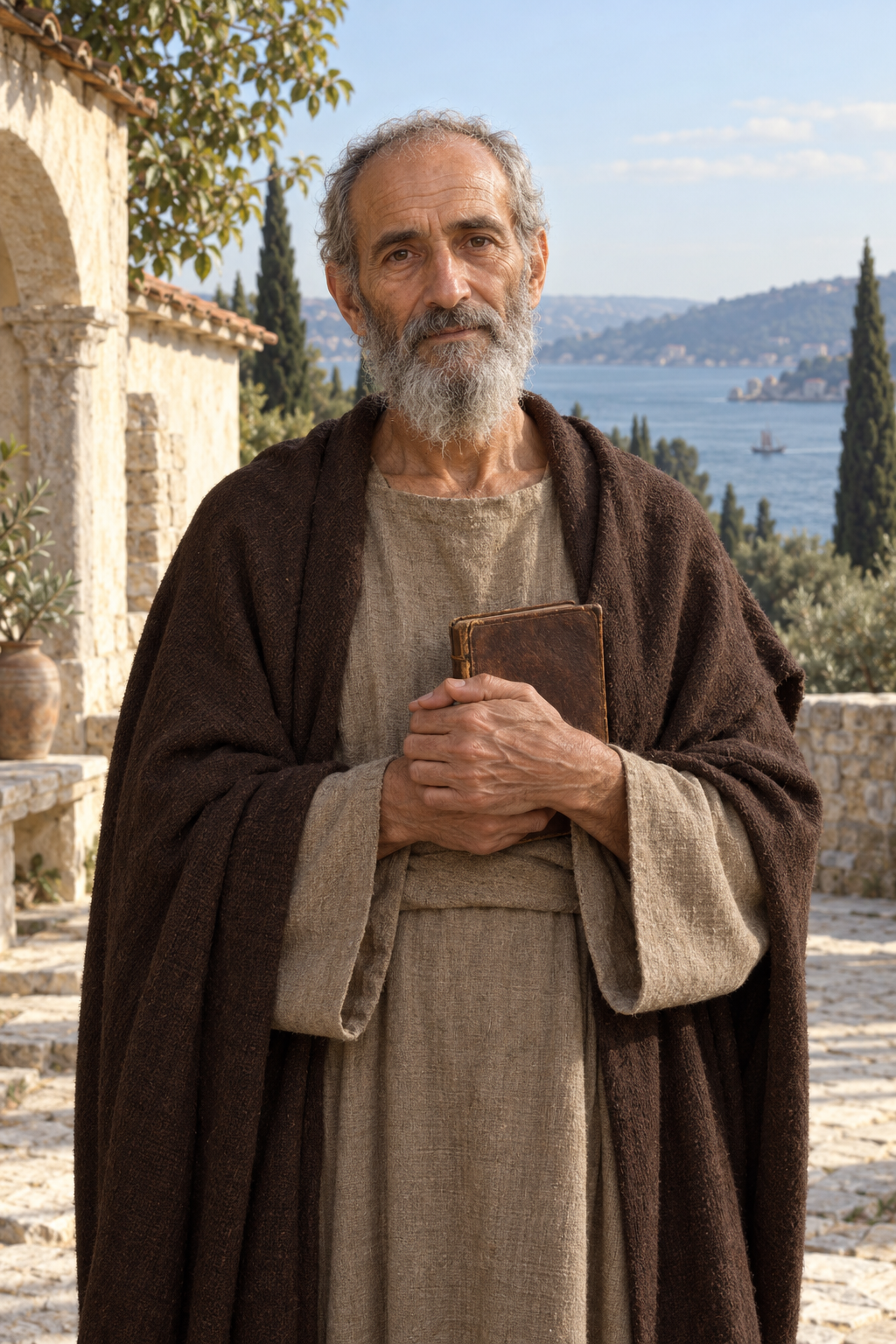
About Alexander the Acoemete
Alexander the Acoemete founded monastic communities in Syria and near Constantinople during the early fifth century. He is associated with a form of shared worship in which prayer continued through the day and night. His followers became known as the Acoemetes, or sleepless ones. Their community survived the suppression of its house in Constantinople and established a new home at Gomon on the Asian side of the Bosporus.
The Orthodox Encyclopedia places his birth around 350 on an island in the Aegean Sea. His early life is remembered through a saint’s biography: he grew up in Constantinople, served in the military, and then entered a monastery near Antioch under an abbot named Elias. After several years, he left the community for a period of solitude in the wilderness. These details belong to the received life, rather than a continuous contemporary record.
The church’s account describes him going into the wilderness with the Gospel as his companion. Later, a large community gathered around him near the Euphrates. The monks organized their chanting in successive watches, allowing the psalms to be sung at every hour. The title sleepless describes this continuity of communal prayer; the monks took turns. The story presents Alexander’s decision as the result of prolonged prayer and divine guidance. That explanation expresses the community’s religious memory.
One celebrated episode requires particular caution. Alexander’s Life credits him with converting Rabbula, later bishop of Edessa. Scholars regard this passage as an interpolation. A separate Syriac Life of Rabbula instead associates his conversion with other church leaders and his baptism with a journey to the Jordan. Alexander does not appear there. The competing accounts show how a conversion story could be reshaped to strengthen a community’s claim to an influential bishop. Alexander’s role in it cannot be treated as established history.
The manuscript history adds another limit to this evidence. Bitton-Ashkelony notes that Alexander’s Life survives in a single manuscript from the tenth or eleventh century. Its account therefore reaches modern readers through a copy made centuries after the events it describes.
The Life also places Alexander and his monks in conflict with church and civic authorities at Antioch. In Rafal Kosinski’s analysis, Bishop Theodotos appears to have considered the group a threat to public order. Alexander is described as entering the city secretly and lodging his followers in an empty bathhouse without the bishop’s permission. The narrative takes Alexander’s side, so its portrayal of hostile advisers needs to be read as part of that argument.
Kosiński also describes the charitable work behind this conflict. Alexander arranged shelters for poor people and enlisted wealthy citizens to support them. At the same time, he criticized the bishop and the military commander for neglect. According to the Life, officials eventually sent him to Chalcis and dispersed his community from Antioch. He was kept under guard, but escaped at night in disguise. The account presents him as a determined religious leader whose popular support alarmed the authorities; his care for the poor and his confrontations belong to the same story.
His difficulties continued at Constantinople. The monastery there was suppressed in 426 or 427, and he subsequently founded the community at Gomon. He died around 430. The monks later moved farther south along the Bosporus to Irenaeum. Their house developed into an important center of religious controversy and manuscript learning, extending the influence of Alexander’s foundation beyond his own lifetime.
Older reference works do not agree on the date of his death. Joseph Sollier’s Catholic Encyclopedia article places it around 440, whereas the more recent Oxford entry gives 430. This difference makes an approximate date preferable to an apparently exact chronology.
The communities that followed Alexander developed a practical organization for their demanding worship. Sollier describes groups of Latin, Greek, Syrian and Egyptian monks, with each group divided into choirs according to the number of members and the needs of the service. He also records the importance of manuscript copying among the Acoemetes. These details concern the continuing monastic tradition; they should not all be projected back onto Alexander’s first house. His foundation became part of a larger history in which communal prayer and the preservation of books developed together.
His biography also had a long life of its own. It was translated into Slavonic by the end of the eleventh century, and later church collections preserved his commemoration. This transmission helped carry the memory of an early monastic founder into communities far removed from the places where he had lived. The Orthodox Encyclopedia identifies a further stage in the sixteenth century, when both the longer Life and a shorter commemoration appeared in the Great Menaion Reader.
The Orthodox Church in America commemorates Alexander on February 23 and July 3. Its account remembers a founder whose lasting contribution was the organization of continuous praise as a shared task.
Wondering how to weigh the stories and sources? Learn how to read a saint biography.