Biography
Alexius Kim Si-u
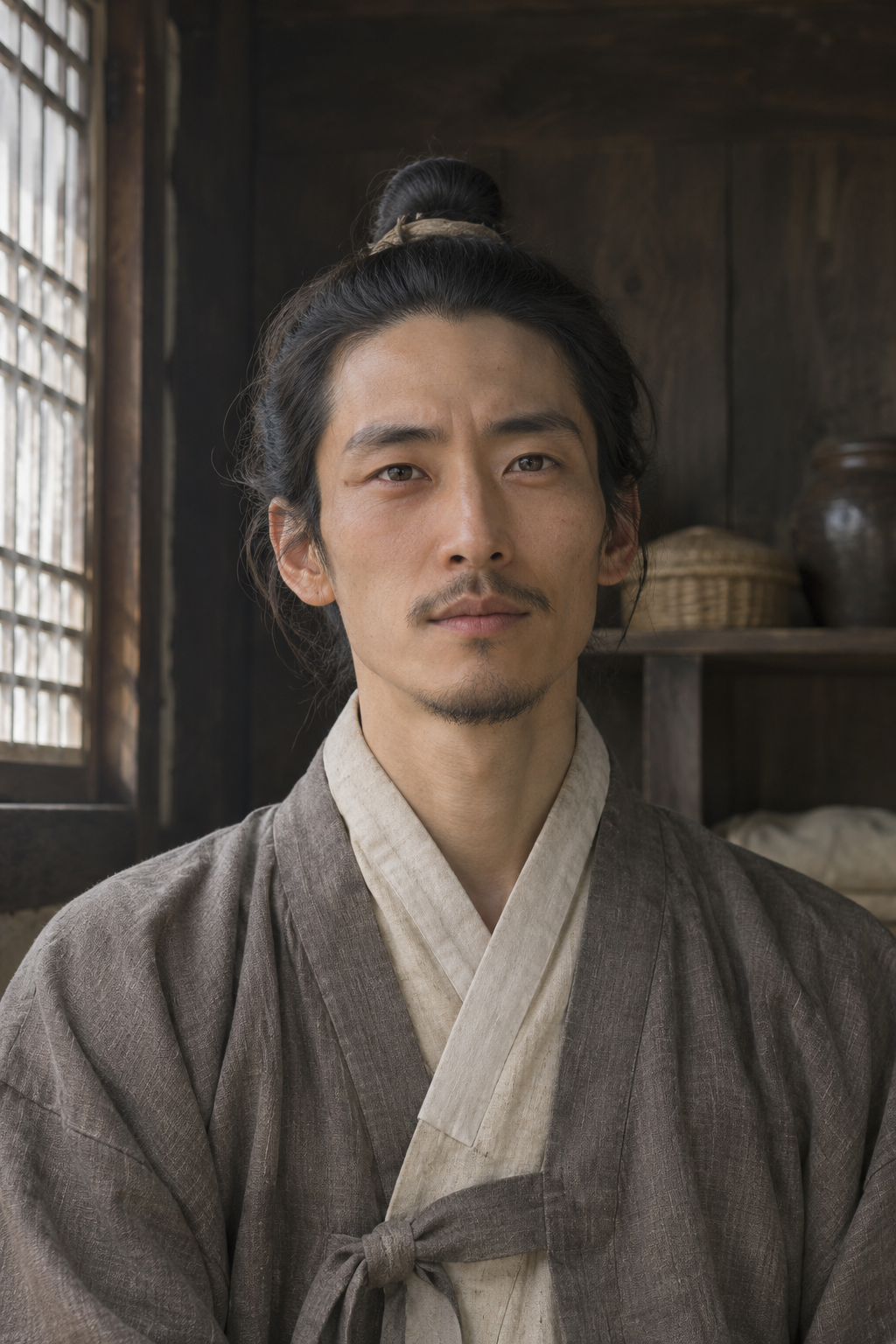
About Alexius Kim Si-u
Alexius Kim Si-u came from a yangban family in Cheongyang, in Chungcheong-do. The Korean bishops give his birth year as 1783 and record Si-hoe and Si-u-jae as other names.
An older Catholic encyclopedia gives 1781 instead. It identifies his clan as Yeonsan and describes the poverty in which he lived. The right side of his body was paralysed, making ordinary work difficult. He remained unmarried. His education nevertheless gave him skills that would become important to the Catholic communities he visited. A third year, 1782, appears in the Daegu diocesan bulletin.
After learning the Catholic faith, Alexius taught it to his sister. He continued studying and observing its practices himself. Cha Ki-jin describes him travelling among scattered believers, receiving alms for his support and teaching when opportunities arose. He also copied religious books with his left hand and gave them to other Catholics. This work brought him into contact with teaching that some of his neighbours did not know, and he used what he learned to instruct them.
Oh Se-taek’s account describes a livelihood made up of gifts from fellow Catholics and small payments for copied books. Alexius’s dependence on other people did not prevent him from taking an active part in their religious life. He explained the catechism to believers and sought to bring non-Christians into the Church. He eventually followed other Catholics to the mountain village of Meorusan in the Jinbo district.
In 1815 the Eulhae persecution reached the community. Officers came to arrest its Catholics but initially passed Alexius over because of his disability. The Daegu diocesan account remembers him crying and explaining that he too was a Catholic. He asked to be taken with the others. The officers then included him among the prisoners, and he followed them.
At Andong, Alexius underwent repeated questioning and punishment. He continued explaining Catholic teaching to the officials who interrogated him. Cha Ki-jin’s account lists the subjects he addressed: the creator, the incarnation and redemption, and the reward of good and punishment of evil. The prisoner who had taught in village households continued arguing for his religion before the authorities. He was then sent on to Daegu, where the provincial governor questioned him again.
The governor challenged his worship of Jesus, asking what was admirable about someone who had suffered a violent death. Alexius answered by invoking the traditional Chinese story of Yu the Great, remembered for labouring to save his people from floods. The Daegu account describes the comparison as an argument that Jesus cared for human souls as well as bodily life. Alexius urged the governor himself to honour Jesus and accept Catholicism. In his retelling, the floods had afflicted the country for nine years. According to the story he invoked, Yu passed his palace three times without going inside.
Historian Lee Gyeong-gyu examines the use of that classical example. His 2002 study places the exchange before Yi Jon-su, a governor committed to Confucian learning and the reform of public morals. Lee argues that Alexius spoke in terms the governor’s own education made intelligible: the comparison began with a celebrated ruler and moved to the Christian understanding of salvation. In Lee’s reading, Alexius’s knowledge of the classics and his Catholic teaching met within the same defence.
The interrogation also concerned his books and the people to whom he had supplied them. The encyclopedia says that he identified where books were hidden but refused to disclose the names of the Catholics who had received them. His jaw was then subjected to punishment intended to stop him speaking, and the authorities continued pressing him to renounce his faith. The account describes a death sentence, followed by his return to prison while royal permission for execution was still pending.
The provincial judgment lists some of what Alexius had learned by heart. Along with the commandments and rosary prayers, it names the Seven Victories. That book had been written in Chinese by the Jesuit Diego de Pantoja in Beijing in 1614. Each section paired a vice with a practice intended to overcome it, such as humility in the face of pride or patience in the face of anger.
In prison Alexius could neither secure enough food nor eat normally. Other prisoners made straw sandals that could be exchanged for meals, but he could not do that work. Hunger added to the injuries inflicted during questioning.
Lee Gyeong-gyu describes a woman supplying food in return for payment or the prisoners’ work. Alexius used the little money he possessed, but when it was gone he could offer her nothing. Lee says the supplier rebuked him and ceased bringing food once he could no longer pay. He died after about two months in Daegu custody, worn down by hunger and punishment.
The exact date remains uncertain. The current bishops’ biography places his death before December 9, 1816. The older encyclopedia and Cha’s 1997 account place it in 1815. The later date is an upper limit, not an execution anniversary.
Wondering how to weigh the stories and sources? Learn how to read a saint biography.