Biography
Alphonsa of the Immaculate Conception
About Alphonsa of the Immaculate Conception
Alphonsa of the Immaculate Conception was born Annakutty Muttathupadathu at Kudamalur, in the region of Arpookara and the Diocese of Changanacherry, on August 19, 1910. The says she was baptized eight days later according to the Syro-Malabar rite and received the name Annakutty.
The profile should preserve her Indian and Syro-Malabar context clearly. Her birthplace, baptismal rite, and family name are not decorative details; they locate her holiness within Kerala's Catholic life. She was the youngest of five children, and the official source says her mother died when Annakutty was only three months old.
This context also guards against a generic convent biography. Alphonsa belonged to a local Church with its own liturgical life, family prayer customs, and religious vocabulary. The page should name the Syro-Malabar rite and Kerala places so readers understand where her vocation took shape, while avoiding unverified cultural generalizations.
Annakutty spent early childhood with her grandparents at Elumparambil. The Dicastery source describes that period as important for human and Christian formation. Her grandmother communicated love of faith, prayer, and charity toward the poor. Even as a child she led evening family prayer according to Syro-Malabar custom.
Her first communion in 1917 and early desire for God are part of the source's account, but direct quotations from letters should be avoided unless separately budgeted. The useful editorial point is that her vocation did not appear late or under pressure only. The official biography presents it as a long-developing offering shaped by prayer, family loss, and religious formation.
The account of her youth includes painful pressure toward marriage and her firm defense of religious vocation. This material requires care. The public page may say she resisted an imposed marriage and suffered consequences, but it should not dwell on self-injury or graphic bodily detail. The editorial emphasis should be vocation, not spectacle.
Her confessor, Father Giacomo Muricken, guided her toward Franciscan spirituality and introduced her to the Franciscan Clarists. On May 24, 1927, Annakutty entered their college at Bharananganam as a boarding student. On August 2, 1928, she began postulancy and took the name Alphonsa of the Immaculate Conception.
She received the religious habit on May 19, 1930, during the first pastoral visit of Bishop Mar Giacomo Kalacherry to Bharananganam. Between 1930 and 1935, the source says she endured serious illnesses and moral suffering. She taught at Vakakkad for one school year, then served as assistant teacher, catechist, and secretary when weakness limited other work.
These modest assignments matter because they show her service within limits. A profile focused only on illness would miss the teaching, catechesis, secretarial work, and community life the source records. Alphonsa's holiness was not passivity. It included doing the work she could do, accepting limits, and remaining charitable within ordinary convent responsibilities.
In 1934 the canonical novitiate was introduced in her congregation. Alphonsa wanted to enter immediately, but poor health delayed her admission until August 12, 1935. After serious illness early in the novitiate, the source reports a healing during a novena to Kuriakose Elias Chavara. The profile can mention this as part of the official account without overexplaining the miracle.
Alphonsa made perpetual profession on August 12, 1936, the feast of Saint Clare. The Dicastery profile presents this as the fulfillment of a long-guarded desire. Her life after profession was marked by repeated illness, psychological and physical suffering, and a deliberate offering of those sufferings in union with Christ. This should be worded gently and without romanticizing pain.
The profile should avoid treating suffering as a personality trait. Alphonsa's holiness is better shown through prayer, fidelity to vocation, patience with illness, charity toward sisters, and hidden service when health allowed. Her story can speak to people who suffer without suggesting that pain itself is the goal. The source's own spiritual framing should be paraphrased with restraint.
The same restraint applies to psychological and physical illness. The Dicastery biography names specific illnesses and a long period of weakness, but the public page should not become a catalogue of symptoms. It should summarize the pattern and then return to her response: prayer, patience, silence, charity, and steady attachment to Christ.
Alphonsa died at the Franciscan Clarist convent in Bharananganam at 12:30 on July 28, 1946. The existing death date and death place are therefore supported. The Dicastery page also gives July 28 as her liturgical memorial, beatification by John Paul II on February 8, 1986, and canonization by Benedict XVI on October 12, 2008.
Her recognition as India's first woman saint can be included, because the Dicastery page includes that theme in the canonization material. The final profile should present it as recognition of a life rooted in the Syro-Malabar and Franciscan Clarist traditions, not as a slogan detached from her actual vocation.
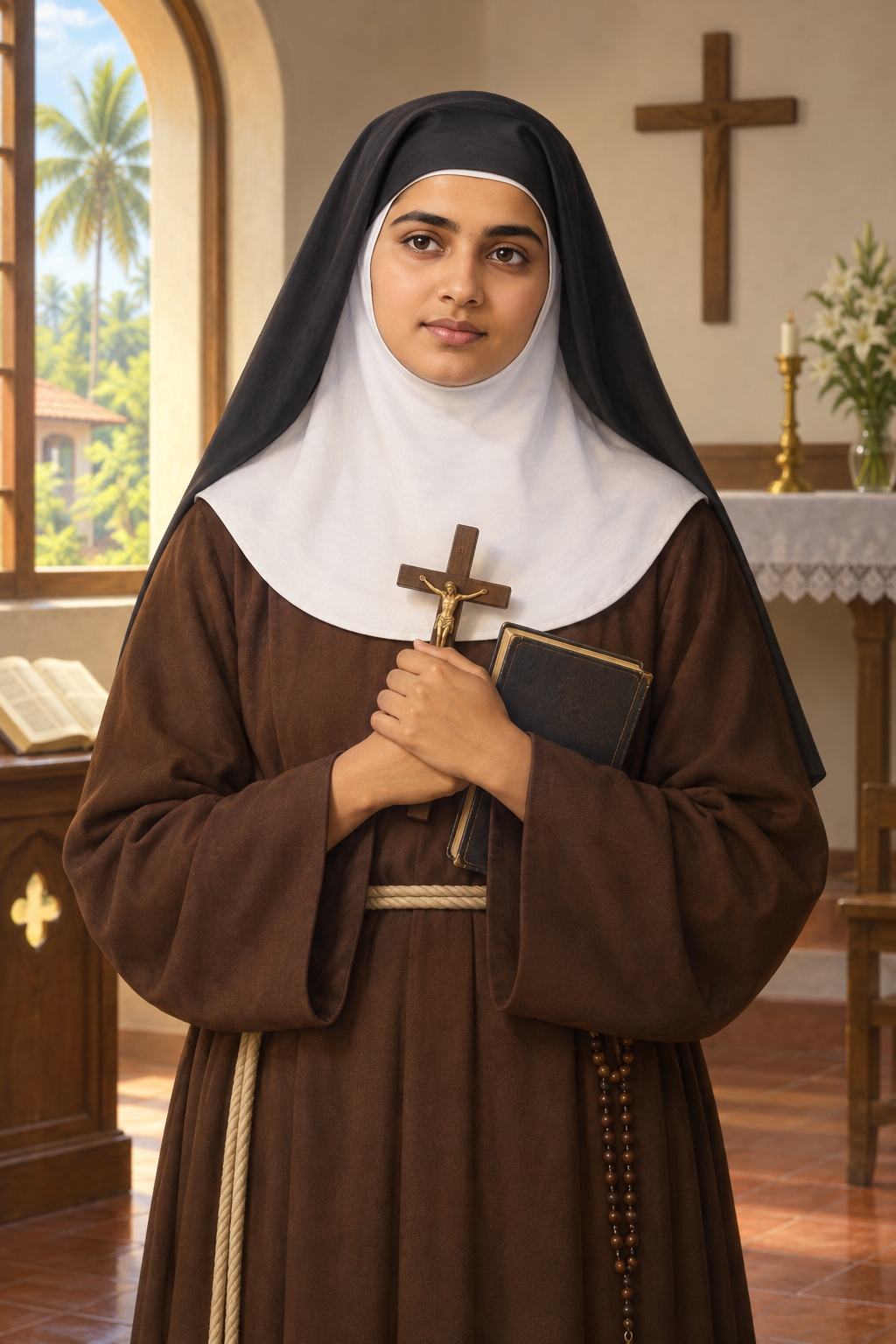
Artwork should show a young Indian Franciscan Clarist in a Kerala convent chapel with a cross or prayer book. It should avoid flames, wounds, illness imagery, forced-marriage scenes, or sentimental suffering. The badge should preserve the face, veil, cross, and book as signs of prayerful consecrated life.
Wondering how to weigh the stories and sources? Learn how to read a saint biography.