Biography
Amalberga of Temse
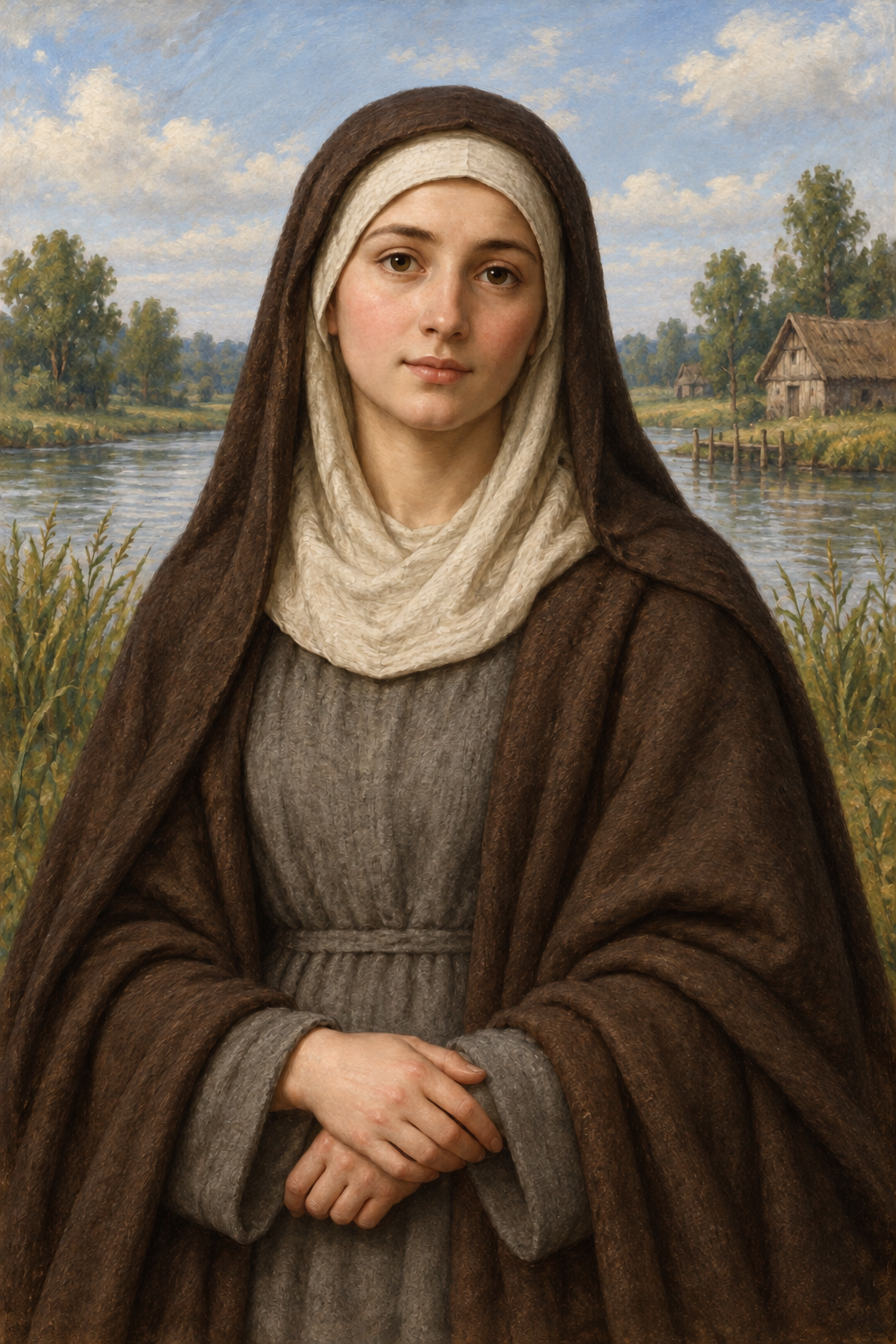
About Amalberga of Temse
Amalberga of Temse is remembered in Catholic tradition as a consecrated woman associated with the Scheldt and the Flemish town of Temse. Nominis commemorates her locally on 10 July and places her in the eighth century. Its Roman Martyrology notice recalls her receiving the veil from Willibrord.
She is distinct from Amalberga of Maubeuge, the married woman remembered at Lobbes, and from the later abbess of Susteren. The New Catholic Encyclopedia warns that legendary embellishment has made the first two women’s stories difficult to disentangle.
An early account survives in a sermon attributed to Radbod of Utrecht. He portrays Amalberga choosing simple clothing, prayer and care for the poor. After her parents’ deaths, she lives with a brother on inherited property beside the Scheldt. These are features of a devotional account rather than a contemporary record of her household.
The sermon tells of a ruler called Charles attempting to force her into marriage. When persuasion fails, he follows her into an oratory and injures her arm while trying to drag her outside. The account describes a miraculous recovery through Christ. The episode belongs to her legend; it cannot establish which historical Charles was involved.
A longer medieval life develops the story further. The Geschichtsquellen catalogue describes that work as a late eleventh-century legendary narrative and questions its attribution to Theodoric of Saint-Trond. Historian Léon van der Essen’s comparison likewise warns of confused chronology and anachronisms. Those accounts do not provide secure birth and death dates.
Her remembrance remains visible in Temse. The municipality describes images of her in and around the Church of Our Lady, and streets and institutions bearing her name. It also describes the Wegom, a walking pilgrimage of about 23 kilometres through nine chapels, held at Pentecost and in September. The September observance remembers the transfer of her remains to Ghent.
Wondering how to weigh the stories and sources? Learn how to read a saint biography.