Biography
Amata of Assisi
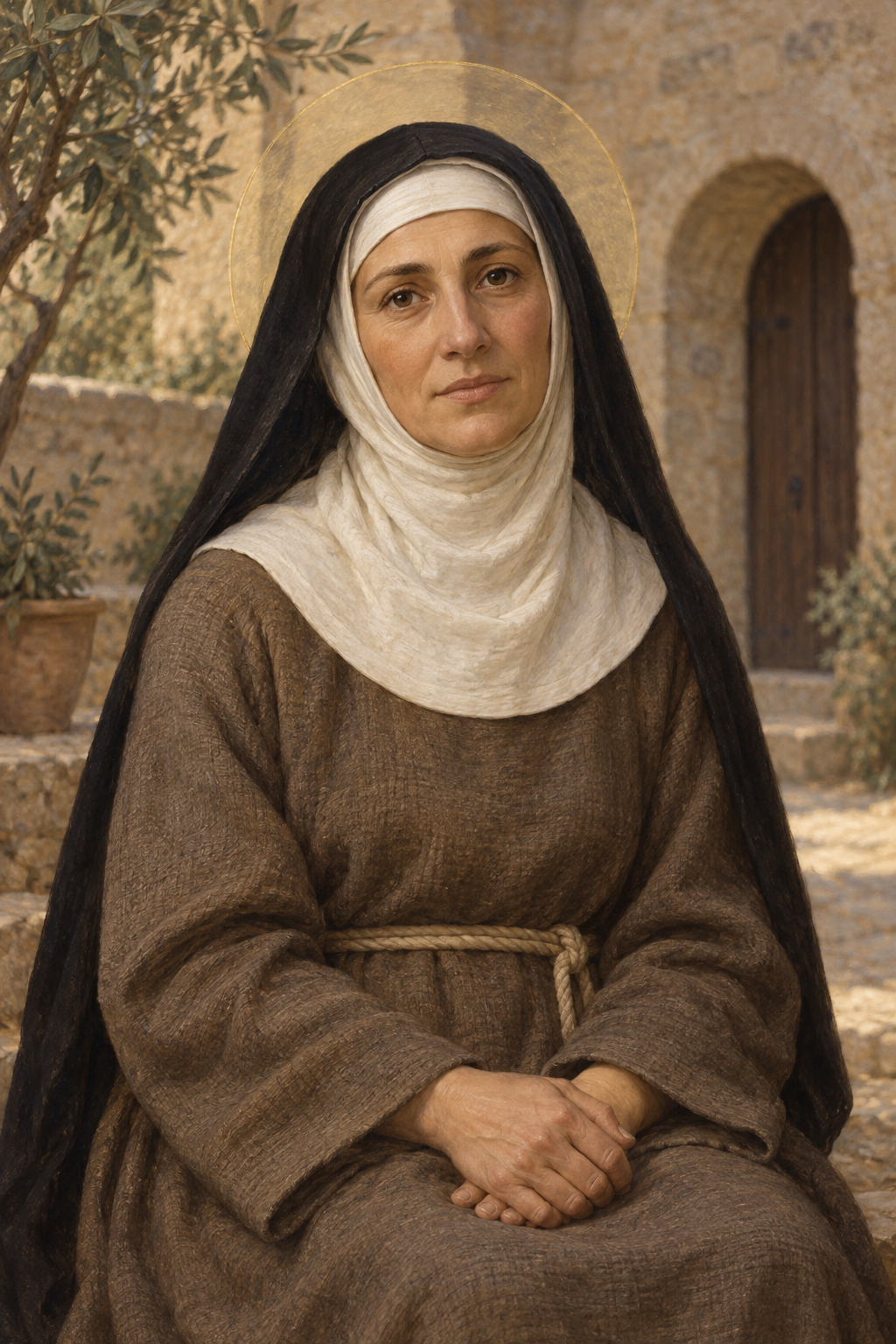
About Amata of Assisi
Amata of Assisi was a nun at San Damiano and a relative of Clare of Assisi. In the canonization inquiry she said that she had entered religious life through Clare’s encouragement and had lived in the community for about twenty-five years. She regarded Clare as a mother.
Amata’s testimony preserves her account of serious illness, with fever, coughing and swelling that lasted thirteen months. She said that Clare prayed over her and made the sign of the cross, after which she recovered. This is her sworn account of a healing attributed to Clare, rather than an independently verified medical explanation.
She also recalled being alone with Clare shortly before the abbess’s death, when Clare repeatedly asked whether she could see the King of Glory. The testimony records Clare’s words to Amata; it does not say that Amata herself saw the vision.
Historian Ugolino Nicolini dates the inquiry to November 1253. The surviving text is a fifteenth-century Umbrian-Perugian rendering, rather than the original Latin record. He also cautions that Amata’s family relationship to Clare may have been through a cousin. Her testimony establishes kinship without settling the later family tree.
Later devotional notices celebrate her religious life and commemorate her on 20 February. Germano Cerafogli’s Italian notice calls her Blessed. The Catholic Church in Norway calls her Saint. Neither notice supplies a formal canonization decree. They also give an entry year of 1213, which conflicts with the approximate twenty-five years stated in her testimony.
The received account recalls the transfer of her remains when the women left San Damiano in 1260, and their later placement in a stone urn in 1602. These notices preserve her remembrance within the early community, while much of her individual chronology remains uncertain.
Wondering how to weigh the stories and sources? Learn how to read a saint biography.