Biography
Ambrose Kim Se-bak
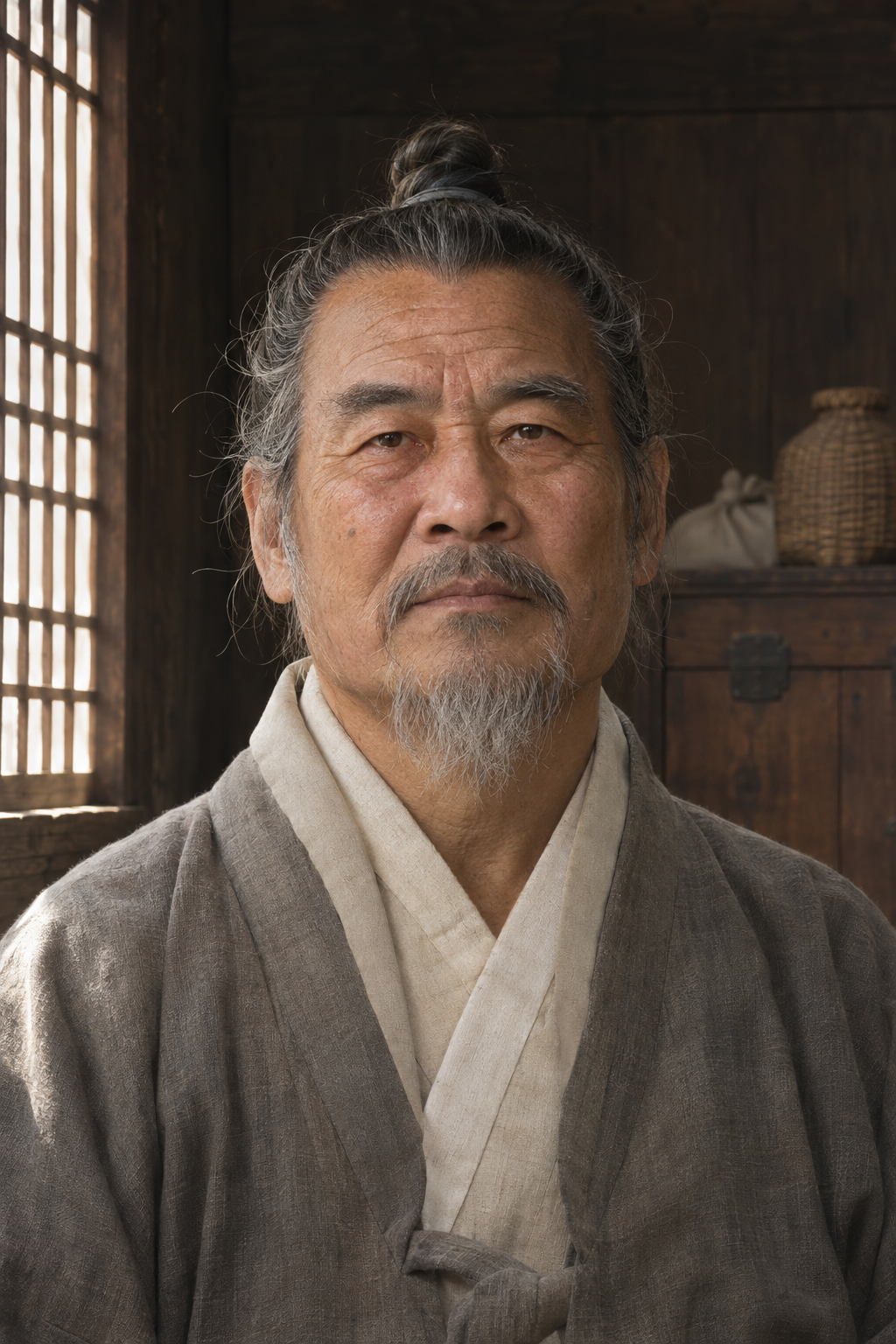
About Ambrose Kim Se-bak
Ambrose Kim Se-bak was born in Seoul in 1761, into a family of interpreters. He became a Catholic soon after the religion reached Korea, and spent much of his adult life teaching it to other people. He was also known as Gun-mi and by the adult name Eon-u. His distant relative Thomas Kim Beom-u belonged to the first generation of Korean Catholics.
Ma Baek-rak names his father, Kim Deuk-seo, and grandfather, Kim Gap-ryeong, as interpreters.
The official name reflects an editorial choice. Missionary records preserved Gun-mi and Eon-u, but their Chinese characters were unknown. Compilers preferred Se-bak, whose characters appeared in government records.
The faith did not unite his own household. Ambrose tried to instruct his wife and children, but they rejected his teaching. The Catholic accounts describe particular conflict over his observance of fasting and abstinence. After 1791 he left his family and began moving between Catholics’ homes in the countryside. He supported himself by copying religious books and selling the copies. His teaching followed the same routes: people who welcomed him could also hear him explain the religion for which he had left home.
He met the Chinese priest James Zhou Wen-mo after the priest entered Korea and received the sacraments from him. He also gathered children and people who had not become Catholics to teach them the catechism. For a time he accompanied Zhou in his work and learned from him while helping to teach. He had no permanent home. Sometimes he withdrew into the mountains for prayer, then returned to the households where he taught. People who had become less active in the faith were also among those he tried to encourage. The diocesan account remembers him as a teacher concerned with individual people.
The rhythm of his religious life included waking at midnight to pray, even in winter. He limited the amount he ate rather than changing the rule according to whether the food was appealing. Yeo Jin-cheon’s account links these observances to the teaching for which people called him “Master Ambrose.” It describes the communities he visited taking renewed interest in their faith. These were practices of his long itinerant life, before the later prison fast that became a disputed part of the story of his death.
He escaped arrest during the persecutions of 1801 and 1815. But the pursuit of Catholics in 1827 left him without a secure place to stay. The person sheltering him had gone into hiding with a non-Christian household. Ma Baek-rak’s account describes Ambrose walking to the Andong office with his small bundle and asking to see the commander. The guards initially tried to turn him away. He insisted that he was a Catholic and wanted the official to know that he was there. They eventually brought him in for questioning.
Officials demanded the location of other believers and of religious books. Ambrose would not supply it. After a month he was transferred to Daegu, where he joined Andrew Yi Jae-haeng, Andrew Kim Sa-geon and Andrew Pak Sa-ui. The prisoners encouraged one another through repeated questioning and punishment. He signed the final judicial statement and remained in custody awaiting execution.
Ma places the food crisis after the death of Paul Pak Gyeong-hwa, an older fellow prisoner. Some made straw sandals, but Ma’s account says Ambrose could not do that work: he was elderly and had never learned the skill. The authorities therefore required nearby residents to contribute toward food for prisoners unable to earn their keep. Learning where the food came from troubled him.
The current bishops’ biography says that Ambrose then stopped eating. When fellow prisoners proposed following his example, he discouraged them. The same account says that he eventually yielded and ate again, but that torture and fasting had left him exhausted and seriously ill. It places his death in Daegu prison on December 3, 1828. His companions were with him. The story ends in illness and death in custody, rather than a formal execution.
An earlier report differs. In a letter written around November 17, 1837, the missionary Pierre Maubant says that Ambrose died after twenty days without food. He also reports that Ambrose told the other Catholics to keep eating. Maubant asked whether the decision had followed a special revelation, but the people he questioned said that they did not know. He likewise found no one able to tell him of a miracle linked to Ambrose’s death or intercession.
Historian Lee Seok-won identifies that earlier Ambrose with Kim Se-bak by comparing the letter with Daveluy’s later records. He notes information preserved only in Maubant’s account: flight into a southern region described as near Japan, and Catholics dividing Ambrose’s possessions after his death. The letter does not name the refuge precisely. Nor does Maubant’s question establish a revelation. Lee suggests that Maubant’s questions may themselves have helped shape the later tradition of divine inspiration.
Wondering how to weigh the stories and sources? Learn how to read a saint biography.