Biography
Anastasia Kim Jo-i
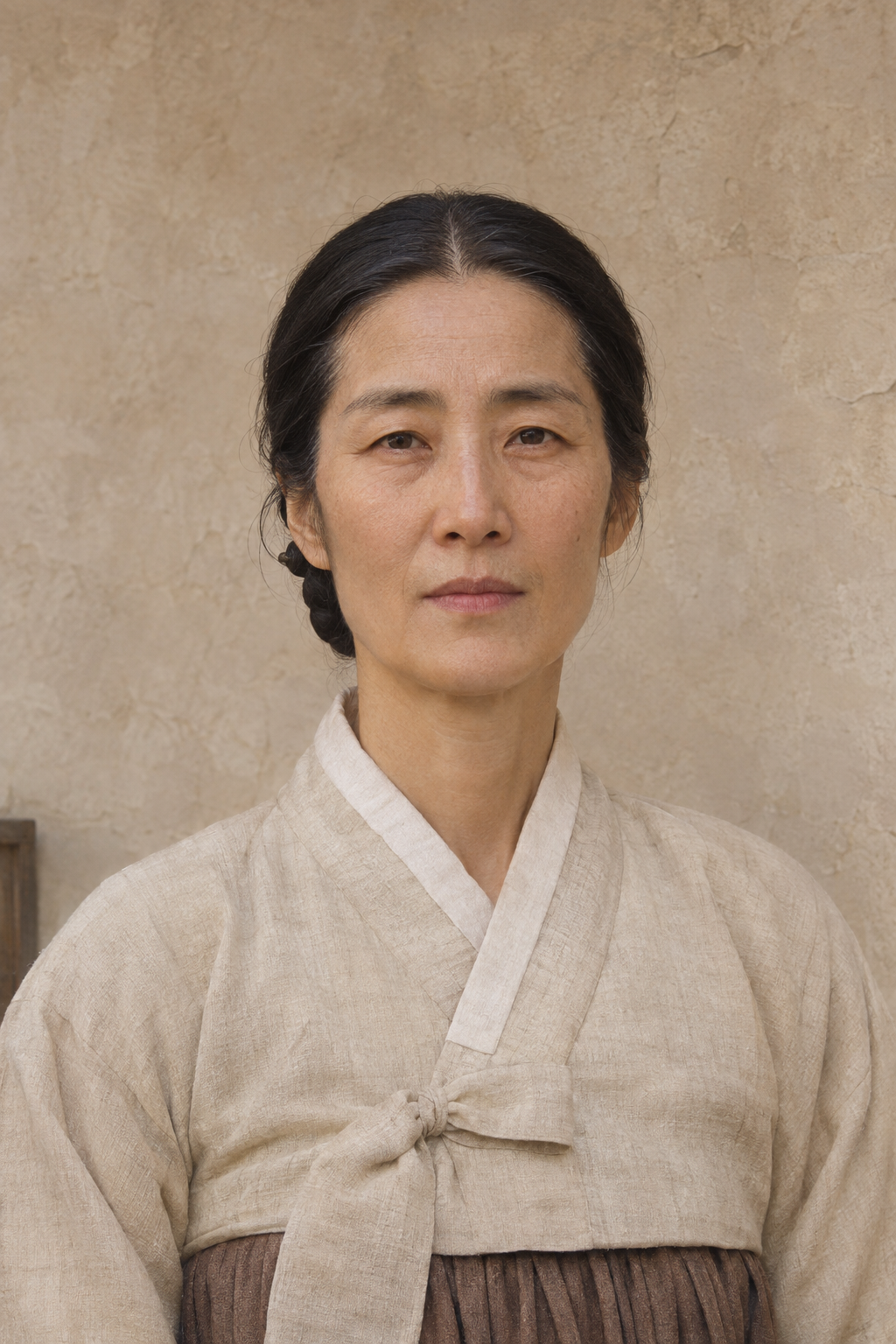
About Anastasia Kim Jo-i
Anastasia Kim Jo-i came from a commoner family in Deoksan in Chungcheong Province. She married Paul Yi Seong-sam, who instructed her in Catholic teaching. She became known for her care in passing on what she had learned.
Jo-i, written with the characters 召史, appears after the family names of several Korean women in accounts of the persecution. Some later writers read it as a title for a widow. A historical study of the name finds it applied much more widely, to women of different ages and social backgrounds. Its appearance in her name tells us little about her marital circumstances on its own.
A historical account by Baek Byeong-geun places her marriage at about nineteen and remembers her as having practised Christianity from childhood. That differs from the account of her learning the faith after marriage. Both accounts agree on the important place of religious instruction in the home she made with Paul. Her teaching extended beyond her children. Other women in the village came to her for encouragement in practising their faith.
The persecution that first displaced the family began in 1827. Ri Gil-jae traces its outbreak to a dispute at a Catholic settlement in Gokseong. A member of the community denounced it to the magistrate. The search for Catholics spread through neighboring districts, including Jangseong. Anastasia and Paul escaped arrest in this first persecution. Their move placed them among the many families in Jeolla who had to seek shelter away from their earlier homes.
Her daughter, Yi Bong-geum, received the same Christian name as her mother. By about ten she had learned the questions and answers of the catechism and the prayers Catholics said morning and evening. When a French missionary visited the family, he gave the child permission to receive her first Communion. In Jeonju they spoke of that faith again.
A missionary was able to visit the family at the place to which they had fled. The priest was their guest in the same household where Anastasia taught the children. When persecution broke out again in 1839, the family could no longer leave together as they had in 1827. Paul was away. Anastasia had to decide where to go with Bong-geum, who was still a child.
Mother and daughter found a welcome in Gwangju at the home of Protase Hong Jae-yeong. His daughter-in-law, Barbara Sim, helped give the fugitives food and a place to sleep. Two other women, Magdalene Yi and Barbara Choe, also sought shelter there. Officers from Jeonju arrested members of the Hong household together with the people they had taken in.
Officials demanded two things of Anastasia. They wanted her to give up her religion and to tell them where they could find her husband. She refused both demands. Her questioners returned to Paul’s whereabouts and punished her more harshly when she continued to protect him.
Her daughter too was brought back to the prison after questioning. Anastasia feigned doubt. According to the Church’s account, Anastasia told her that the next round of punishment would be too hard for her to bear and that she would surely give way. The child protested.
Anastasia signed the written death sentence before the provincial governor. She was beaten again and returned to prison to await the royal decision.
The Church remembers her dying at Jeonju from illness and the injuries sustained in custody, around the tenth month in the traditional account. Her daughter lived to see her death and was subsequently killed in the same prison.
The Diocese of Jeonju’s history in the Korean Catholic Encyclopedia gives a different account of the deaths. It groups the two Anastasias together as having been strangled in custody. The individual biographies distinguish the mother’s death from wounds and illness from her daughter’s strangulation. The surviving descriptions therefore support the year and the prison more securely than the precise day or the older collective account of how the mother died.
When the cause of these martyrs was investigated in 2006, researchers walked from the diocesan offices to revisit the site of the prison. Father Kim Jin-so of the Honam church history institute had compared maps from the 1840s and the 1910s to identify the plot. At the time of the inspection it was used as a parking lot. Father Kim testified that the provincial hospital had once used the site for its mortuary. The investigators identified it as the place where Anastasia died and where her daughter, whom she had taught at home and encouraged in prison, was later strangled.
When the Diocese of Jeonju first sought recognition for its martyrs in the 1980s, it put forward five names. Anastasia and her daughter were among nineteen others whom it included when the Korean bishops brought the diocesan causes together. Both women were named individually in the larger cause submitted in 2003.
Wondering how to weigh the stories and sources? Learn how to read a saint biography.