Biography
Anatoly Kamensky
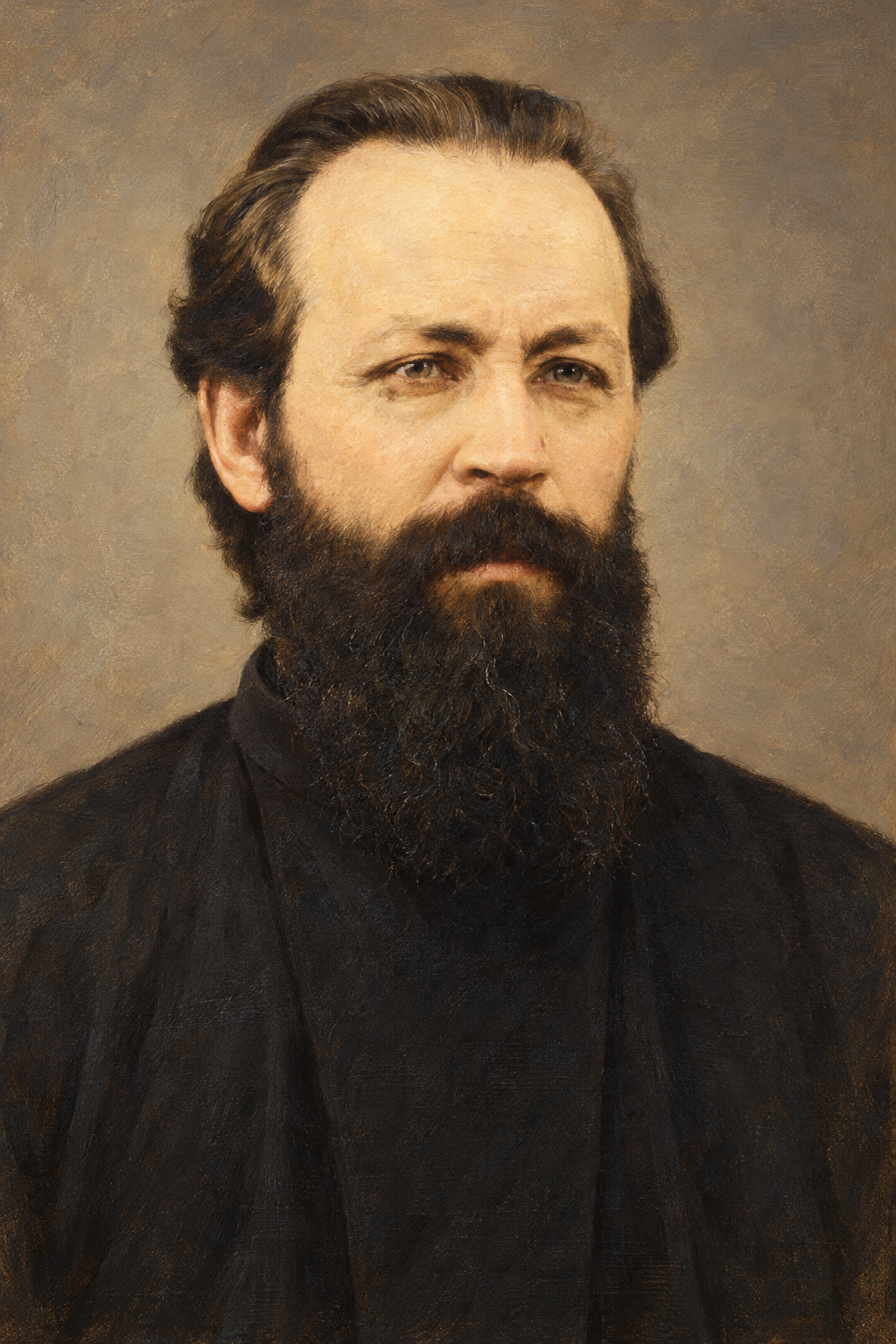
About Anatoly Kamensky
Anatoly Kamensky served as a priest and teacher in Alaska and Minnesota before becoming a bishop in Russia. Born in Samara Governorate, he completed seminary and was ordained in 1888. After being widowed, he pursued further theological study and became a monk in 1895. He was assigned to Saint Michael’s Cathedral in Sitka and supervised its mission school. In 1899 he taught at the Minneapolis mission school and took responsibility for its associated shelter. The encyclopedia also records that he took three courses at the University of Minnesota; this does not establish that he earned a degree there.
His Alaskan years also led to an ethnographic book about the Tlingit, published in Odessa in 1906. Sergei Kan later translated it into English with an introduction, annotations and supplementary material. Reviewing that edition, Richard Dauenhauer valued its account of Tlingit life during a period of colonial change. He also warned that Kamensky’s observations contained errors and reflected the cultural assumptions of a Russian missionary of his time. The book records encounters among Tlingit people, Russian Orthodox Christians and American Protestant missionaries. It preserves useful historical evidence, but requires critical reading rather than treating every judgment as an accurate description of Indigenous life.
Returning to Russia in 1903, Anatoly directed the Odessa seminary and became a bishop in 1906. He later served in Tomsk, belonged to the State Duma and attended the Russian Church Council of 1917–1918.
His political commitments extended beyond a parliamentary seat. The Tomsk Memorial Museum identifies him as deputy chairman of the Union of the Russian People’s main council from 1912 to 1914 and a participant in monarchist congresses. On becoming bishop of Tomsk in 1914, he left the council and subsequently resigned from the Duma.
The Union defended tsarist autocracy and promoted antisemitic and anti-Ukrainian views. Historian Roman Senkus describes its members’ violence against Jews and other perceived enemies. This organizational history matters when considering Anatoly’s leadership role, although it does not establish his personal participation in a particular attack.
In Tomsk, his administration also addressed parish life and the consequences of war. From 1915, he directed the diocesan newspaper to publish the names of local soldiers killed or wounded so that parishes could remember them in prayer. He initiated preparations for parish reform at a gathering of diocesan deans in December 1916, before the revolution transformed relations between church and state.
During the civil war, he helped organize religious groups associated with Admiral Kolchak’s White Army. He remained in Russia after its defeat. Soviet authorities arrested him in 1922 on accusations that included concealing church property. A death sentence was commuted to imprisonment. After his release, he lived in Omsk.
The museum’s account makes the military connection explicit: he blessed the Holy Cross brotherhood and the formation of combat detachments. In September 1919, churches in his diocese offered prayers for victory and encouraged recruitment. His public ministry therefore included support for armed resistance to Bolshevik rule.
The diary of Irkutsk priest Peter Popov records how Anatoly’s imprisonment coincided with a struggle over church authority. In July 1922, local clergy debated demands from the Living Church movement and initially supported their own elected diocesan committee. While Anatoly was in prison, the committee received a telegram removing him from diocesan administration. Popov also recorded a message reporting that the imprisoned archbishop was seriously ill and requesting medical attention and communion. The diary follows the subsequent transfer of diocesan administration to the rival movement. Published by archivists in 2011, this local account preserves the uncertainty and institutional conflict surrounding his detention. The editors’ accompanying note dates the commutation of his death sentence to January 1923 and his release to August 1924.
The Orthodox Encyclopedia places his death in Omsk in 1925.
Accounts of his death disagree, and this uncertainty also appears in the history of his commemoration. In a scholarly edition published in 2020, historian A. A. Kostryukov reproduced a preliminary list prepared for the Russian Orthodox Church Outside Russia’s 1981 glorification of new martyrs. Its entry for Anatoly Kamensky incorrectly places his killing in 1921. The editor marks his name with an asterisk, explaining that this identifies people subsequently included in ROCOR’s official calendar.
Kostryukov distinguishes the draft from the official list published in the late 1990s: the 1981 council had announced only a limited number of names, and further work continued afterward. The draft’s mistaken chronology cannot establish when or how Anatoly died. Its place in the canonization record helps explain his recognition without resolving the biographical contradictions. The original council resolution and later calendar have not been independently examined for this account.
The All Saints of North America parish in Arizona honors him as Saint Anatole of Irkutsk and displays September 20 as his feast. That local observance is recorded here without assuming a calendar conversion or uniform recognition across every Orthodox jurisdiction.
Wondering how to weigh the stories and sources? Learn how to read a saint biography.