Biography
Andrea Corsini
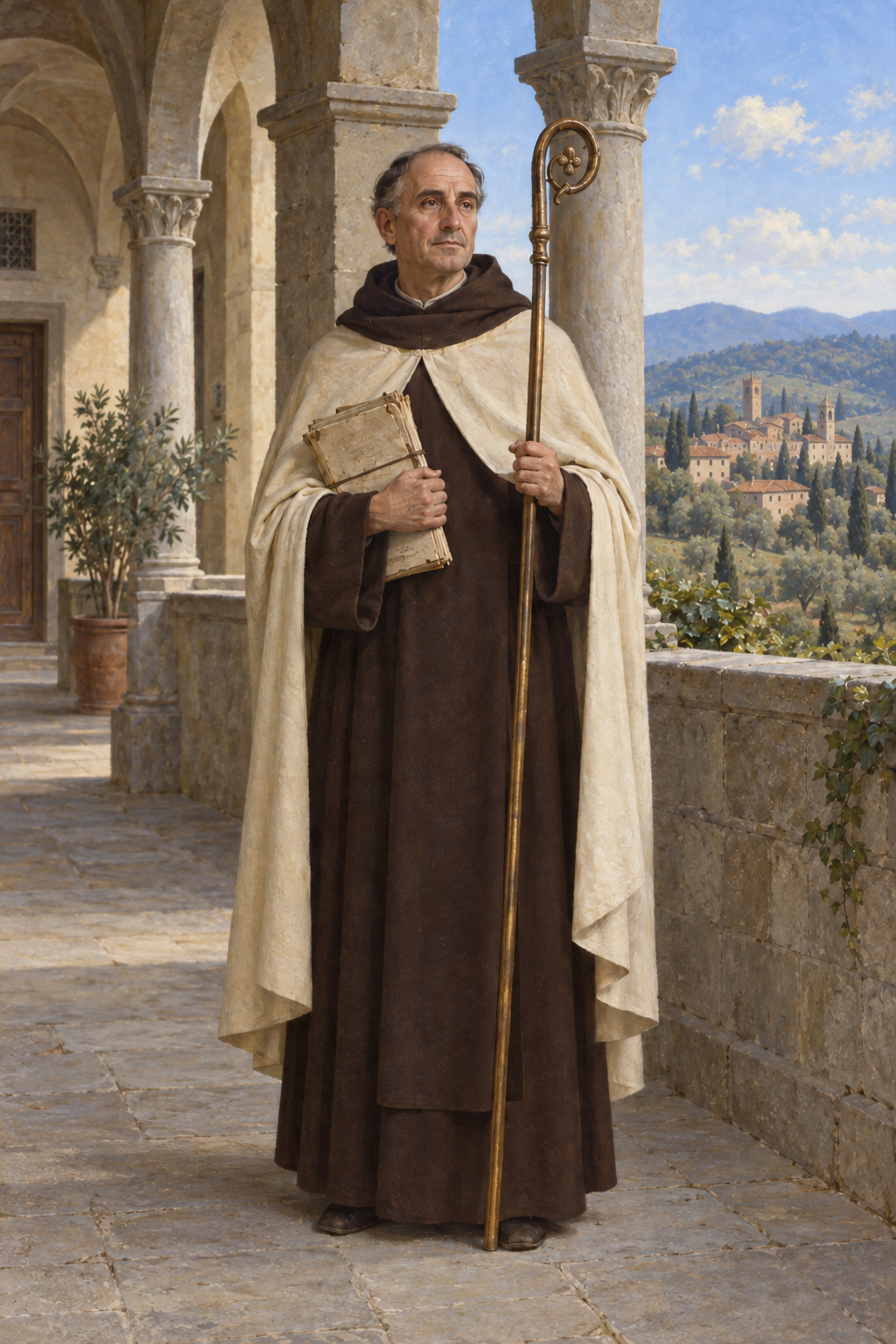
About Andrea Corsini
Andrea Corsini was born in Florence early in the fourteenth century, in a family prominent in the city. His mother was Gemma degli Stracciabende and his father Niccolò Corsini. A commonly printed birthday, 30 November 1301, rests on a later life that does not reliably establish the date. The earliest securely dated appearance of Andrea himself is a mandate of 3 August 1338 naming him among the friars of Florence's Carmine convent. His religious life was already underway by then, but the record does not fix its beginning or prove a dramatic youthful conversion.
The Carmelites combined an older ideal of prayerful withdrawal with expanding ministries in European towns. Alexandra Dodson's study of Carmelite buildings and rules shows how urban churches, communal life and pastoral duties developed while the order continued to recall its eremitical origins. A later story places Andrea's first Mass at the rural house of Santa Maria delle Selve, but the scholar treats this as a reported tradition, not a dated eyewitness record. The setting helps explain the range of Carmelite practice without making the story a firm episode of Corsini's early life. His documented path soon led into the order's administration.
Records place Corsini at Pisa in 1343 and in advisory and teaching duties at the Florence convent from 1344. The Carmelite delegation's account traces these appointments from surviving documents rather than a later dramatic life. His work as a friar thus included decisions about property, instruction and the affairs of a large community. Florence was not merely the backdrop for his story: the Carmine's building and membership bound him to the city's religious and civic networks. The exact year he entered the order is less secure than these dated records. Ordinary administrative tasks would become a lasting part of his service.
At the Carmelite general chapter in Metz in 1348, Corsini became provincial of Tuscany. The Black Death struck Florence and took many members of the local Carmelite community. The British Carmelite account describes the burden this placed on a provincial responsible for religious houses and their care. The appointment was not simply a personal promotion; it meant organizing the order during loss and disruption. He remained provincial into the opening of 1350, even after being named a bishop. This overlap of offices is attested by the records and helps explain why the change in his responsibilities was gradual.
Pope Clement VI named Corsini bishop of Fiesole on 13 October 1349. The Dicastery's account remembers his decision to live in Fiesole rather than use the residence in Florence favored by earlier bishops. That choice placed him near the cathedral and parish communities he was charged to serve. Later stories say he fled the appointment until a child found him, but the documentary record does not support that scene. He was still carrying out provincial duties in Florence after the papal decision. His first preserved act as bishop is from March 1350, so an exact installation day should not be invented.
As bishop, Corsini directed clergy, parishes and material relief after the plague. A papal message to Fiesole centuries later recalls his attention to people in need and to priests' formation. Such praise reflects later Catholic remembrance, but the practical concerns also appear in surviving records: support for the poor, oversight of church property and expectations for clergy. He did not set aside Carmelite life entirely when he became a bishop. The account of his episcopate is strongest where it names actual decisions and duties, not where it infers private motives from his later reputation.
Corsini kept accounts and watched over resources assigned to churches and the poor. He established a priests' confraternity concerned with the education and conduct of future clergy. A papal message from 2001 recalls his care for church buildings and mediation in disputes. The value of his episcopate lies in practical decisions that can be traced in records, not in assuming every later tale is an eyewitness account.
Saggi warns that the familiar Bologna peace mission may confuse Corsini with another Carmelite.
Florentine memorial records preserve connections between Corsini and the Carmine even during his episcopate. The University of Virginia's Sepoltuario records a gift of twenty florins toward a chapel, drawn from the convent's patronage book, and links him to later spaces and memorials in the church. These entries show a continuing institutional relationship rather than a claim that every later monument was his own project. They also reveal how his family and the Carmelites shaped remembrance in stone, gifts and burial space. A memorial is useful evidence for the history of devotion, but it cannot turn a much later image into an authenticated portrait from life.
Corsini died at Fiesole on 6 January 1374. The University of Virginia's Florentine memorial database independently records the day and place. His burial history connects Fiesole to the Carmine in Florence, where later chapels and memorials commemorated him. The recorded death date is firmer than the popular birthday repeated in many later accounts.
Older accounts sometimes print 1373 because Florence then began its numbered year in March; the Carmelite research summary states the normalized year. The order's feast is 9 January; the Dicastery lists a 6 January memorial. A Vatican celebration used 4 February. These dates mark calendar practices, not three deaths.
Local devotion grew after his death. Giovanni Ciappelli's critical study centers on a Latin life composed in a Carmelite setting in the mid-fifteenth century and asks how its narrative related to Corsini's actual history. The publisher's description establishes the scope of that research, not conclusions from pages unavailable here. The old wolf-to-lamb dream, a supposed vision announcing his death and miraculous aid at Anghiari belong to this later devotional world. They can be studied as the way Florentines remembered a bishop without being inserted as established events of his life. The durable historical picture is of a friar and bishop managing communities after plague.
Urban VIII canonized Corsini on 22 April 1629, according to the Dicastery's ceremony record. Another critical biography prints 29 April, so the disagreement remains visible in the review notes. The official record confirms the existing catalog date. Canonization recognized a cult that had developed across centuries in Florence, Fiesole and the Carmelite order. It does not settle every medieval detail repeated in later lives. Corsini remains significant for the documented choices of his episcopate: residence among his people, careful stewardship of resources, relief for those affected by plague and attention to the training of clergy.
Wondering how to weigh the stories and sources? Learn how to read a saint biography.