Biography
Angelina of Serbia
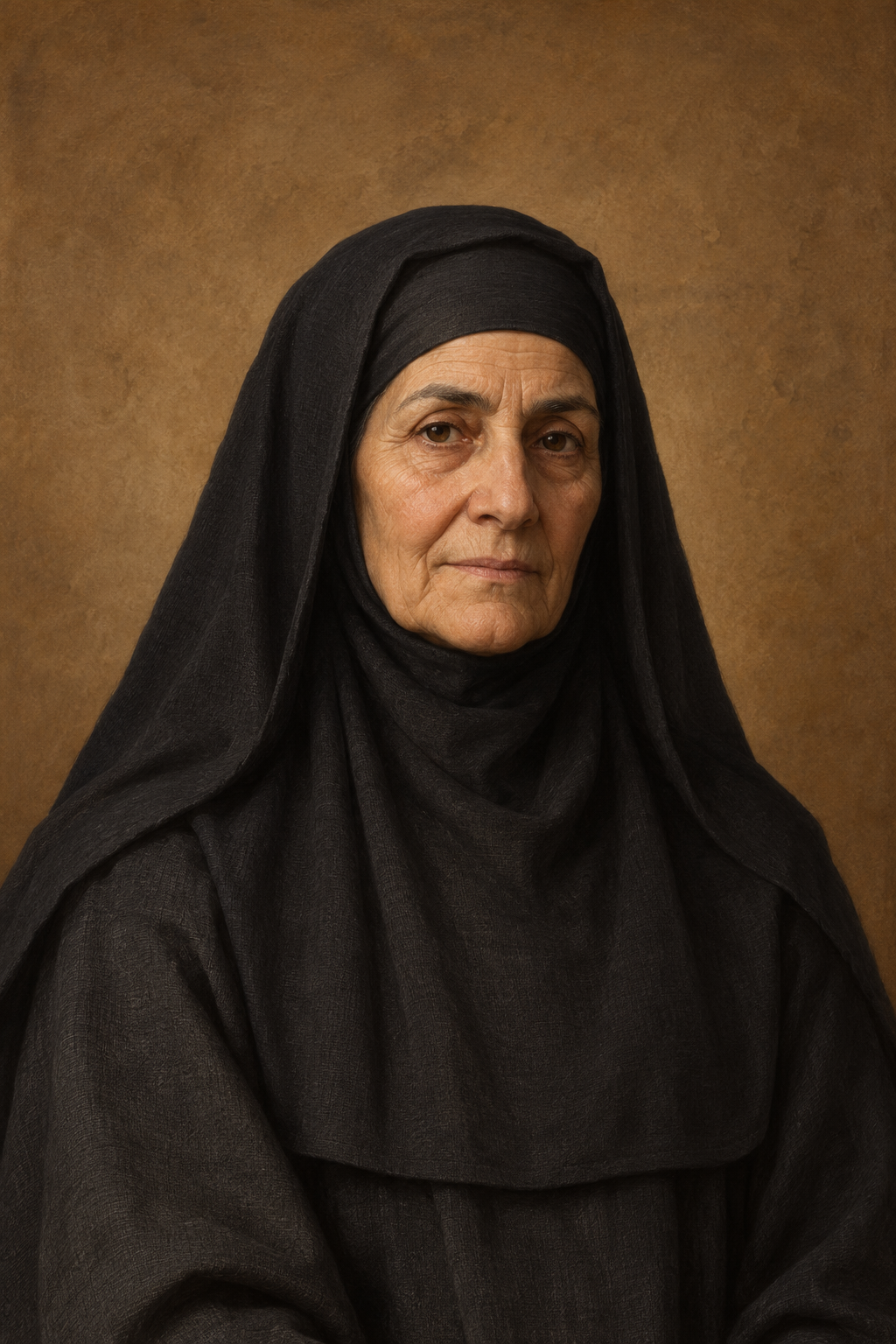
About Angelina of Serbia
Angelina Branković was an Albanian noblewoman whose marriage joined her life to an exiled Serbian ruling family. Her father was George Arianiti. She married Stefan Branković, the blinded former Serbian despot, and their children included George, John, and Mara. The family settled in northern Italy, where Stefan died in 1476.
Angelina remained a widow in Italy before accepting an invitation from the Hungarian king Matthias Corvinus. In 1486 she brought her family and her husband’s remains to Srem. Her later movements took her to Wallachia and back to Srem. These journeys placed her within a network of courts, monasteries, and relatives stretching across several political and religious boundaries.
Her support for religious communities is documented in charters issued with her sons. They made provision for the Athonite monasteries of Saint Paul, Hilandar, and Esphigmenou. These records show her acting publicly as a benefactor, rather than appearing only in later stories about her family. She also appealed to the Moscow ruler Vasily III for help with monastic building.
Together with her son George, who became the monk and metropolitan Maksim, Angelina helped establish Krušedol. The Serbian Orthodox Church’s historical account also identifies her as the founder of a nearby women’s community whose church was dedicated to the Presentation of the Lord. The two foundations should not be treated as a single indistinguishable building project.
The larger monastery acquired a role beyond family burial. Nikola Piperski explains that, as Maksim became metropolitan of Belgrade, Krušedol also developed as an episcopal center. Support from Wallachia contributed to its construction. Its church drew on forms associated with Athos and late medieval Serbian architecture. The buildings seen today include substantial later alterations, so their present appearance should not be treated as an unchanged survival of Angelina’s foundation. Yet the original project helped establish a religious center north of the Sava and Danube whose importance endured through successive changes of political rule.
Her nearby women’s foundation had a distinctive place in this landscape. Miroslava Kostić notes that such convents were uncommon north of the Sava and Danube at the time. The church remained associated with Mother Angelina even as its furnishings changed in later centuries, preserving her memory within a separate community.
Art historian Jelena Erdeljan places these foundations within the Branković family’s effort to preserve religious memory in exile. Krušedol became a repository for family relics and a focus of dynastic remembrance. Angelina’s giving also crossed confessional boundaries: Erdeljan records gifts for the relics of John the Merciful in Bratislava and Simeon the God-bearer in Zadar. Her Orthodox identity did not prevent her from supporting shrines in the Catholic West.
Angelina eventually became a nun, keeping her name. The precise date of her vows is uncertain. Manuscript evidence also connects her with religious reading: the Orthodox Encyclopedia identifies a manuscript of John Chrysostom’s homilies on Genesis that belonged to her. A larger personal library is possible, but not securely documented in its entirety.
The Russian Orthodox monastic account remembers her later years through prayer, charitable work, and the care of family relics. Its calendar lists commemorations on July 1 and December 10. These are Russian calendar observances, distinct from the Serbian July commemoration.
The surviving life of Mother Angelina is not an autobiography. Boris Stojkovski attributes it to an anonymous monk of Krušedol, perhaps around 1530, and describes the family’s lives as brief texts with few personal details. He notes that her life mentions the journey from Italy to Srem and monastic foundations, while offering little information about Hungary itself. Such sources preserve religious remembrance without providing a complete record of every stage of her life.
Liturgical poetry gave that memory another enduring form. Dominika Gapska identifies a sixteenth-century service in Angelina’s honor, probably composed in the circle of Krušedol. Its author is unknown. She notes that the service entered successive editions of the Srbljak, the collection of services for Serbian saints. In her interpretation, worship also transmitted an understanding of Angelina as an heir to the family’s sacred tradition. The hymns connected personal sanctity with collective endurance during political upheaval. This helps explain how a noblewoman living much of her life away from Serbia came to be remembered as Mother Angelina by later generations. The manuscript she discusses is preserved in the Serbian Orthodox Church’s museum.
Her association with Krušedol continues in the monastery’s patronal celebration, or slava. Although its principal church is dedicated to the Annunciation, the monastery celebrates Mother Angelina as its patron saint. A diocesan report from 2016 describes the relic venerated as her hand being carried from Krušedol to Sremski Karlovci. Clergy, choirs, and local people joined the procession. This records a continuing practice of devotion; it does not independently establish the physical history of the relic. Her memory remains rooted in the religious communities that her family helped sustain.
Wondering how to weigh the stories and sources? Learn how to read a saint biography.