Biography
Anthelm of Belley
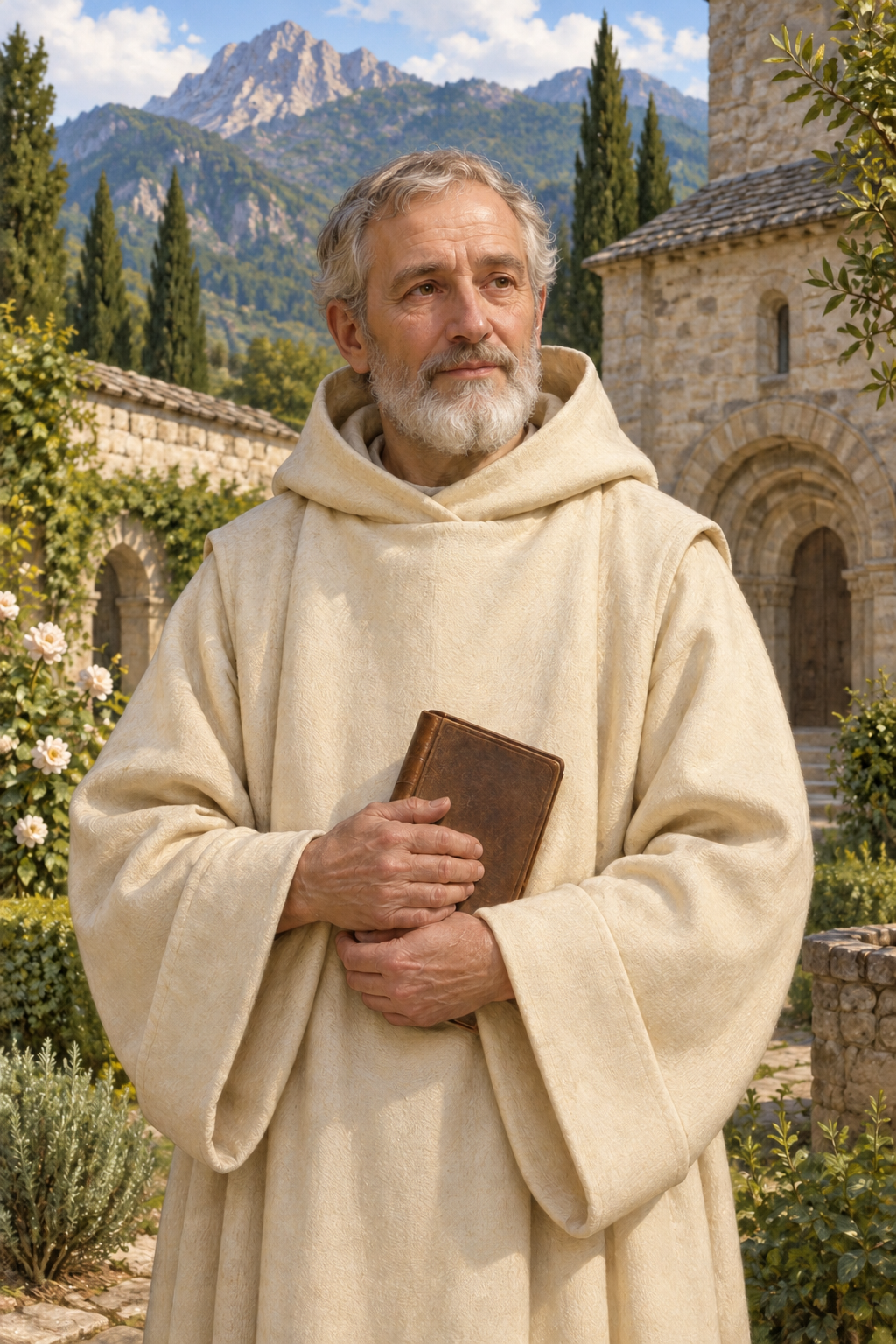
About Anthelm of Belley
Anthelm moved from cathedral service at Geneva and Belley to Carthusian life. He became prior of the Grande Chartreuse and later bishop of Belley, in 1163.
His medieval life remembers visits to religious women and people with leprosy, with care for their material and spiritual needs.
One remembered act made this charity concrete: after damaged harvests, he distributed stored grain to farmers who lacked both food and seed, treating the monastery’s resources as available to meet their need.
As bishop, he continued returning to a solitary cell among the monks. The author describes him asking their prayers and joining their ordinary observances.
A letter to Louis VII gives a more direct view of his dealings outside the monastery. Addressing the king as bishop of Belley, Anthelm recalled a royal visit to the Chartreuse and promised prayer for the king and the stability of his realm. He urged mercy, sound judgment and gentleness as qualities of kingship. The letter then made a particular request: support for Anthelm’s nephew, who was studying in Paris and needed the means to continue. The text brings counsel, family responsibility and a request for patronage together, without telling us whether the king granted the assistance.
Firmness also marked his authority. The life describes his refusal to reconcile a count without reparation, even after papal intervention. It later presents a deathbed reconciliation. This is a sympathetic account of a contested exercise of power.
The life’s authorship and date deserve caution. Rosalind Green summarizes competing scholarly positions: a Carthusian of Portes writing around 1178, or a Belley canon writing in the 1220s. Jean Picard favoured the former; De Meyer and De Smet argued for the latter, citing the treatment of Hugh of Lincoln as a saint and apparent departures from Carthusian practice. The disagreement cautions against treating the work as an unquestioned eyewitness record.
Green places Anthelm’s story among biographies portraying Carthusian holiness through monks who became bishops. These works need careful reading as expressions of religious ideals as well as accounts of lives.
Green’s comparison also places the Life beside accounts of Hugh of Lincoln and Hugh of Grenoble. The connection was not simply that all their subjects had belonged to the same order: Hugh of Grenoble had supported the Carthusians without himself becoming a Carthusian monk. Authorship, patronage and the ideals expressed by a text all matter when considering its religious setting. Green therefore brings Guigo’s writings on Carthusian practice into the comparison as a more direct account of the order’s principles. This approach keeps a saint’s biography from serving unquestioned as a rulebook for monastic life.
Catholic tradition remembers Anthelm on 26 June. His life brings practical charity into the responsibilities of leadership.
Anthelm’s later cult joined the cathedral and the Carthusian communities. A published account of the transfer of his relics in 1630 describes an inquiry before the ceremony. The cathedral chapter and civic representatives requested a more honoured setting, while the inquiry considered the identification of the tomb and existing public devotion. The bishop’s decree authorized a transfer to a new chapel. These proceedings record the community’s recognition of the remains; they are not modern scientific authentication.
The ceremony on 26 June involved clergy, religious communities, civic officers, school pupils and local confraternities. The account describes new vestments, a receptacle prepared by Visitation nuns, prayers through the night and a procession before the relics were placed in the chapel. It also records the invitation of neighbouring Carthusian priors, of whom two attended. The presence of both civic and religious groups made the occasion a public renewal of Anthelm’s place in Belley’s memory. Its descriptions of extraordinary fragrance and healing belong to the devotional claims of the report, rather than independently verified effects. The dated episcopal record identifies this event as a transfer of relics, not a new canonization.
Letters exchanged in 1633 show a further consequence of that renewal. Justus Perrot, prior of the Grande Chartreuse and the order’s general, thanked Bishop Jean de Passelaigue for honouring Anthelm. He granted the bishop a share in the Carthusians’ prayers and spiritual exercises and promised a continuing commemoration after his death. The letter describes prayer as reciprocal support: pastors pray for their people, and the people also sustain their pastors. Anthelm’s memory provided the occasion for strengthening a living relationship between the diocese and the order.
The bishop’s reply accepted that association with gratitude. He described monastic solitude as compatible with helping the wider Church through prayer and invoked Anthelm as a figure belonging both to the Carthusians and to Belley. His language treated the surviving monks as continuing the spiritual example honoured at the tomb. This correspondence is evidence of how a later bishop understood Anthelm’s legacy, not testimony from Anthelm’s lifetime. Together, the letters and the transfer record show how remembrance could take practical institutional forms: shared prayer, a public observance and continuing obligations between communities.
Wondering how to weigh the stories and sources? Learn how to read a saint biography.