Biography
Anthony of Kiev
About Anthony of Kiev
Anthony of the Caves is remembered as an early founder of monastic life in Kyivan Rus. He was born around 983 in Liubech, near Chernihiv, according to later biographical sources, and was called Antyp before taking his monastic name. The precise details of his childhood are not securely documented. What the surviving accounts emphasize is the direction he eventually took: toward the disciplined life of a monk.
Orthodox tradition places Anthony's monastic formation on Mount Athos. The Orthodox Church in America's account says he received tonsure there and was sent back toward his homeland by his superior. Its account of the superior's blessing is later devotional writing, not a contemporary transcript. The tradition nevertheless expresses a lasting feature of Anthony's memory: a solitary discipline learned in the Greek monastic world was carried into Rus. The extent and exact timing of his Athonite stay remain uncertain.
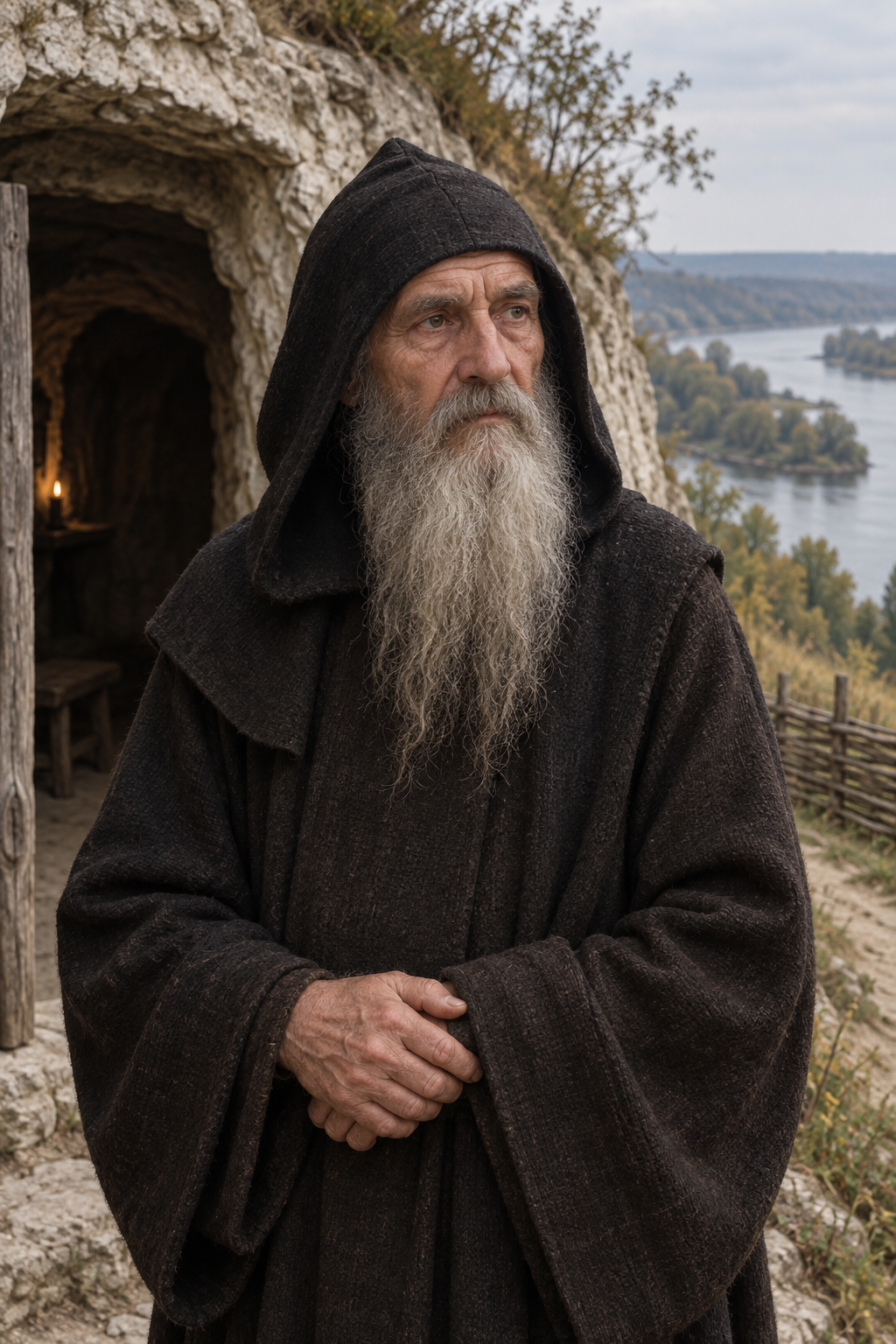
Returning to the Kyiv area, Anthony settled in a cave near Berestove. The Encyclopedia of Ukraine reports the tradition that the cave had earlier been used by Ilarion, who became metropolitan of Kyiv. Anthony's withdrawal did not keep others away. People came to him, and some stayed to pursue monastic life. This early community formed the nucleus of the Kyivan Cave Monastery. The later name “Pechersk” points to the caves that first housed the monks; it does not describe the large architectural complex that visitors know today.
The National Preserve links the monastery's foundation to a chronicle entry for 1051. It says Anthony occupied a cave and gathered followers, then appointed Barlaam superior when the group numbered twelve monks. These details reach us through medieval narratives rather than contemporary records and remain traditional.
Anthony did not simply become the head of an institution and remain at its center. In the OCA's account, he appointed Barlaam to lead the brethren and then dug another cave for his own prayer. Yet monks began to settle near him there as well. This sequence is a traditional account of a monastery growing around a man who still sought solitude. Sources do not use the same cave labels consistently, so identifying one surviving chamber as the exact site of every episode would go beyond the evidence.
Theodosius of the Caves became central to the community's next stage. In an interview with Vatican News, medieval historian Dmytro Hordienko distinguishes Anthony as the first founder from Theodosius, under whom the monastery took a more stable common form. This distinction helps avoid assigning every later rule, building, or practice to Anthony alone. The two men are remembered together, yet their roles were not identical: Anthony's cave drew followers, while Theodosius shaped a shared pattern of life for the growing brotherhood.
The monastery's growth also involved rulers and land. The National Preserve recounts a grant from Prince Iziaslav when the group had become large enough to build above the caves. Wooden church buildings and cells preceded the monumental churches of later centuries. Monks did not cease using the caves; some remained connected with worship and burial there. These developments show that Anthony's foundation was neither only a private retreat nor yet a finished institution. It changed as new members arrived and as a princely gift made more extensive buildings possible.
The later tradition is less certain about episodes that give the story a miraculous frame. The Encyclopedia of Ukraine notes that legends eventually arose about the monastery's saints and the building of its main church. Such accounts belong to the monastery's devotional memory; they cannot be treated as independently verified construction records. They still matter for understanding how generations of monks interpreted their foundation. The historical narrative can distinguish the growth of the community from later stories told to express the meaning of that growth.
The Encyclopedia of Ukraine also reports a brief displacement of Anthony to Chernihiv after conflict with Prince Iziaslav, followed by his return to Kyiv. The episode gives a glimpse of the monastery's place within the political world of Rus, though the surviving summaries do not establish every motive or date. Anthony's death is placed in Kyiv in 1073. The OCA life gives July 10 as the received death date and commemorates him on July 10. The Encyclopedia of Ukraine separately gives July 23 as the feast, with July 10 old style in parentheses. Neither source supplies a secure date of birth.
Anthony's later reputation spread beyond the group that gathered in his cave. The monastery became a center of monastic writing, worship, and education, and its histories kept his name alongside Theodosius. A modern historian cautions that the foundation should be understood through both their roles: Anthony began the cave community, while Theodosius gave it lasting communal structure. Anthony remains significant as a figure through whom an Athonite monastic ideal became part of the religious life of Kyivan Rus, and whose remembered search for solitude helped start a durable community.
Wondering how to weigh the stories and sources? Learn how to read a saint biography.