Biography
Artemide Zatti
About Artemide Zatti
Artemide Zatti was born at Boretto, in Reggio Emilia, Italy, on October 12, 1880. The says he learned sacrifice early and was already working as a farm laborer at nine. The profile should use this detail plainly, without making childhood hardship into spectacle.
Poverty pushed the Zatti family to emigrate to Argentina while Artemide was an adolescent. They settled at Bahía Blanca, where he first worked in a hotel and then in a brick factory. He began attending the parish served by the religious of Saint John Bosco and gradually turned toward Salesian life.
Zatti went to Bernal as a Salesian aspirant when he was twenty. The official profile describes that time as difficult: he was older than his companions but behind them in formal study. His strengths were tenacity, intelligence, and solid piety, not an easy path through formation.
While assisting a young priest with tuberculosis, Zatti contracted the same illness. He was sent to the Salesian house at Viedma, where the climate was expected to help his health. There he found a missionary hospital under Father Evasio Garrone, a Salesian nurse who effectively served as physician.
Father Garrone advised him to entrust himself to Mary Help of Christians and to promise lifelong service to the sick if he recovered. The source says Zatti recovered mysteriously. The profile can report the promise and recovery without turning the illness into a medical proof or adding miracle language beyond the source.
On February 8, 1911, Zatti made perpetual profession as a Salesian lay brother. Faithful to the promise connected with his recovery, he gave himself fully to the hospital. After qualifying for pharmacy work, he first distributed medicines, then took on wider responsibility.
When Father Garrone died in 1913, responsibility for the hospital fell on Zatti's shoulders. He became vice-director and administrator and worked as a nurse. The official profile says both patients and medical personnel respected him, and doctors gradually gave him more freedom of action.
This responsibility was practical and demanding. Zatti handled medicine, patients, administration, and relationships with doctors. The source does not present him as a licensed physician in the modern sense, so the profile should use nurse, pharmacist, administrator, and Salesian brother rather than inflate his title.
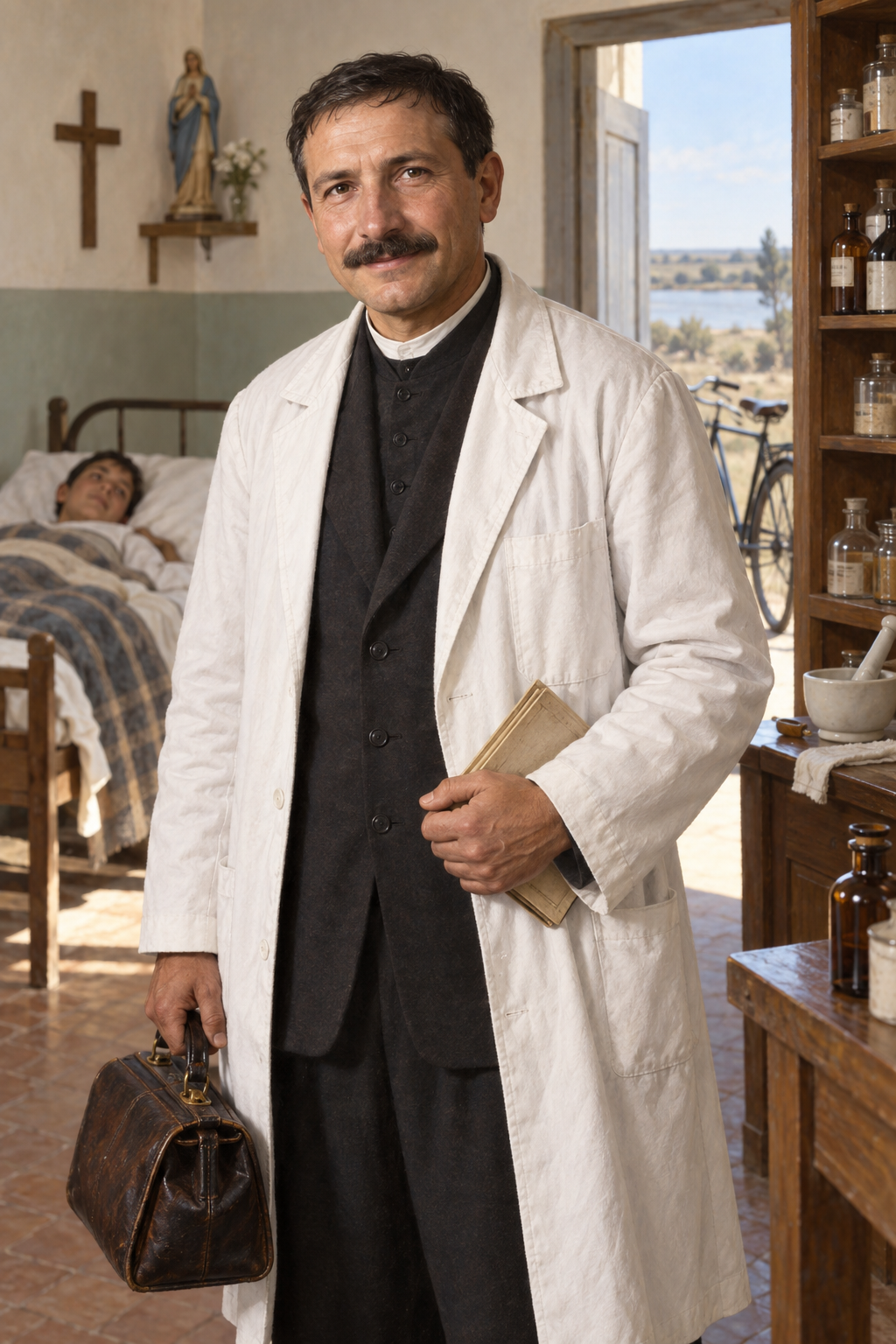
His service did not stay inside the hospital walls. The source says he moved through the city of Viedma and crossed the Rio Negro to reach Patagones. He often went out in a white coat with a bag of common medicines, riding a bicycle and praying the Rosary.
The profile should treat the bicycle as a practical attribute, not a charming legend detached from service. It shows how Zatti reached people in need. The source says poor and rich people benefited from his care, but he especially loved serving those who had nothing and lived on the margins.
Zatti did not ask for payment. When someone gave him something, he used it for the hospital. The source also says he was available at any hour and in any weather, while preserving good relations with physicians and legal administrators even when views differed.
This availability should be described without making him superhuman. The reliable claim is steady service across ordinary and difficult conditions. His care reached poor people in outlying places, and the source emphasizes both humility and balance in his relationships with patients, doctors, and hospital authorities.
He remained a community man. The official profile says he lived Don Bosco's motto of work and temperance and was regular in community observance despite being extremely busy. That detail keeps the biography from reducing him to a medical volunteer; he was a Salesian brother serving from religious life.
Community observance is especially important for the final tone. Zatti's work was expansive, but the official profile also shows punctuality, prayer, and obedience. His service to the sick should therefore be read as a vowed brother's mission, joined to the Salesian house, not as an isolated charitable career.
In 1950, after a serious fall, clinical exams found signs of cancer, which Zatti recognized clearly. He continued his mission for several months. After a period of suffering lived consciously and surrounded by affection and gratitude, he died on March 15, 1951.
The official profile says people from Viedma and Patagones came to his funeral in exceptional numbers and that devotion grew quickly. It records his beatification by John Paul II on April 14, 2002, and canonization by Pope Francis on October 9, 2022. Current devotion should not be overstated beyond the source.
Artwork should show a Salesian lay brother in dark clothing or a white work coat in a modest Viedma hospital or pharmacy setting. A bicycle, medicine satchel, or simple bottles can appear as attributes. Avoid modern scrubs, modern medical equipment, rendered labels, graphic illness scenes, and any claim to historical portrait likeness.
Wondering how to weigh the stories and sources? Learn how to read a saint biography.