Biography
Assicus
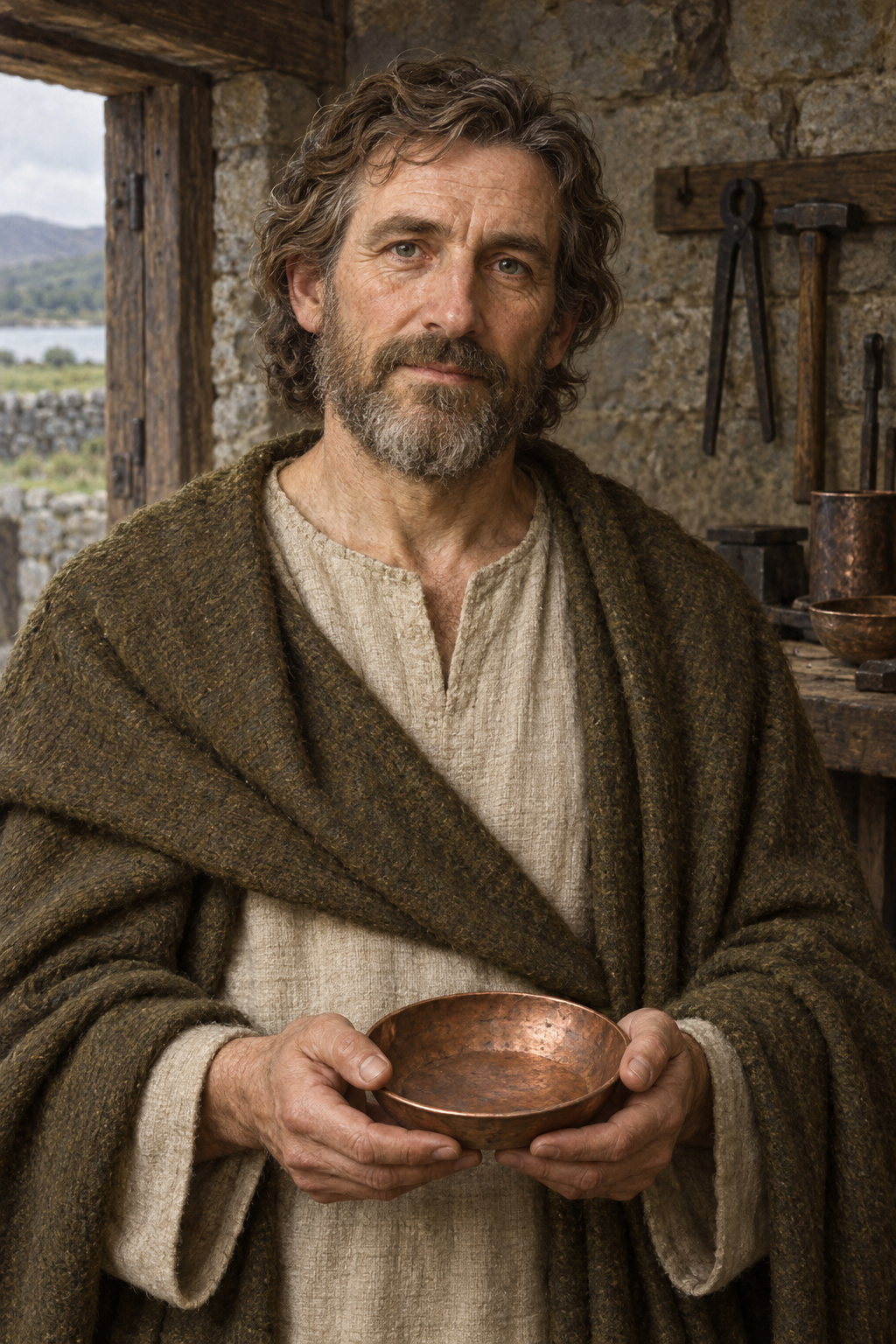
About Assicus
Assicus, also known as Asicus, is honored as a patron of the Diocese of Elphin and of coppersmiths. His feast is celebrated on April 27.
The Tripartite Life of Patrick remembers him as a bishop and craftsman placed at Elphin. It describes him making altars, rectangular tables, and book covers for Patrick, and names churches where examples of his work were remembered. The same account tells of a painful withdrawal: Assicus leaves for the north because of shame associated with a falsehood. He spends seven years on an island before his monks find him in the mountain glens and bring him away. He dies with them in the wilderness, and they bury him at Raith Cungai. The narrative joins craftsmanship, religious responsibility, and a community’s search for its absent leader. It is a traditional account, however, rather than a contemporary record of every journey and conversation. The text’s association with Patrick does not make the whole Life Patrick’s own writing, and its descriptions cannot authenticate surviving objects as Assicus’ personal work.
The distance between the remembered life and its written transmission matters. In his introduction to the 1887 edition, Whitley Stokes argues that the Tripartite Life cannot have been compiled before the middle of the tenth century and probably belongs to the eleventh. He bases that judgment on historical allusions and features of the language, while acknowledging that it uses older documents. His assessment therefore leaves room for earlier material without making the compilation a fifth-century eyewitness account. The printed text and translation also expose uncertainties that smooth modern retellings can hide. A note preserves a different reading of a family relationship, and another identifies a passage as misplaced. Such details counsel restraint when reconstructing Assicus’ family or the precise circumstances of his departure.
Later writers have approached the story with different degrees of confidence. John Healy, Archbishop of Tuam, retells it in his 1905 Life and Writings of Saint Patrick and interprets Assicus’ shame as evidence of his moral character. Healy also reports looking for the grave near Ballintra without finding a recognizable trace. His report is valuable as an account of his own search and interpretation. It does not prove that the medieval narrative happened in every detail, nor does the unsuccessful search settle the identity of remains at the place now honored as the saint’s grave.
His name and dates require similar care. The Norwegian Catholic directory records both 470 and 490 as proposed years of death. It also warns against confidently identifying him with Tassach of Raholp, another saint remembered as a metalworker associated with Patrick. This profile therefore retains Assicus and verified name variants, while leaving his birth and death dates unknown. It does not combine the two saints’ stories. The directory reports confirmation of his cult under Leo XIII in 1902; that is a later recognition of veneration, rather than evidence for the proposed fifth-century chronology.
Local devotion has remained visible. Sligo Cathedral’s newsletter for August 26, 2012 announced that the bishop would celebrate Mass at the place called Assicus’ tomb near Ballintra. It identified him as the patron of Elphin and arranged transport for those wishing to attend. This is a concrete record of a community honoring him centuries after the medieval text was copied. It documents the announced celebration and the place’s devotional importance, without establishing that the Mass occurred as planned or authenticating the grave’s contents.
The diocesan website continues to direct visitors to the grave near Ballintra. For Elphin, Assicus remains the saint whose remembered skill served the church. His feast gives the community a shared day of remembrance. The present patronage and commemoration are clear even where the details of his early life remain provisional.
Wondering how to weigh the stories and sources? Learn how to read a saint biography.