Biography
Athanasius of Meteora
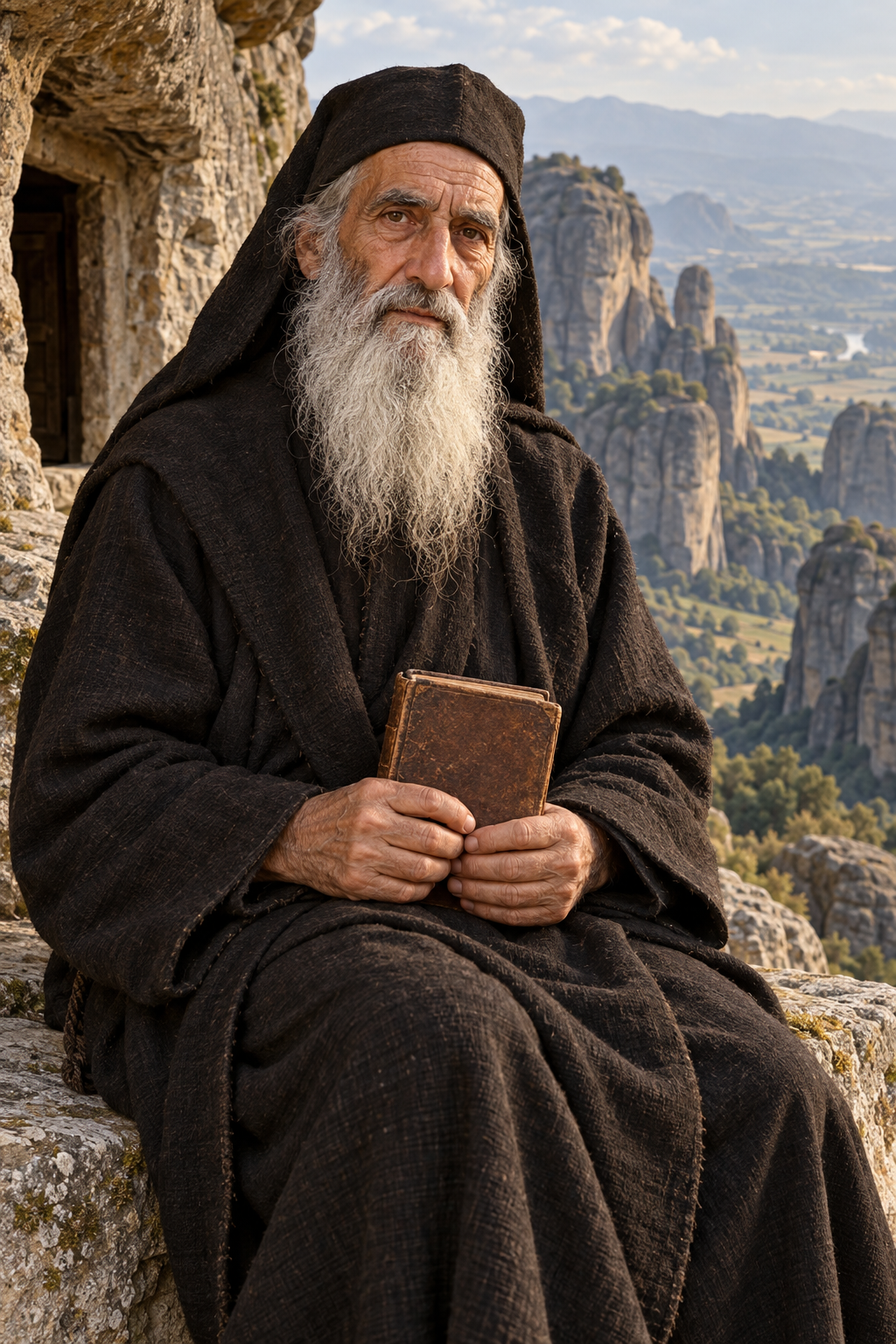
About Athanasius of Meteora
Athanasius of Meteora helped turn a place of scattered hermit dwellings into a community with a shared rule of life. He founded the Great Meteoron in Thessaly, on a high rock that he named Meteoron. His work belonged to an existing monastic landscape: hermits and small communities were already established around Doupiane. His particular contribution was to organize monks around common worship and common provision, while retaining a strong commitment to secluded prayer.
The received account names him Andronikos before he became a monk. Born at New Patras, now Ypati, he lost his parents young and was brought up by an uncle. The capture of his hometown disrupted that upbringing. He escaped captivity and later reached Thessaloniki, where he pursued an education. The church biography describes teachers allowing him to study without payment after noticing his eagerness to learn. These details come through the story of his life preserved by his admirers.
His search for a monastic home took him to Athos, Constantinople and Crete. The account describes an early refusal at Athos because he was still a beardless youth. He eventually returned as an adult and joined the elders Gregory and Moses. His names changed with successive stages of monastic commitment: first Anthony, then Athanasius. Raids made that life insecure, and he left with Gregory and another disciple to seek a more secluded setting in Thessaly.
The Orthodox Encyclopedia places his move to the rock called Platylithos around 1340. Meteoron was the name he gave this high rock; it later came to describe the surrounding group of rocky summits. The same account describes a rhythm in which Athanasius spent weekdays in his cave and joined the community’s services on Saturdays and Sundays. Solitude and communal worship thus remained connected in the remembered pattern of his life, even as the number of monks around him grew.
His surviving rule gives a more direct view of the community he sought to establish. It requires equal food, drink and clothing, allowing exceptions for illness. Monks were to hold possessions in common, with clothing excepted because their sizes differed. A monk discovered keeping private property could be excluded from communion. The rule also required attendance at the daily night office. Its introductory narrative says that monks already living independently were allowed to remain, although new arrivals were to accept communal life.
It also prohibited selling surpluses of grain, wine or oil. The final clause acknowledges that distraction, weariness and overeating could interfere with the monks’ observance of prayer. Its restrictions also extended beyond the brotherhood. The rule prohibited teaching children secular letters and barred women from entering the designated boundary. More severely, it forbade giving a woman food even if she was starving. This exclusion is part of the surviving text and cannot be reconciled with a claim that its provisions extended equal care to everyone.
The monastery initially centered on a church dedicated to the Mother of God. As its community developed, a church of the Transfiguration became its principal place of worship and supplied the name by which the monastery is also known. The Orthodox Encyclopedia’s institutional history associates this development with a brotherhood of fourteen monks. The rock, cave and churches are therefore parts of a history of changing communal needs, rather than a single building project completed at one moment.
His death is usually placed around 1380, although an older chronology gives 1383. The Orthodox Encyclopedia explains that the earlier date follows Demetrios Sophianos’s reading of evidence about Makarios, whom Athanasius appointed to care for the community. A letter of November 1381 already calls Makarios its spiritual father. The same encyclopedia describes the Life as an anonymous work from the late fourteenth century; identifying its author more precisely remains less secure than identifying the community it describes.
Joasaph, the former ruler John Uroš, subsequently continued the foundation’s development. His enlargement of the Transfiguration church in 1388 was followed by further construction in later centuries. The large complex now associated with Great Meteoron should therefore not be imagined as a structure entirely built by Athanasius. A sixteenth-century expansion incorporated the older sanctuary into a larger church, and a refectory and kitchen followed. These later additions supported a community living long after the founder’s death. Its later growth preserved his foundation while substantially changing the buildings in which the monks lived and worshipped.
The monastery’s account traces his veneration through concrete witnesses. Athanasius and Joasaph appear as saints in its frescoes of 1483. A service in his honor followed, and a typikon written in 1580 records the founders’ commemoration on April 20 with a vigil the preceding evening. These witnesses show how his memory became part of the community’s worship. His lasting significance rests in the foundation and rule that later generations inherited, including provisions that require an honest account of their limits.
Wondering how to weigh the stories and sources? Learn how to read a saint biography.