Biography
Athracht
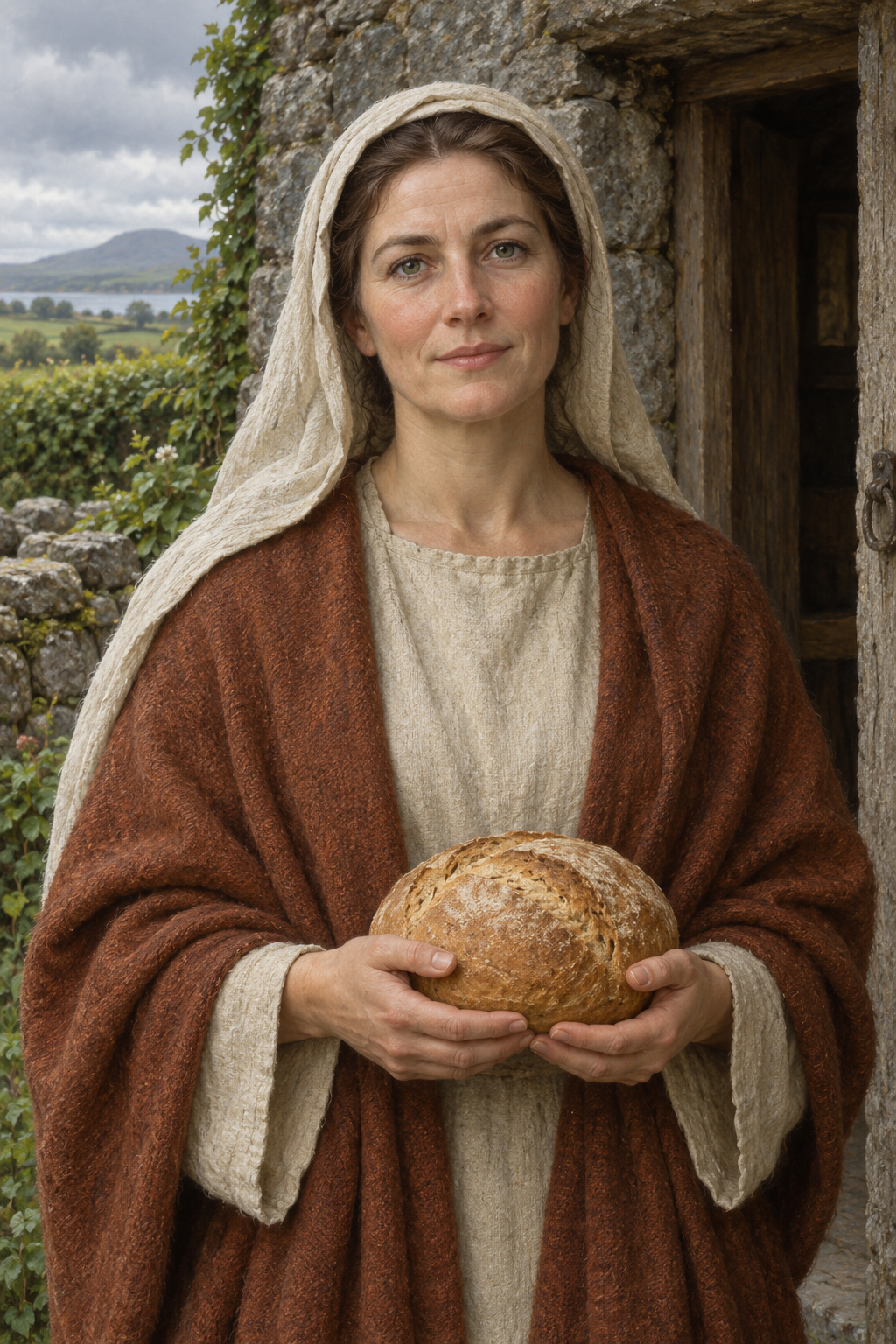
About Athracht
Athracht, remembered in Latin sources as Attracta, is a patron of the Diocese of Achonry. The Irish Catholic Bishops’ Conference records her commemoration on August 11.
Her received Life presents hospitality as a central commitment. It tells of a young woman who leaves home when her parents wish her to marry, traveling to Connacht with two companions. She vows to remain chaste and to establish a place where travelers can obtain what they need. The account gives the site a memorable feature: seven roads meet there. A companion discovers it, and a church and household are established with the inhabitants’ permission. This portrays Athracht taking responsibility for a religious foundation whose welcome reaches people arriving from different directions. It is a traditional portrait of her vocation, rather than a contemporary record of the journey and every conversation.
The same Life includes confrontations, curses, and spectacular miracles, rather than hospitality alone.
The transmission of that account places real limits on a biography. The editors of Acta Sanctorum say that the Life published by John Colgan lacked its beginning and ending. They repeat his conjecture that its unnamed author may have belonged to the Cistercian community at Boyle, centuries after the early Irish period in which the saint was placed. They also report doubts about the writer’s style and reliability, and acknowledge omitting some material. These judgments belong to the old editors and should not be treated as proof that every tradition was invented. They do show why the printed text cannot establish a precise family tree or a sequence of dated events. Its own notes question proposed relationships and identities.
Her association with Patrick creates a particular chronological problem. The present diocesan account identifies the episode of receiving a veil from him as legend and points out that other supposed contemporaries belong to a later century. It also preserves remembrance of her through holy wells in the diocese. Those continuing associations are clearer evidence of local devotion than of an exact birth year. Her birth and death dates remain unknown.
Modern scholarship considers these traditions within the wider history of Irish religious women. In Sacred Sisters, Maeve Brigid Callan places Attracta, also named Athracht, among saints whose stories survive through early modern adaptations of earlier Lives or legends. Her introduction distinguishes those forms of survival from the fuller medieval Latin Lives discussed elsewhere in the book. She also sets out a method attentive to women’s roles in religious communities and to the perspectives of the men who transmitted many of the texts. This offers a useful way to read Athracht’s reputation: the stories can preserve cultural memory and ideals of female religious authority without becoming a secure diary of an early life.
Her name remains part of institutional memory as well. St Attracta’s Senior National School in Meadowbrook identifies her as the patron of its school and parish. Its own account records the school’s dedication in 1977 and that of its oratory in 1981. The page pairs the English name Attracta with the Irish Athracht in its concluding invocation. These are specific examples of later remembrance, and a clear witness to the two names being used for the same saint. The school’s account of her early life is not used to settle the chronology left uncertain by the older sources.
For Achonry, the current patronage and feast are firmly recorded. The surviving tradition remembers Athracht as a woman who formed a place of welcome and a community around it. That emphasis on hospitality remains meaningful even where the date of the foundation, the identities of her relatives, and the details of the miraculous stories cannot be established independently.
Wondering how to weigh the stories and sources? Learn how to read a saint biography.