Biography
Augustine Jeong Yak-jong
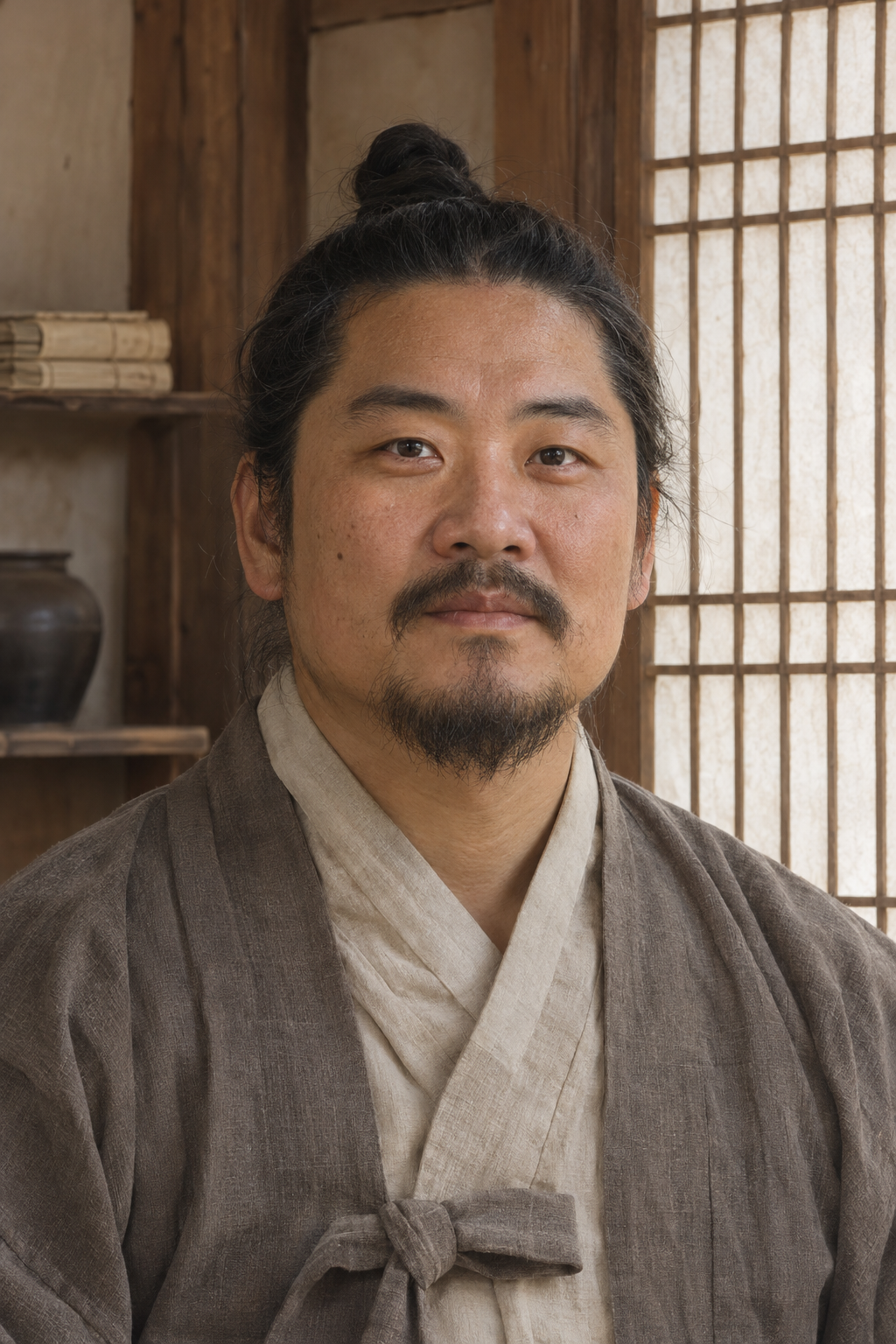
About Augustine Jeong Yak-jong
Augustine Jeong Yak-jong grew up in the Jeong family of Majae, in Gwangju. His brothers Yak-jeon and Yak-yong pursued the learning associated with their scholarly circle and the civil examinations. Yak-jong initially followed a different interest, Daoist teachings about prolonging life. Catholic instruction eventually displaced that search. His family was connected by marriage with several early believers, including Yi Byeok and Peter Yi Seung-hun, but those connections did not make agreement about religious practice easy within the household.
In his interrogation in 1801, Yak-jong traced his first instruction to his elder brother Yak-jeon in 1786. Historian Cha Gi-jin distinguishes that statement about hearing the teaching from a precise record of baptism. John Choe Chang-hyeon identified Yi Seung-hun as the person who baptized him and Francis Xavier Kwon Il-sin as his godfather. Cha places his entry into the Church probably in 1786–1787. The distinction matters because the surviving testimony does not establish an exact baptismal day.
His commitment outlasted the religious enthusiasm of some relatives. Opposition from his father, and the dispute over Catholic refusal of ancestral rites, made continued life at Majae difficult. After the death of his first wife, he married Cecilia Yu. He eventually moved with Cecilia and his eldest son, Charles Jeong Cheol-sang, across the river to Bunwon. There he could teach and practise his religion away from the immediate pressure surrounding the ancestral ceremonies in his original household.
Bunwon became a place where people of markedly different social standing learned together. Shin Ui-sik’s study identifies Choe Gi-in, the son of an enslaved person belonging to Jeong’s household, among those instructed there. The same study cites the testimony of Thomas Im Dae-in, who had worked in the household and learned the Ten Commandments. These named relationships give substance to Jeong’s reputation as a teacher beyond his own scholarly and family circle.
His contacts widened during the 1790s. Accounts examined by Cha place him in discussions with other Catholic leaders and record increasingly frequent visits to Seoul. In 1799 he wrote a letter for Beijing on Father James Zhou Wen-mo’s instructions, after communicating with the imprisoned Louis Gonzaga Yi Jon-chang; Thomas Kim Yu-san carried it at the end of that year. Arrests around Yeoju and Yanggeun in 1800 prompted his move to Seoul. Columba Kang Wan-suk helped him lodge first with Viviana Mun Yeong-in, before his brother Yak-yong helped him find another home inside the South Gate.
Father Zhou appointed Jeong the first head of the Myeongdohoe, a lay association for religious instruction and evangelization. Its precise founding date remains disputed. Small groups met in believers’ homes, and members’ study and teaching were reported to the priest. Admission involved an initial period in which their diligence was assessed. Women as well as men belonged. Jeong’s presidency thus connected his own teaching with an organized network of learners and instructors, rather than giving him responsibility for a single local gathering.
He also composed Jugyo-yoji in Korean, drawing on Catholic books without simply translating the Chinese work of the same title by Ludovico Buglio. Its two parts presented arguments about God and then the Christian account of creation, the Incarnation and redemption. The date of composition is generally placed in the later 1790s. Copies circulated before the persecution: a volume appears among books seized from Agatha Han Sin-ae’s house in 1801. This was a text being copied and used by believers during his lifetime.
Theologian Han Min-taek interprets the book’s arrangement as a connected course of instruction. The first part starts with knowledge of God through the created world; the second leads into salvation history and the life of Christ. In Han’s reading, Jeong sought to connect doctrine with the experience of people in Joseon, rather than merely finding parallels between Christianity and Confucianism. That interpretation helps explain the care involved in his Korean exposition: the sequence of teaching mattered alongside the language in which it was written.
Jugyo-yoji was not the end of his writing plans. He began Seonggyojeonseo, intended to bring together religious teaching scattered through other books, but persecution interrupted the work before completion. The surviving account describes it as less than half finished when he was arrested.
The persecution of 1801 brought his books and correspondence into the investigation. A chest being moved for safekeeping was discovered, exposing papers that authorities questioned him about after his arrest. During repeated interrogation, he sought to defend Catholic belief without supplying information harmful to other believers. The official life preserves his argument that worshipping God was a duty, identifying God as the supreme king and father. He refused to abandon that position under punishment. He was condemned and beheaded outside Seoul’s Small West Gate on April 8, 1801. His eldest son Charles also died in that persecution. Cecilia and their younger children, Paul Ha-sang and Elizabeth Jeong-hye, survived him, carrying the family’s Catholic life into another generation.
His catechism survived through manuscripts and later printed editions, but those witnesses are not all identical. Successive editors revised, shortened and supplemented the text. Its continued use preserved Jeong’s contribution to Korean religious instruction while also reflecting the changing concerns of later readers and teachers.
Wondering how to weigh the stories and sources? Learn how to read a saint biography.