Biography
Austrebertha
About Austrebertha
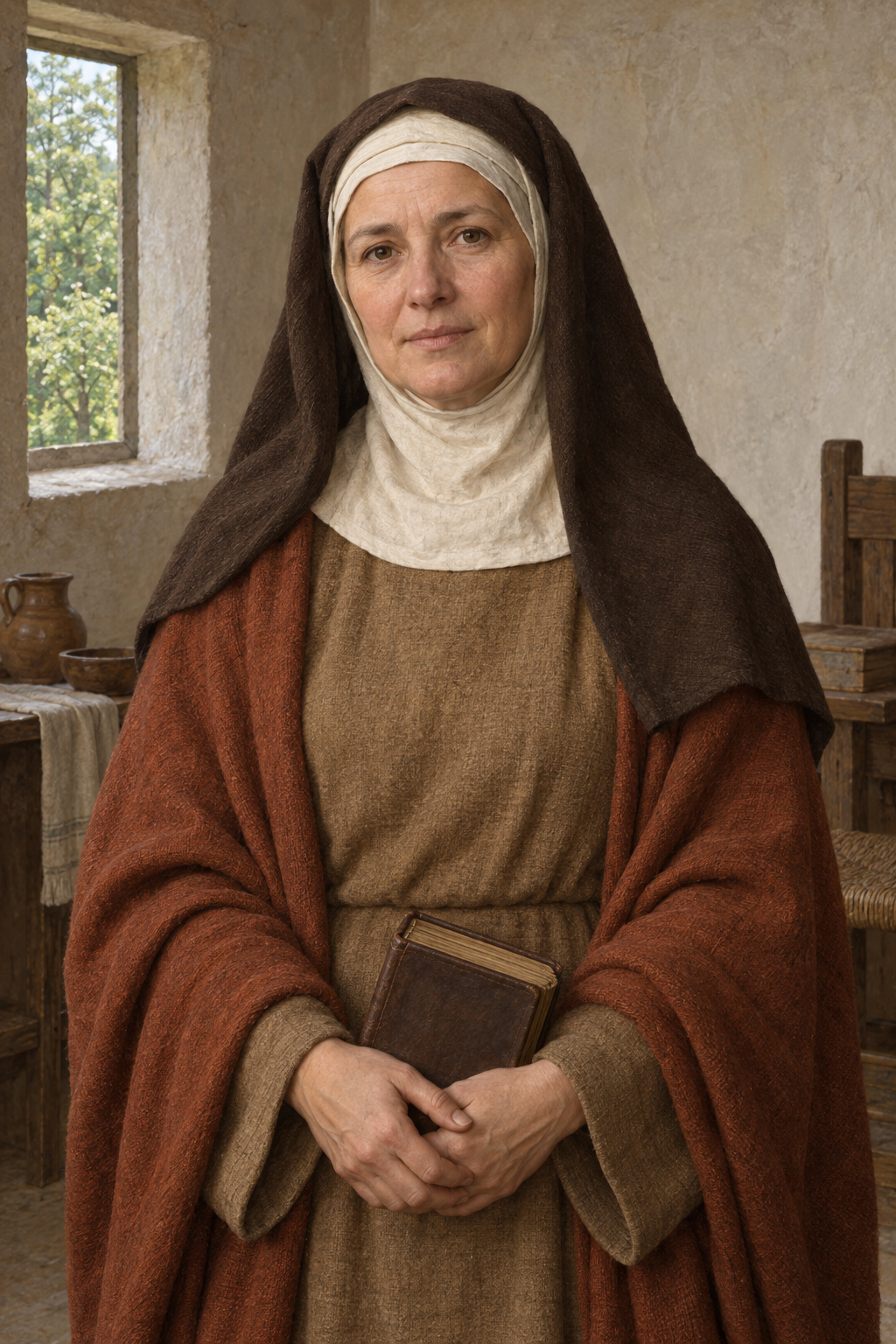
Austrebertha is remembered as abbess of Pavilly. Her surviving Life places her origins in the territory of Thérouanne and describes her entering a women’s community at Port, on the Somme. There she is portrayed as serving the other sisters before being given responsibility within the community. The account presents humility and steady attention to others as foundations of her leadership.
The same Life connects her move to Pavilly with Philibert and the needs of another women’s community. Its story includes opposition to her discipline and a dramatic threat from the monastery’s patron. That episode belongs to the hagiographic account; it is not an independently preserved trial record. The writer makes her courage central to the story, while portraying the threat as one she survived.
The account of her last illness emphasizes advice to retain patience and charity. Even at its close, the Life is concerned with how a community should continue after its abbess’s death.
The texts through which she was remembered should also be considered on their own terms. The IRHT manuscript catalogue identifies a Life and two miracle collections together in a Rouen manuscript, on folios 126v–133. This is evidence for the transmission of her story. A catalogue entry identifies the surviving texts; it does not independently verify all the events they narrate. The physical manuscript has not been used here as an eyewitness record of her lifetime.
Later devotion added a particularly familiar image: Austrebertha with a wolf. The Diocese of Rouen explicitly distinguishes the wolf-and-donkey story from the earlier accounts, calling it a later legend and noting its absence from the early biographies and ancient miracle texts. That qualification matters when looking at her representations. An animal beside her in later artwork belongs to the development of her cult, rather than proving an episode from her life.
Her remembrance also survives in the landscape of Pavilly. The town’s heritage account describes the former abbey chapel, its conversion to a stable and forge during the Revolution, and its restoration for worship in 1860. It records protection as a historic monument from 1934. A statue outside the chapel depicts the saint with a wolf, and a painting inside gives the animal a green color. These are documented features of the site and its devotional imagery. They should be distinguished from the seventh-century community and from the legendary actions represented.
The Catholic Church in Norway’s record places her life around 630–704 and gives 10 February as her commemoration. Those received years are retained approximately. They do not justify assigning an exact birth date or converting a narrated weekday into a modern calendar date.
Wondering how to weigh the stories and sources? Learn how to read a saint biography.