Biography
Barbara
About Barbara
Barbara is honored as a virgin martyr in longstanding Christian devotion, but the evidence does not permit an ordinary historical biography. Johann Peter Kirsch’s Catholic Encyclopedia study says no authentic early authority for Christian antiquity mentions her and that her name is absent from the original recension of the Martyrology of Jerome. Legendary Acts existed by about the seventh century, when her veneration was already becoming common. The same study finds public devotion established in East and West before the ninth century. Barbara’s cult is historically documented; the detailed story attached to her is later tradition, not contemporary testimony.
Even the place of martyrdom varies. Kirsch reports Heliopolis in one stream, Nicomedia in another, and Tuscany, Rome, or Antioch in martyrological adaptations. Such disagreement prevents a responsible birthplace, death place, or map coordinate. The database’s former dates of 250 and 306 also carried invented January 1 precision and are cleared. An official OCA life places Barbara under Maximian in 305–311 and at Heliopolis in Syria; Vatican News gives a birth at Nicomedia in 273. These incompatible details are evidence of living traditions, not grounds for combining them into a synthetic chronology.
The familiar passion begins with Barbara as the daughter of a wealthy pagan named Dioscorus. He confines his only daughter in a tower, according to the legend, restricting who may see her. Suitors seek marriage, but she refuses them. The OCA version describes her contemplating creation, rejecting idols, meeting Christian women after her father relaxes her isolation, and receiving baptism from a priest traveling in disguise. No early record confirms these scenes. They can still communicate the tradition’s concern with conscience and religious freedom, provided confinement and conversion are explicitly attributed rather than narrated as verified fact.
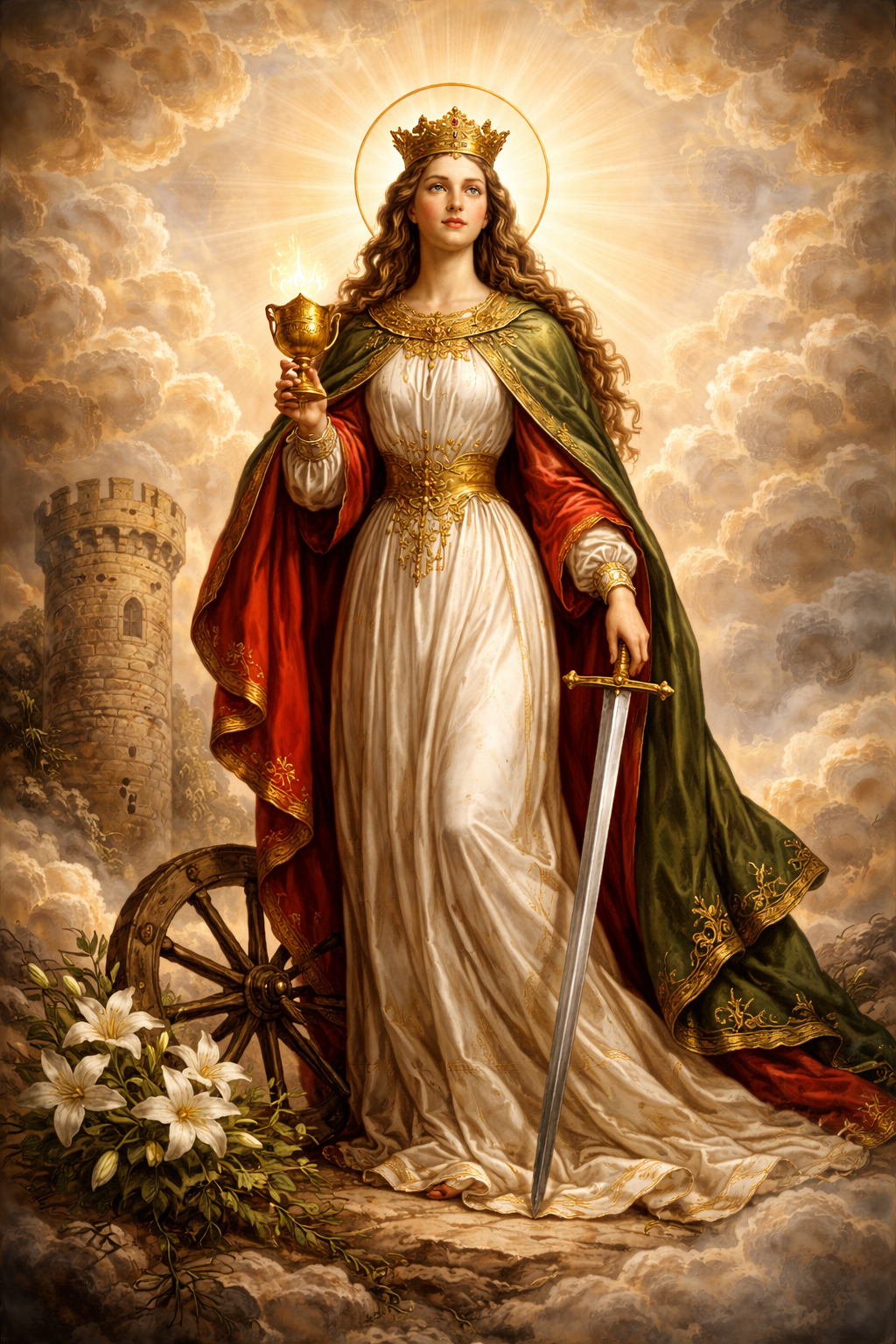
Another celebrated episode concerns a bathhouse her father is building. Barbara orders a third window added to the planned two and explains the three as a sign of the Trinity. The OCA account also says she traces a cross in marble, leaves footprints in stone, and that the bathhouse water later heals people. These miraculous details belong to the developed legend. Art often gives Barbara a three-windowed tower because of this episode, but the symbol is not architectural evidence. A devotional image may represent the story honestly only when its caption makes clear that it is modern and not a historical likeness.
When Barbara discloses her Christianity, the story says Dioscorus draws a sword and pursues her. A hill opens to hide her, but a shepherd reveals her refuge. Her father beats her, imprisons her, denies her food, and eventually hands her to an official named Martianus. The account then describes repeated torture and miraculous healing. Preserving the violence matters: the legend is about coercive control within a family as well as persecution by government. Yet details of supernatural escape and healing should not be used to turn abuse into spectacle or imply that faithful victims ordinarily receive immediate bodily rescue.
The OCA passion introduces Juliana as a Christian woman who witnesses Barbara’s torture, voices solidarity, and is seized. Both women are further tortured and led naked through the city for public humiliation; the legend says an angel covers them. They are then beheaded, with Dioscorus himself killing his daughter. The story ends with lightning killing Dioscorus and Martianus. This is severe material: incarceration, torture, sexualized humiliation, execution, filicide, and retaliatory death should not be softened. At the same time, the lightning episode is legendary and cannot justify vengeance against persecutors.
Later devotion drew symbols and patronages from the passion. The Catholic Encyclopedia explains that the lightning story probably led ordinary people to invoke Barbara against thunderstorms and fire, and later by analogy made her a protector of artillery workers and miners. The tower, sword, palm, chalice, and lightning became common attributes. These associations document the development of devotion, not events in Barbara’s life. Because patronage lists vary widely by place and occupation, this packet does not preserve the former sprawling parent-field list without jurisdiction-specific evidence. It records the relationship with Juliana and the received titles virgin and greatmartyr.
The OCA also recounts transfer of relics to Constantinople in the sixth century and then to Kyiv in the twelfth, where they were associated with Saint Volodymyr’s Cathedral. Those claims belong to ecclesiastical tradition and are not made into featured map events because the packet does not establish a traceable itinerary or verify relic identity. December 4, by contrast, is a documented present observance on both the OCA and Vatican News calendars. Calendar evidence shows how communities remember Barbara today; it does not establish December 4 as the exact date of an ancient execution.
No securely attributable words from Barbara survive. The OCA kontakion places a confession of the Trinity in her mouth, but a liturgical composition is not a trial transcript. The quotation field therefore identifies its words as liturgical attribution rather than verbatim history. No prayer is imported: the OCA provides troparia and a kontakion, but transforming a hymn into a general prayer would obscure genre and provenance. Publication would require exact-text review, translation credit, tradition, and rights status in the prayers workflow.
Barbara’s enduring significance lies in what generations found within the legend: conscience resisting confinement, a woman choosing faith despite patriarchal violence, and Juliana refusing to remain a silent spectator. Historical honesty strengthens rather than diminishes those themes. It allows readers to honor an ancient cult without claiming certainty the sources cannot give, and to reject the violence without romanticizing martyrdom. Her practical challenge is concrete: notice a person whose choices are being controlled or whose suffering is publicly humiliating, listen without taking over, and help that person reach appropriate support or safety.
Wondering how to weigh the stories and sources? Learn how to read a saint biography.