Biography
Barnabas Jeong Gwang-su
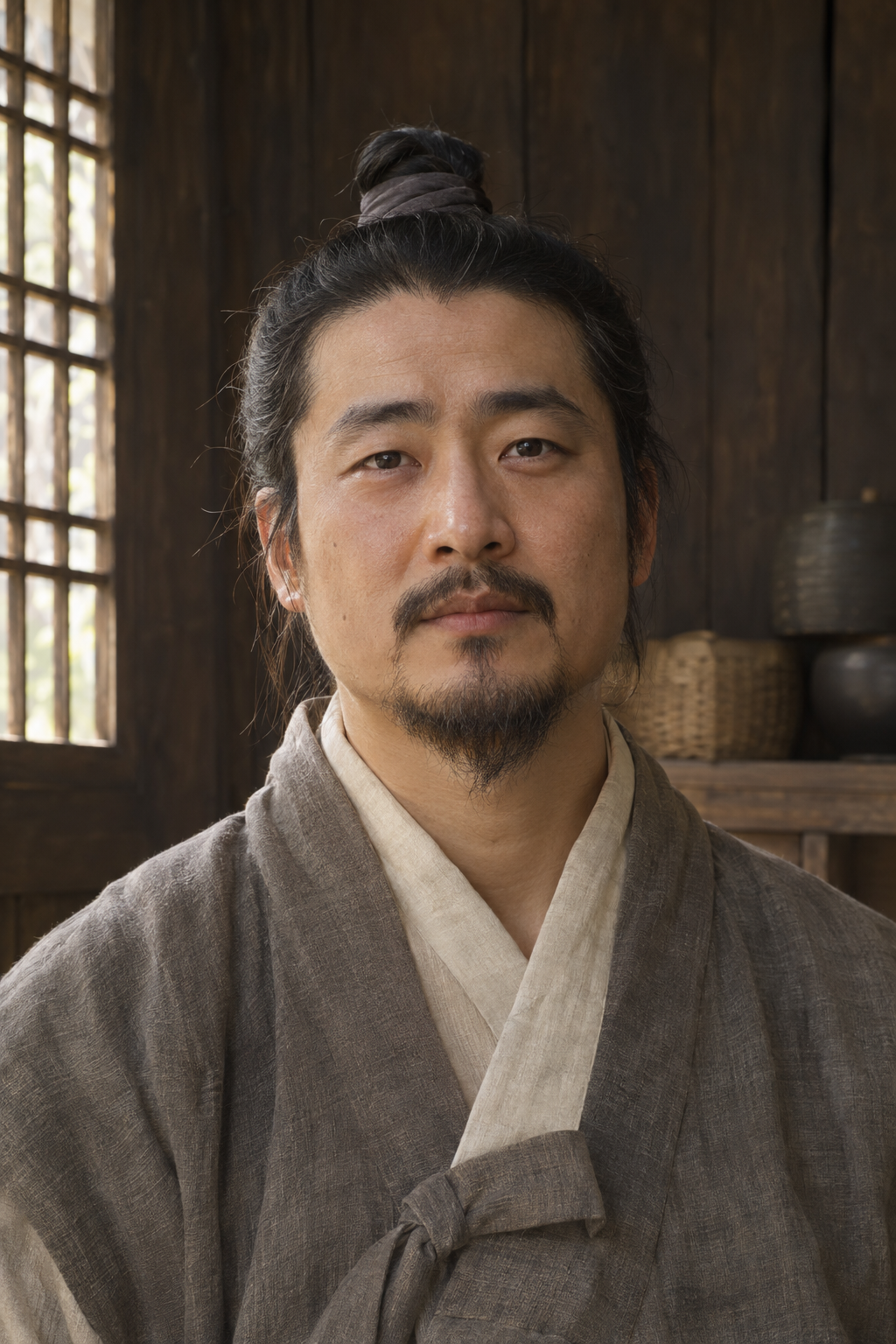
About Barnabas Jeong Gwang-su
Barnabas Jeong Gwang-su came from a yangban family at Bugok in Yeoju. Francis Xavier Kwon Il-sin taught him Catholic doctrine. He married Lucy Yun Un-hye without his parents’ consent or the customary marriage documents. His parents pressed him to abandon Catholicism and participate in ancestral rites.
He visited Father James Zhou Wen-mo in Seoul after the priest’s arrival. Zhou entrusted him with a letter for Josephat Kim Geon-sun in Yeoju, giving Barnabas an opportunity to introduce Catholic teaching there. The encyclopedia places this visit in 1797, when he stayed at Philip Hong Pil-ju’s house.
In 1799 the couple moved to Byeokdong in Seoul. Hong Yeon-ju records that Barnabas borrowed money from fellow Catholic Hong Si-ho and his sister-in-law Agatha Yun Jeom-hye. He built a small room in the open space at his home for religious study. The arrangement connected with the neighboring houses of Choe Hae-du and Jerome Jo Seop, whose dividing walls were opened so the households could meet together.
Jeong Min interprets this arrangement as a community project rather than simply Barnabas enlarging a private house. Gervase Son Gyeong-yun helped prepare the worship space by undertaking its papering. Jeong emphasizes how adjoining Catholic households could share entrances and passages. Visitors did not all have to use a single conspicuous doorway. Such arrangements also provided escape routes when searches threatened a gathering. The house’s usefulness depended on the cooperation of its neighbors as well as the couple who lived there.
Lee Won-hui’s study of early gathering places uses Barnabas’s house to distinguish a domestic room pressed into service from a separate space deliberately prepared for worship. The surrounding home remained a residence, while a dedicated room accommodated teaching and the visiting priest. This small arrangement belongs to the history of Catholic meeting places before the construction of public churches.
Yeo Jin-cheon describes a gathering there lasting three days and nights, with Zhou celebrating worship and teaching. Among the participants he names Philip Hong, Anthony Hong Ik-man, Simon Kim Gye-wan, Yi Yong-gyeom, Columba Kang Wan-suk and Agatha Yun.
Barnabas copied religious books for other believers. With Lucy he also made religious images and rosaries, which they sold or distributed. The books connected with their household included Gospel explanations, catechisms and guides for confession, prayer and meditation. The encyclopedia names the catechism Yori Mundap, the confession manual Gohae Yori and the meditation guide Muksang Jijang among them.
Cha Gi-jin’s account describes the couple working at night, drawing images of Jesus and Mary, carving wood for rosaries and copying Christian writings. By day they carried such materials to other believers. His description gives a practical sense of the household’s service: books and small devotional objects had to be made and passed from person to person. Barnabas’s teaching was therefore accompanied by work that placed religious materials in other people’s hands.
Jeong Min’s later investigation adds an economic dimension. He interprets the house as a workshop and sales outlet as well as a meeting place. He identifies evidence of professional copying commissioned for payment, distinguishing that arrangement from a believer casually lending a personal book. His discussion of the Korean expression for selling also cautions against automatically imagining itinerant peddlers. Materials could be produced and sold through the household itself. Jeong argues that Barnabas’s circle had a specialized role in supplying the Church, because accounts of making and selling devotional objects cluster around people connected with this house. These are the historian’s conclusions from the records, extending the older picture of a couple distributing things they had made. His spatial analysis links Byeokdong’s busy tavern trade with the congregation’s ability to meet without attracting attention.
One of the household’s books, Muksang Jijang, was a practical guide to meditation. Won Jae-yeon describes its stages of preparation, reflection and conclusion, including repentance, a resolution for daily life and thanksgiving. The book circulated in Korean as well as Chinese. Its presence alongside catechisms and confession guides shows the range of religious practice served by the collection: instruction for newcomers and materials for believers continuing their prayer.
The couple also taught their child Christian doctrine. Barnabas’s sister Barbara Jeong Sun-mae accompanied them to Seoul and joined the household.
Persecution broke up the household in 1801. Police seized Lucy when they raided the house. After fleeing between Seoul and the provinces, Barnabas surrendered. At the police bureau he refused to abandon his faith or identify other believers. He was transferred to the Ministry of Punishments and sentenced to death.
Sent back to Yeoju, he was beheaded on January 30, 1802. His wife and sister had already died in the persecution.
Later memorials in Yeoju place him among the district’s martyrs. Oh Se-taek describes a monument carrying their names, erected by the parish and city in June 2009. He explicitly distinguishes its position from the precise execution site. Barnabas is remembered locally alongside his sister, whose death also ended in Yeoju.
Wondering how to weigh the stories and sources? Learn how to read a saint biography.