Biography
Barnabas Kim I-u
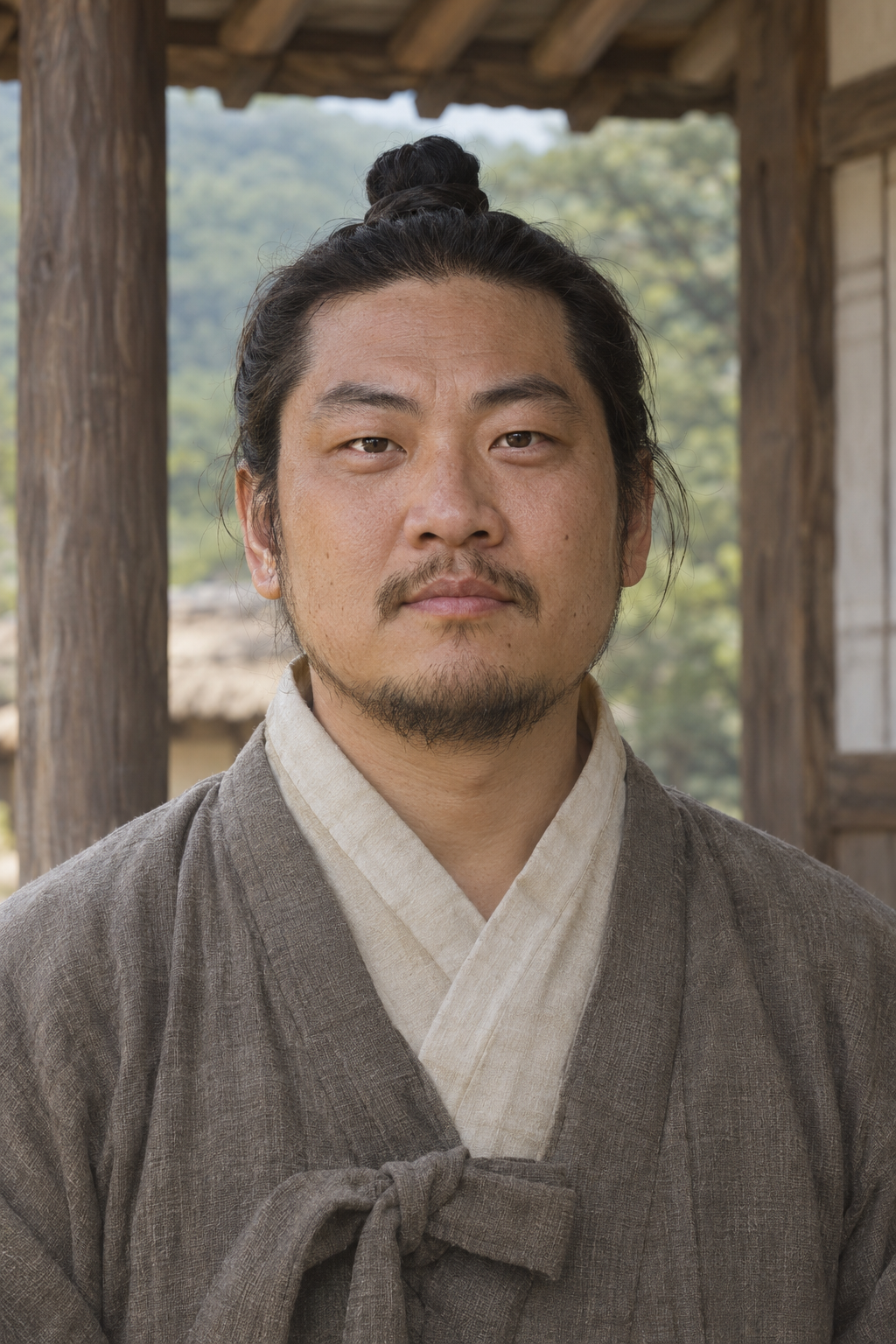
About Barnabas Kim I-u
Barnabas Kim I-u grew up in Myeongnyebang in Seoul, in a family known for interpreters. His elder half-brother was Thomas Kim Beom-u, whose home became an early Catholic meeting place. Matthew Kim Hyeon-u was his younger brother. Barnabas’s birth year is unknown.
Family records do not settle every detail of Barnabas’s early life. In his study of the Kim lineage, historian Kim Doo-heon observes that the genealogy omits the birth and death years of Kim Ui-seo’s elder concubine-born son, Barnabas.
Thomas’s own official biography makes the family’s introduction to Catholicism more concrete. After his baptism, the elder brother taught his younger brothers as well as lending books to other acquaintances. His house became a regular gathering place around the turn of 1784–1785, when meetings moved there from another Seoul household. In spring 1785 officials entered during a gathering, seized religious objects and books, and took the participants for questioning. Thomas subsequently suffered punishment and exile. Barnabas’s association with the faith therefore began within a family already exposed to the danger of opening its doors to fellow believers.
Barnabas also preserved a memory of his elder brother’s death. Jeong Min notes that Barnabas and Peter Yi Seung-hun placed Thomas’s death in 1786, contrasting their reports with the later genealogy’s 1787 date.
The Catholic Encyclopedia records that Barnabas remained unmarried as an adult. Among the Catholics with whom he worked were Peter Choe Pil-je, Yi Yong-gyeom, Gervase Son Gyeong-yun and Florus Hyeon Gye-heum. These were personal connections through which he shared the faith; the entry does not identify a public teaching office or a surviving book of his own.
Father James Zhou Wen-mo’s arrival at the end of 1794 brought Barnabas and Matthew into closer contact with the priest. They visited him at Philip Hong Pil-ju’s home. Barnabas subsequently offered his own house as a refuge when the priest was in danger. He also joined the Myeongdohoe, a lay association established by Zhou.
Journalist Ri Gil-jae’s 2026 account follows the brothers’ connections through their family. He describes Florus Hyeon’s continuing visits after Thomas’s death, citing Jeong Min’s historical study. The same feature reports historian Cha Gi-jin’s proposal that Barnabas’s home was the unidentified sixth meeting place in an interrogation concerning the Myeongdohoe. That identification remains a scholarly inference. The established account of meetings in his house does not by itself prove its place in a complete six-house arrangement.
The size and purpose of these gatherings have been debated. Jeong Min argues that the six principal meeting places should not be mistaken for the whole association. He understands them as centers supporting a wider network of smaller groups, with responsibility for admitting members and maintaining contact. In his reading, the organization distributed work among lay people while the priest could not personally reach every believer. He places the meetings at Barnabas’s house within this organized religious life. That interpretation gives the hospitality a continuing purpose beyond an isolated visit by the priest. It also leaves an important limit: evidence for a gathering in Barnabas’s house does not establish that he held one of the association’s six central offices. Jeong distinguishes the operators of meeting places from the officers responsible for the association as a whole.
Barnabas’s house also appears in Jeong’s reconstruction of the first attempts to escape the 1801 arrests. Yi Hap-gyu discussed hiding there, then consulted Columba Kang Wan-suk by letter. Kang directed the endangered men towards Juliana Kim Yeon-i’s house, where Hwang Sa-yeong had already sought shelter. Barnabas’s home belonged to this network of proposed refuges as well as to the community’s regular meeting places.
When the persecution began in 1801, Barnabas and Matthew were arrested and taken to the police bureau. Officials already knew that his house had sheltered Zhou and served as a meeting place. Barnabas endured questioning and repeated punishment without disclosing what they demanded. He died under beating in custody, around the fifth lunar month.
His baptismal name presents a further question. The modern Church calls him Barnabas, following the older missionary history. In a study of Christian names, Jeong Min points out that the recorded form Ballaso does not readily correspond to the Chinese form of Barnabas. He proposes that it is closer to a Korean rendering of Felix and calls for reconsideration. This is a historian’s qualified identification, rather than an established change to the name by which the Church commemorates him. The familiar name Barnabas is retained here alongside that unresolved historical question.
A later devotional painting offers another form of remembrance. Tak Hui-seong’s image, reproduced in the Jeonju diocesan bulletin, places Barnabas’s name above a domestic scene. A man in a broad black hat faces people gathered beside a raised wooden porch; a woman and children stand near the house. The picture recalls a household setting, while the accompanying caption identifies Barnabas as a martyr who died under beating. It is a commemorative work, rather than a contemporary record of his appearance or the layout of his home.
Wondering how to weigh the stories and sources? Learn how to read a saint biography.