Biography
Bartolomea Capitanio
About Bartolomea Capitanio
Bartolomea Capitanio was born in Lovere, in the Province of Bergamo, on January 13, 1807. The existing catalog stores both the full date and the Lovere birth place, and this draft preserves them.
The page should let Lovere remain more than a label. Lake, town, parish, schooling, family life, and local poverty all shaped the setting in which Bartolomea's vocation became concrete.
She was young when the work associated with her name took shape. That youth should not be sentimentalized. The sources present a person of energy, discipline, prayer, and practical purpose.
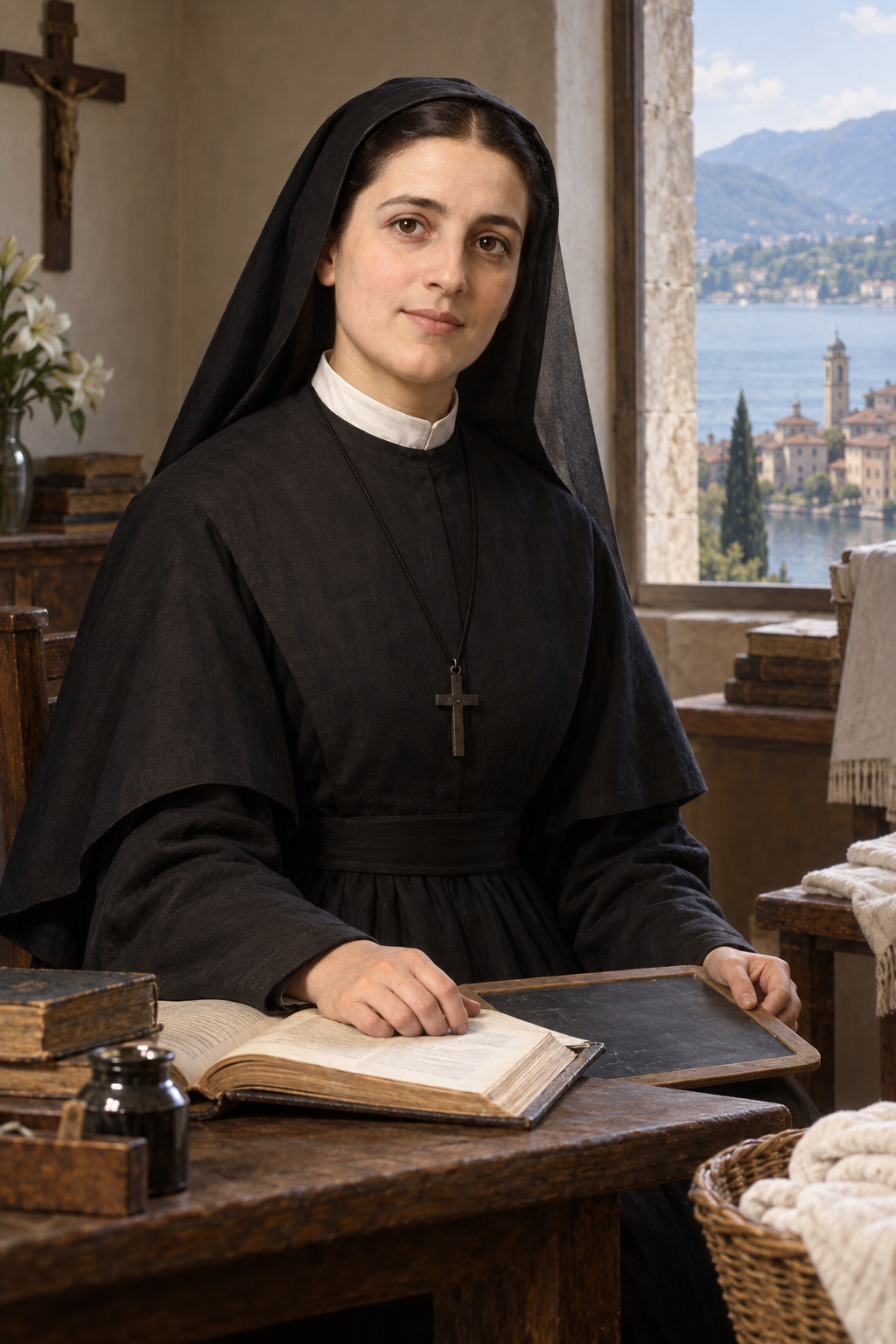
Bartolomea's education and teaching belong near the center of the biography. Books, slate, and classroom tools are appropriate visual cues because her charity included formation, not only emergency relief.
This educational emphasis keeps the page grounded. Bartolomea's charity was not only feeling for suffering people; it included forming girls, shaping habits, and giving young people tools for a more stable life.
Her work developed alongside Vincenza Gerosa. The page should honor that collaboration while keeping Bartolomea's identity clear, especially because Vincenza already has a separate packet in this batch.
The collaboration should be described without making one woman disappear into the other. Bartolomea's youth, teaching, and initiative belong in her own page, while Vincenza's maturity and stewardship belong more fully in Vincenza's page.
Together, their memory is connected with the Sisters of Charity of Lovere, later known in the Maria Bambina family. The public article can name that continuity without importing modern institutional statistics or promotional language.
The congregation's later scope is not the main point of this packet. The key claim is simpler: Bartolomea helped give a durable form to care for girls, poor people, and sick people in her own place and time.
The Diocese of Brescia presents Bartolomea and Vincenza together in liturgical and local memory. That source supports shared feast and holiness language, but the draft should still avoid blending their lives into one indistinct story.
This distinction matters in the artwork. The portrait should show Bartolomea alone, young, teaching, and ready for charity, rather than making Vincenza a second central figure.
Bartolomea's vocation joined virginity and religious life. The catalog stores `Virgin` and `Monk / Nun`, and this draft preserves both fields. The visual language can use a simple habit and veil without overdecorating the scene.
Her charity should be described with dignity. Girls, poor people, and the sick should not appear as scenery for her virtue; the page should emphasize the work of teaching, organizing, and caring.
That means avoiding a crowd of anonymous children or suffering people in the image. A book, slate, folded linen, and simple charitable room say enough while keeping the people served from becoming decoration.
The Dicastery profile supports the official Catholic identity and cause memory. It also helps keep the article from relying only on later institutional summaries.
The Maria Bambina congregational source is useful for continuity and local memory. This draft uses it carefully, without borrowing current institutional claims, numbers, or modern branding.
The catalog records Bartolomea's death on July 26, 1833, but leaves death place blank. Lovere is strongly supported in source tradition, yet this draft does not fill the structured field before final review.
That is a deliberate drafting boundary, not a denial of Lovere's importance. The whole biography can remain rooted in Lovere while the database waits for a single explicit approval before changing a blank structured field.
That restraint keeps the shared database stable. The biography can remain saturated with Lovere context while the exact death-place field waits for the single approval packet.
Bartolomea was canonized with Vincenza Gerosa in 1950. The article can mention that shared recognition, but the center should remain her brief life of teaching, foundation, and charity.
The canonization note should also help readers distinguish memory from merger. The two saints were recognized together, but the page still needs a clean Bartolomea profile with its own narrative and visual identity.
The page should avoid making shortness of life the whole point. Bartolomea matters not because she died young in itself, but because the work formed around her continued beyond a young age and an early death.
Her relevance is concrete for educators, religious communities, and people who begin good work before they feel ready. She shows that disciplined charity can be young, practical, collaborative, and durable.
That relevance should stay practical rather than inspirational in a vague way. The page can point to teaching, organizing, and shared service as the actual forms her courage took.
The final page should leave readers with a young founder at a desk and in a charitable house: teaching, praying, organizing, and placing education at the service of people who needed care.
Artwork should show a young nineteenth-century Italian religious woman in a simple dark habit and veil, with book, slate, folded linen, and Lovere or Lake Iseo context. Avoid a second foreground founder, hospital drama, modern school objects, rendered text, halos, and exact-likeness claims.
The badge crop should keep her face, veil, book or slate, and charitable-school context visible. It should read as Bartolomea the young founder and teacher, not as a generic religious portrait.
Wondering how to weigh the stories and sources? Learn how to read a saint biography.