Biography
Basil of Ostrog
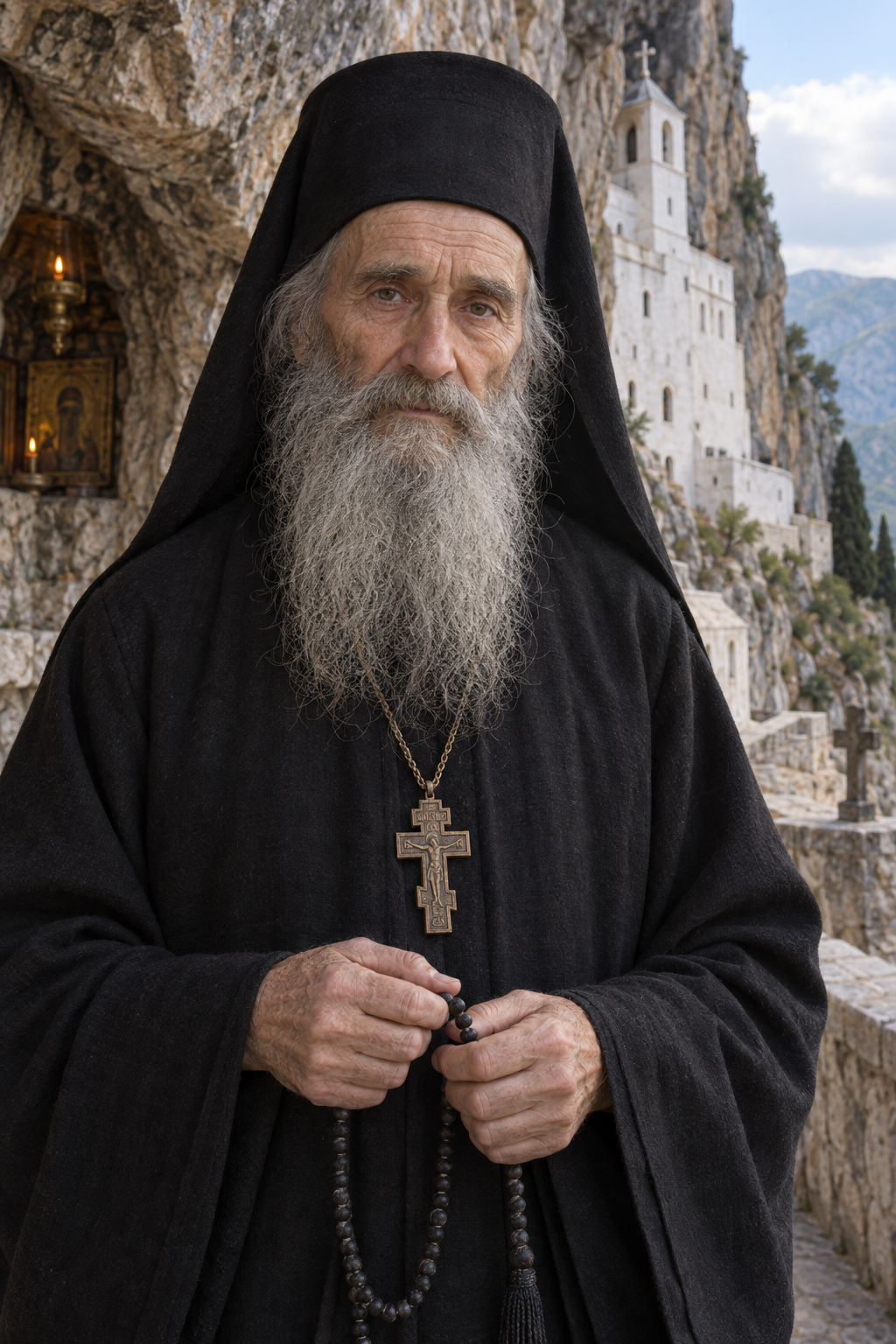
About Basil of Ostrog
Basil of Ostrog was a Serbian Orthodox monk and bishop associated with the monasteries of Herzegovina and Ostrog. Born around 1610 in Mrkonjić, in Popovo, he entered monastic life and became known as Vasilije. The historian Vasilj Jovović places his early formation at Zavala and Tvrdoš and his episcopal appointment in 1639. The details of his movements are less secure than the outline of his ministry.
A later church life dates his consecration to 1638, while citing his signature as metropolitan in a manuscript dated February 13, 1639. That entry supports his holding episcopal office by 1639 without settling the conflicting appointment dates. The same life recounts his work renewing churches and gathering a brotherhood at Ostrog.
In 1639 Basil endorsed a monastery’s book donation and forbade anyone to remove the volume.
Basil’s authority was contested: an Ottoman register records Savatije’s attempt to take his place. The academy’s Hilandar study, following Radmila Tričković’s archival research, places Basil’s restoration to office in June 1642.
His testament, dated 1666 in Leontije Ninković’s edition, describes restoring Ostrog with other monks and providing property for it. He presented that work as something sustained by God amid opposition. Ninković also cites a patriarchal letter from 1667 protecting the monastery’s land. These records show practical responsibilities as well as prayer: maintaining a community required resources and the defence of its holdings. The monastery existed before Basil; his contribution was renewal, not creation from nothing.
Basil also gave his blessing to work on Ostrog’s Church of the Holy Cross. Its inscription distinguishes the church’s construction in 1665 from its painting in 1667. It names Abbot Isaiah as responsible for the undertaking and its payment, alongside Basil’s episcopal blessing. The monastery’s account identifies Radul as the painter. These distinctions preserve the agency of the abbot, workers, and artist instead of assigning every achievement to the bishop alone. They also provide a securely bounded example of Basil's collaboration with a monastic community. For mapping, Ostrog can represent the monastery complex at settlement or site level, but the inscription does not establish a route taken by Basil.
His patronage also reached Hilandar. An inscription published by Ljubomir Stojanović records the renewal of Saint George’s tower under Metropolitan Basil and is placed under 1671 in the edition. The text also names Abbot George and the former abbot Victor in connection with the work. The record places Basil within a network extending beyond his own diocese and again names collaborators rather than portraying solitary action. Because the inscription is preserved through a published transcription, the work and its association are documented while conclusions about Basil's personal presence remain limited.
The Hilandar renewal changed the chapel itself: a dome replaced its old roof, and a partition separated the worship space from the entrance area. New arches supported the altered structure. Architectural analysis helps explain what the word renewal meant in material terms. It does not show that Basil designed or physically supervised each change, so the packet records patronage without converting it into an invented construction narrative.
Basil died in 1671. Later devotion remembered his fasting, prayer, and pastoral care. Nikolai Velimirović’s account, included in Healings of Soul and Body, presents these qualities as the pattern of his ministry. Accounts of healing and the preservation of his relics belong to this devotional reception. They express the hope with which pilgrims approach his shrine, rather than supplying a contemporary record of his daily life. Reported cures and claims about his relics remain devotional tradition, not independent evidence for his movements.
Basil's dates require similar care. The historical outline supports birth around 1610 and death in 1671, but it does not establish exact civil days for either event. His liturgical commemoration is April 29 on the Julian calendar, corresponding to May 12 on the current civil calendar. A feast date is not automatically a death certificate, so the profile retains an approximate birth year and a death year without treating May 12 as a proven day of death. The calendar forms are stored separately so that readers can understand why two dates appear in Orthodox usage.
The documentary outline presents a bishop working through communities and durable institutions. He protected a donated book, recovered contested office, renewed monastery property, blessed a church project, and supported work at Hilandar. These actions demonstrate stewardship and perseverance more clearly than generic claims that he was holy or powerful. They reveal leadership exercised through records, property, books, buildings, and cooperation with named members of monastic communities. That evidence is modest but concrete, and it does not require imagined conversations or motives. They also explain his enduring significance: Ostrog's devotional prominence grew around a person whose surviving record includes concrete care for worship, property, learning, and monastic cooperation. A careful biography can honor that reception while keeping later miracle traditions distinct from the evidence supplied by inscriptions, editions, and the testament.
Wondering how to weigh the stories and sources? Learn how to read a saint biography.